GMB vs SEO vs GEO vs AIO: The Complete 2027 Guide to Being Found on Google and AI Search
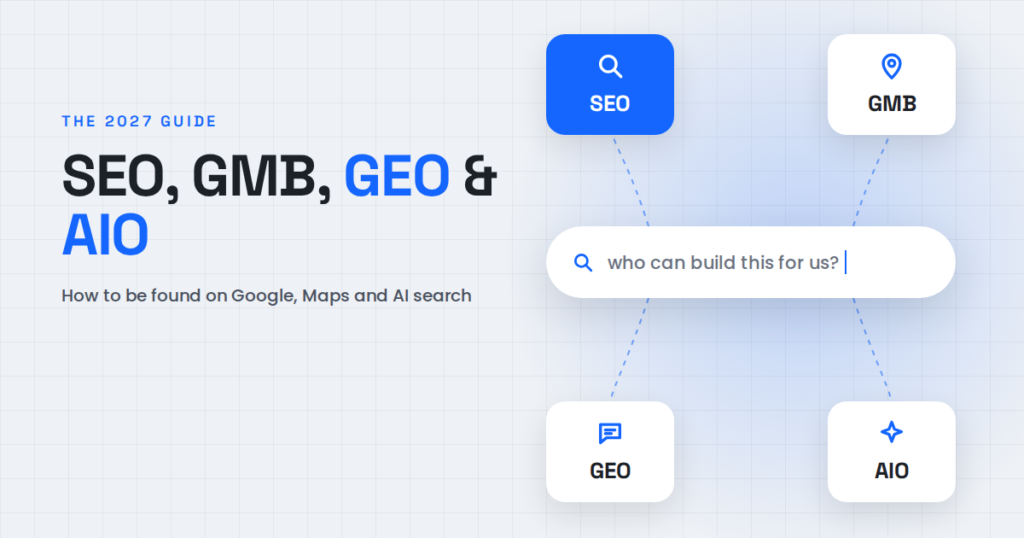
SEO, GMB, GEO and AIO are four ways of making sure the right people find your business, each aimed at a different place where people now search. SEO gets your website into Google’s regular results. GMB (now called Google Business Profile) gets your business onto Google Maps and the local pack. GEO gets your brand cited inside AI answers from tools like ChatGPT, Gemini, Perplexity and Copilot. AIO is the umbrella term for optimizing for AI-driven search in general, and most people use it to mean Google’s AI Overviews and AI Mode specifically.
The short version for 2027: SEO is still the foundation for all four. Google said so plainly in May 2026, when it published its own guide to optimizing for generative AI features and described that work as still SEO. If your website is slow, thin, hard to crawl or not trusted, no GEO or AIO trick will save it. If it is solid, the other three disciplines become extensions of the same work rather than separate projects.
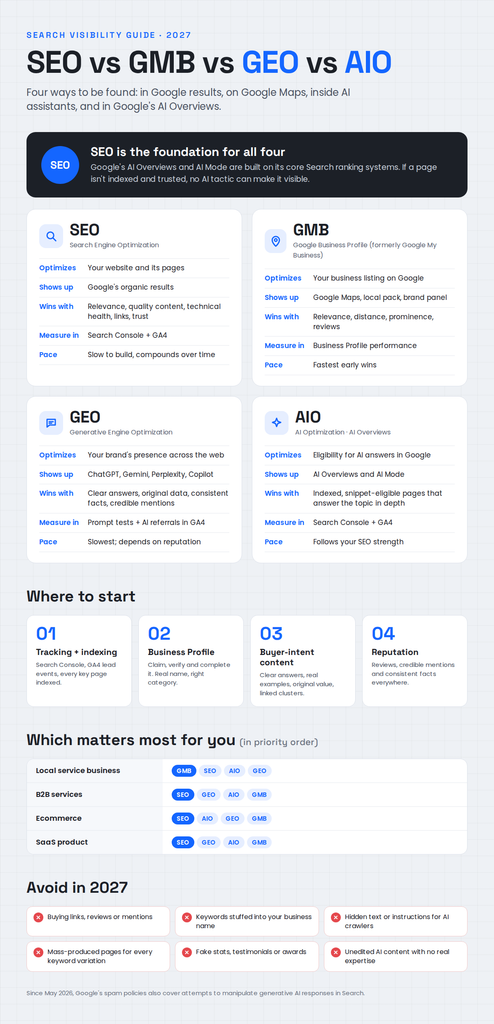
Here is how they compare at a glance.
| SEO | GMB / Google Business Profile | GEO | AIO | |
| Full name | Search Engine Optimization | Google My Business, renamed Google Business Profile | Generative Engine Optimization | AI Optimization (often: AI Overviews optimization) |
| What you optimize | Your website and its pages | Your business listing on Google | Your brand’s presence across the web, so AI models cite and describe you correctly | Your content’s eligibility to appear inside Google’s AI Overviews and AI Mode, and AI search in general |
| Where you show up | Google’s organic results (the blue links) | Google Maps, the local pack, the business panel on the right of search results | ChatGPT, Gemini, Perplexity, Copilot, Claude and other AI assistants | AI Overviews and AI Mode in Google Search, plus other AI answer surfaces |
| What decides it | Relevance, content quality, technical health, links, trust | Relevance, distance, prominence (Google’s own three factors) | Being retrievable, clear, specific, consistent and mentioned by trusted sources | The same core ranking and quality systems as regular Google Search |
| Main measurement | Google Search Console, GA4 | Business Profile performance report | Manual prompt testing, AI referral traffic in GA4 | Google Search Console (AI features reporting is rolling out), GA4 |
| Who needs it most | Every business with a website | Businesses serving customers in a physical area | Brands whose buyers research with AI assistants | Anyone whose topics trigger AI Overviews |
| Pace | Slow to build, compounds over time | Fastest early wins | Slow; depends on reputation across the web | Follows your SEO strength |
If you only remember one line from this guide, make it this: do SEO properly, claim and maintain your Business Profile, and earn real mentions across the web. That combination covers all four. The rest of this guide explains how, in detail, with the mistakes to avoid.
Who this guide is for
This guide is written for business owners, marketing managers, founders and SEO beginners who keep hearing these four acronyms and want one clear explanation of what each means, how they differ, where to start, and what to do in 2027. It also includes 30 interview questions with model answers, so it doubles as preparation for anyone applying for SEO, local SEO or AI search roles.
We build AI systems and software for a living, including our own SEO automation work, so we see this from both sides: how search engines and AI models actually retrieve information, and what marketing teams need to do day to day.
Why search works differently going into 2027
A few years ago, “being found online” meant one thing: ranking on page one of Google. Today a buyer can find you, or miss you, through at least four different doors, and they often use more than one before they decide.
Picture someone looking for a software partner. They might type a question into Google and read the AI Overview at the top. They might click a follow-up question and end up in AI Mode, a conversational version of Google Search. They might ask ChatGPT or Perplexity for a shortlist of vendors. They might search “software company near me” on Google Maps. And at some point, they will usually visit a few websites, compare them and fill in a form.
Each of those doors has its own rules, and that is where the four acronyms come from.
What changed in 2025 and 2026
Several changes over the past two years explain why this guide exists:
- AI Overviews and AI Mode became part of normal Google Search. In early 2026 Google made Gemini 3 the default model behind AI Overviews and let people move from an AI Overview straight into a follow-up conversation in AI Mode. Instead of ten blue links, many searches now start with a written answer that cites a handful of sources.
- Google published official guidance on AI search. In May 2026, Google released its guide, “Optimizing your website for generative AI features on Google Search.” It explained that AI Overviews and AI Mode are built on Google’s core Search ranking and quality systems. They use retrieval-augmented generation (the AI reads pages from the search index before answering) and query fan-out (the AI runs several related searches behind the scenes to build a fuller answer).
- Google’s spam policies now cover AI answers. On the same day, Google updated its spam policies to state that trying to manipulate generative AI responses in Search counts as spam. Tactics sold as “AI hacks,” such as fake brand mentions or mass-produced pages aimed at every possible question, now carry the same risk as old-school link spam.
- Google Business Profile kept changing. The questions-and-answers section on Business Profiles was retired in favor of an AI-powered “Ask” experience in Google Maps, business short names stopped showing, and review policies tightened. Local search is becoming more automated and more dependent on what the web says about you.
- AI assistants became research tools. ChatGPT, Gemini, Perplexity, Copilot and Claude all search the web and cite sources. For many business purchases, the first shortlist is now written by an AI.
What did not change
The fundamentals are surprisingly stable. Search engines and AI systems still need to find your pages, understand them, trust them and match them to what someone asked. The businesses that win in AI search are, almost without exception, the same businesses that already did good SEO: clear pages, real expertise, a healthy website and a solid reputation across the web.
That is good news. It means you do not need four separate strategies. You need one strong foundation and four sets of finishing touches.
Why plan for 2027 now
Search visibility is slow to build. Pages often take weeks to be crawled and indexed, and months to settle into stable rankings. Reviews accumulate one at a time. Mentions across the web build up over quarters, not days. If you want to be the business AI assistants recommend in 2027, the work that gets you there has to start well before 2027 begins.
What is SEO? Search engine optimization explained
SEO (search engine optimization) is the practice of making your website easy for search engines to find, understand and trust, so that your pages appear when people search for what you offer. It covers how your site is built, what your pages say, and how the rest of the web refers to you.
SEO matters more in 2027, not less, because everything else in this guide sits on top of it. Google’s AI features pull from the same index as its regular results. Most AI assistants also run web searches before they answer, and they tend to read the pages that already rank well.
How search engines work, in three steps
- Crawling. Search engines send automated programs (crawlers, such as Googlebot) to discover pages by following links and reading sitemaps.
- Indexing. Once a page is crawled, the search engine processes its content and stores it in a huge database called the index. A page that is not indexed cannot rank anywhere, and cannot appear in AI Overviews either.
- Ranking and serving. When someone searches, the engine picks the most relevant, useful and trustworthy indexed pages for that query, their location, their language and their device.
Most SEO problems trace back to one of these three steps. A page that never gets traffic is either not crawled, not indexed, or not considered the best answer.
The four pillars of SEO
1. Technical SEO makes sure search engines can crawl and index your site without obstacles. It covers site speed, mobile usability, HTTPS, clean URLs, redirects, canonical tags, XML sitemaps, robots.txt, structured data and server-side rendering for JavaScript-heavy sites.
A real example from our own work: after we moved our website from WordPress to a custom build, we found that Google still preferred old non-www versions of some pages, because the previous site had declared those addresses as canonical. Nothing was “broken” on the new site, but Google needed clear signals (permanent redirects, consistent canonicals and a single sitemap) to update its view. Technical SEO is often this kind of detective work.
2. On-page SEO is about each individual page: its title tag, meta description, headings, body content, images, internal links and how well it answers the searcher’s question. Good on-page SEO means a person and a search engine both understand within seconds what the page is about and who it is for.
3. Content is what you publish: service pages, blog posts, guides, case studies, tools and FAQs. In 2027 the bar is higher than ever. Google’s AI features and AI assistants can summarize generic information on their own, so content that only repeats what is already everywhere has little reason to be shown or cited. Content wins when it adds something: firsthand experience, original examples, clear opinions, specific steps, real data.
4. Off-page SEO and authority covers how the rest of the web sees you: links from other websites, brand mentions, reviews, directory listings, press, partnerships and social presence. Links still matter, but quality beats quantity by a wide margin. One mention in a respected industry publication is worth more than hundreds of links from low-quality sites, and bought links remain a spam risk.
E-E-A-T: experience, expertise, authoritativeness, trust
E-E-A-T is a framework from Google’s Search Quality Rater Guidelines. It is not a single ranking factor you can switch on, but it describes what Google’s systems try to reward:
- Experience: has the author actually done the thing they write about?
- Expertise: do they have the knowledge or skill to speak on it?
- Authoritativeness: do others in the field recognize them as a go-to source?
- Trust: is the page accurate, honest, secure and transparent about who is behind it? Trust is the most important of the four.
In practice, you show E-E-A-T with real author names and bios, real case studies, accurate claims, clear contact details, and content that shows you have done the work rather than summarized others.
Search intent: the part most beginners skip
Every search has an intent behind it, and a page only ranks well when it matches that intent. There are four common types:
| Intent | What the searcher wants | Example query | Page that fits |
| Informational | To learn or understand | “what is GEO in marketing” | Guide or blog post |
| Commercial investigation | To compare options before buying | “best local SEO tools 2027” | Comparison, review, case study |
| Transactional | To buy, book or contact | “hire SEO agency” | Service page, pricing, contact |
| Navigational | To reach a specific site | “Google Search Console login” | The brand’s own page |
A common mistake is trying to rank a service page for an informational query, or a blog post for a buyer query. Google usually shows the type of page that best fits the intent, so check what already ranks before you write.
What is changing in SEO for 2027
- Fewer clicks for simple questions. When an AI Overview fully answers a quick factual question, fewer people click through. Pages built only to answer simple definitions will lose traffic. Pages that help people decide, compare, act or buy hold up better.
- Topic depth beats single keywords. Because of query fan-out, Google’s AI looks at a cluster of related questions, not just the exact phrase typed. Sites that cover a topic thoroughly, across well-linked pages, have more chances to be retrieved.
- Original value is the differentiator. Google’s AI guidance stresses content that is not a commodity: unique insight, firsthand experience, original data.
- Brand matters more. People increasingly search for brands they have already seen recommended elsewhere, including in AI answers. Branded search demand is a sign your wider marketing is working.
- Technical basics are still the entry ticket. If your page is not crawlable and indexable, it cannot appear in regular results or AI answers.
What is GMB? Google Business Profile explained
GMB stands for Google My Business, the free tool businesses use to manage how they appear on Google Search and Google Maps. Google renamed it Google Business Profile (often shortened to GBP) in 2021, but most people still call it GMB, so you will see both names everywhere, including in job ads and interviews.
Your Business Profile is the panel that appears when someone searches your business name, and the listing that appears in the “local pack,” the map with three businesses that shows up for searches like “accountant near me” or “web design agency in Austin.” It shows your name, category, address or service area, hours, phone number, website, photos, reviews and posts.
How Google ranks Business Profiles
Google publicly states that local results are based mainly on three factors:
- Relevance: how well your profile matches what the person searched. Your categories, services, description and reviews all shape this.
- Distance: how far your business is from the searcher, or from the location named in the search. You cannot change this, which is why a local business often ranks well in its own neighborhood and poorly across town.
- Prominence: how well known your business is, both online and offline. Reviews (how many, how good, how recent), links and mentions across the web, and your website’s overall strength all feed this.
You cannot pay Google to rank higher in the free local results. Local Services Ads and regular ads are separate, paid placements.
Does a B2B or online business need a Business Profile?
Yes, in most cases, but for different reasons than a restaurant or dental clinic.
If you serve customers at a real location or within a defined area, a Business Profile can bring you direct calls and visits. If you are a B2B or online-first company, your profile still matters because it is often the first thing people see when they search your brand name. It builds trust with reviews, and it helps Google and AI assistants confirm basic facts about you: that you exist, where you are, what you do, and how to reach you.
One rule to remember: you can only create a profile for a location where you genuinely operate and either serve customers in person or have staff. Virtual offices, coworking addresses you do not actually staff, and P.O. boxes generally break Google’s guidelines and lead to suspensions.
How to set up a Business Profile the right way
- Search first. Check whether a profile already exists for your business. If it does, claim it rather than creating a duplicate.
- Use your real business name. Add nothing to it: no keywords, no city names, no slogans. Keyword-stuffed names are one of the most common reasons profiles get suspended.
- Choose the right primary category. This is one of the strongest relevance signals. Pick the category that describes what you are, not everything you do. Add secondary categories only where they are genuinely accurate.
- Set your address or service area correctly. If customers come to you, show your address. If you travel to customers or work remotely, set a service area and hide the address.
- Verify the profile. Google may verify by video, phone, email, postcard or other methods depending on your business. Have proof of the business ready: signage, equipment, documents, and the ability to show the location on camera.
- Complete every relevant field: hours, phone, website, services, products, attributes, opening date and description.
- Add real photos: your team, workspace, exterior, signage and work. Avoid stock photos.
- Link to the right page. For a single-location business, the homepage is usually fine. For multiple locations, link each profile to its own location page.
How to optimize and maintain your profile
- Reviews are the engine. Ask every happy customer for a review, make it easy with a direct link, and reply to every review, good or bad, in a calm and specific way. Never buy reviews, offer rewards for them, or set staff quotas. Google has tightened its review policies and actively removes reviews that break them.
- Post updates regularly. Business Profile posts let you share news, offers, events and work examples. They keep the profile looking active and give searchers a reason to engage.
- Keep information consistent. Your name, address and phone number (often called NAP) should match exactly across your website, your profile and major directories.
- Add services and products in detail. These fields help Google understand what you offer and can match you to more searches.
- Update hours before holidays. Wrong hours lead to bad reviews and lost trust.
- Watch for edits. Anyone can suggest edits to your profile. Check it regularly so incorrect changes do not stay live.
What changed in Google Business Profile recently
- Questions and answers were retired. The old Q&A section, where anyone could ask and answer questions on your profile, was replaced by an AI-powered “Ask” experience in Google Maps that answers questions using information about your business from across the web. This makes the accuracy of your website, reviews and profile more important than ever, because that is what the AI reads.
- Business short names stopped showing on profiles in Search and Maps in early 2026.
- Chat was removed back in 2024, so your phone number, website and booking links carry the contact load.
- Review rules got stricter, including against using staff names and quotas to drive reviews.
Features come and go often. Before acting on any feature-specific advice, including ours, check Google’s Business Profile help center for the current rules.
GMB and AI search
Business Profiles now feed more than the local pack. Google’s AI features, Gemini and Maps’ AI experiences can draw on your profile, your reviews and what the web says about you to answer questions such as “which agencies here handle enterprise projects?” A complete, accurate, well-reviewed profile is now part of your AI visibility, not just your local visibility.
What is GEO? Generative engine optimization explained
GEO (generative engine optimization) is the practice of improving how often, and how accurately, AI assistants mention and cite your brand when people ask them questions. Where SEO aims for a ranking position, GEO aims for a mention inside a generated answer: “For enterprise AI projects, companies often shortlist X, Y and Z.”
The term comes from a 2023 research paper by researchers at Princeton University and others, titled “GEO: Generative Engine Optimization.” They tested how changes to web content affected its visibility in AI-generated answers, and found that content which cited sources, included specific facts and used clear, authoritative language was more likely to be used by the AI. The industry adopted the name, and it now covers a broad set of practices.
How AI assistants decide what to say about you
Most AI assistants answer in one of two ways, and many combine both:
- From training data. The model learned patterns from a huge snapshot of text, including the web. What it “knows” about your brand reflects what was written about you, and how often, before its training cutoff. You cannot edit this directly. You can only influence future snapshots by being visible and described consistently across the web.
- From live retrieval. The assistant runs a web search (or several), reads a handful of pages, and builds an answer from them, often with citations. This is where your current content and current rankings matter, because the assistant can only cite what its search step finds.
This is why GEO and SEO overlap so much. If your page ranks well for the searches an AI runs behind the scenes, your page is far more likely to be read and cited.
What makes content more likely to be cited
Based on how retrieval-based AI systems work, and on what Google itself recommends, these qualities help:
- Direct answers. State the answer near the top of a section in a clear sentence, then explain. AI systems pull passages; a passage that answers cleanly is easier to use.
- Specificity. Concrete steps, named examples, clear definitions and real numbers (that you can stand behind) are more useful than general statements.
- Original information. Your own data, case studies, processes and opinions give the AI something it cannot get elsewhere, and a reason to cite you.
- Clear structure. Descriptive headings, short paragraphs, lists for steps and tables for comparisons make content easy to parse for people and machines alike.
- Consistency across the web. If your website, Business Profile, LinkedIn, directories and press mentions all describe you the same way (what you do, who you serve, where you are), AI systems are more confident repeating it.
- Third-party validation. AI answers about “the best” or “top” providers lean heavily on independent sources: reviews, industry lists, comparison articles, forum discussions, analyst coverage. Being mentioned by credible others matters more than praising yourself.
- Freshness. For topics that change, updated content with accurate dates has an edge.
Practical GEO tactics that hold up
- Audit your brand in AI tools. Ask several assistants the questions your buyers ask (“Who builds custom AI agents for insurance companies?”) and record whether you appear, what is said, and which sources are cited.
- Fix wrong facts at the source. If an assistant gets your services or location wrong, find where that information comes from (an old directory listing, an outdated page, a confused profile) and correct it there.
- Earn mentions in places AI systems read. Industry publications, podcasts, conference pages, partner websites, review platforms and relevant community discussions.
- Build “answer” content around real buyer questions: comparisons, costs, timelines, how-to-choose guides and honest pros and cons.
- Allow the right crawlers. If you block AI crawlers in robots.txt, some assistants cannot read your current pages. Decide deliberately, and check that your settings match your intent.
What to be careful with
Much GEO advice sold online is guesswork, and some of it is now risky:
- Fake mentions and self-promotional “best of” lists written only to influence AI answers can backfire. Google’s guidance warns against inauthentic mentions, and its spam policies now explicitly cover attempts to manipulate generative AI responses in Search.
- Mass-producing pages for every variation of a question is treated as scaled content abuse by Google.
- llms.txt files (a proposed text file summarizing your site for AI) are not needed to appear in Google’s AI features, according to Google’s own guide. Other AI companies may treat them differently, but no major provider has made them a requirement, so treat them as optional and low priority.
- Hidden text or instructions aimed at AI crawlers count as cloaking or manipulation, and can get pages removed.
The safe rule: if a tactic would still make sense in a world without AI, it is probably fine. If it only exists to trick a model, avoid it.
What is AIO? AI optimization and AI Overviews explained
AIO is the least settled of the four terms, and people use it in two ways. In its broad sense, AIO means AI optimization: making your brand and content visible in any AI-driven search experience. In its narrow sense, AIO is shorthand for Google AI Overviews, so “AIO optimization” means getting your content cited in the AI-generated summaries at the top of Google results. You will also see AEO (answer engine optimization), LLMO (large language model optimization) and AI SEO used for overlapping ideas.
In this guide, we use AIO to mean optimizing for AI answers inside Google Search, meaning AI Overviews and AI Mode, because that is where most businesses feel the impact first. GEO, in our usage, covers the wider world of AI assistants outside Google.
How AI Overviews and AI Mode choose sources
Google has been unusually clear about this. In its May 2026 guide, it explained that AI Overviews and AI Mode are rooted in its core Search ranking and quality systems, and that they use two techniques:
- Retrieval-augmented generation (RAG): before writing an answer, the AI retrieves relevant pages from Google’s search index and grounds its answer in them, with links to those pages.
- Query fan-out: the AI breaks a question into several related searches and runs them at the same time. A question like “how do I choose a software development partner” might fan out into searches about costs, contracts, red flags, time zones and portfolio checks.
Two practical conclusions follow. First, to be cited in an AI Overview, your page must be indexed and eligible to show a snippet in regular Search. Google has said there are no extra technical requirements beyond that. Second, query fan-out rewards sites that cover a topic thoroughly, because each related search is another chance for one of your pages to be retrieved.
What Google says you do NOT need
Google’s guide also lists things site owners can ignore for its AI features, which is useful for cutting through hype:
- You do not need llms.txt or other special AI files.
- You do not need to split content into tiny “chunks” for AI.
- You do not need to rewrite your content in a special style for AI.
- You do not need special schema markup to appear in AI features. Structured data is still useful for regular rich results, but it is not a ticket into AI Overviews.
- You should not create separate pages for every fan-out variation; doing that primarily to manipulate rankings or AI answers counts as scaled content abuse.
How to improve your chances of appearing in AI Overviews
- Get the basics right. Make sure the page is crawlable, indexed and not blocked from snippets by nosnippet or similar settings.
- Answer the core question early. Put a clear, accurate answer near the top of the page or section, then go deeper.
- Cover the surrounding questions. Think about what someone would ask next and answer it on the same page or on a closely linked one.
- Make the content non-commodity. Add what only you can add: your process, examples, mistakes you have seen, opinions backed by experience.
- Keep it accurate and current. AI answers that cite outdated information reflect badly on the source. Review important pages on a schedule.
- Strengthen the page’s authority. Internal links from related pages, plus real external mentions and links, still help it rank, and ranking pages are the ones AI retrieves.
- Use good page experience. Fast, readable, mobile-friendly pages that do not bury the content under pop-ups.
How to measure AIO
Measurement is improving but still incomplete. Google has started rolling out reporting in Search Console that shows impressions from generative AI features such as AI Overviews and AI Mode, initially for a subset of sites. It has also started testing a setting that lets site owners choose whether their content and links appear in its generative AI features. Check your own Search Console to see whether these are available for your property yet.
Until the data is complete for everyone, combine Search Console impressions and clicks, manual checks of important queries, and engagement data in GA4. Watch for a common pattern: impressions rising while clicks fall on simple informational queries. That usually means AI answers are satisfying quick questions directly. It is a reason to strengthen your commercial and decision-stage pages, not to panic.
Can you opt out of AI Overviews?
You can limit how your content is used with standard controls such as nosnippet, and Google has started testing a dedicated setting in Search Console for some sites. Be careful: opting out can also reduce your visibility in regular results, and for most businesses being cited is more valuable than being excluded. Make this decision deliberately, page by page if needed, rather than as a blanket reaction.
SEO vs GMB vs GEO vs AIO: the real differences
The four disciplines share one foundation but differ in their goal, the surface they target, the signals that matter and how you measure success. Understanding the differences helps you budget time sensibly and explain the work to a boss, a client or an interviewer.
Difference 1: what you are trying to win
- SEO wins a position in a list of results.
- GMB wins a spot in the local pack and on the map, plus a strong brand panel.
- GEO wins a mention or recommendation inside an AI assistant’s answer.
- AIO wins a citation inside Google’s AI Overviews or AI Mode.
A position can be tracked precisely. A mention or citation varies from one conversation to the next, because AI answers are generated fresh each time and can differ by wording, user and location. This is the biggest practical difference, and the reason GEO and AIO measurement is harder.
Difference 2: what you control
- SEO: you control your website completely.
- GMB: you control your profile’s fields, photos and posts, but Google, customers and the public also shape it through edits and reviews.
- GEO: you control the least. AI assistants rely heavily on what others say about you, so your influence is indirect: you improve your own content and earn coverage elsewhere.
- AIO: you control your pages, but Google decides which passages to use and how to summarize them.
Difference 3: the signals that matter most
| Signal | SEO | GMB | GEO | AIO |
| Crawlable, indexed website | Essential | Helpful | Essential (for retrieval) | Essential |
| Content quality and depth | Essential | Supporting | Essential | Essential |
| Links and mentions from other sites | Strong | Strong (prominence) | Very strong | Strong |
| Reviews | Indirect | Essential | Helpful | Indirect |
| Physical location and distance | Only for local queries | Essential | Minor | Only for local queries |
| Consistent business information | Helpful | Essential | Very helpful | Helpful |
| Original data and firsthand experience | Strong | Minor | Very strong | Very strong |
Difference 4: how fast results come
A well-set-up Business Profile can start appearing for local searches soon after verification, especially in less competitive areas. SEO usually takes months to build, though technical fixes can show effects sooner. AIO tends to follow your SEO strength, so it moves at a similar pace. GEO is the slowest to influence, because it depends on your reputation across many sources, and on AI models picking up changes in their retrieval or future training.
Where they overlap
The overlap is larger than the differences:
- A strong website feeds all four. It ranks in SEO, it is the link on your Business Profile, it is what AI assistants retrieve, and it is what AI Overviews cite.
- Reviews feed GMB directly and GEO indirectly. AI answers to “best X near me” or “most reliable Y” often summarize what reviewers say.
- Brand mentions feed SEO, GMB prominence and GEO. Being written about by credible sources improves all three.
- Consistent facts feed everything. When every source agrees on what you do and where, search engines and AI models trust and repeat that information.
Think of it as one house. SEO is the foundation and the walls. GMB is the sign on the street. GEO is your reputation in the neighborhood. AIO is how clearly the house shows up when Google describes the street to someone. You cannot have a good sign or reputation for a house that is falling down.
Which one matters most for your business?
| Business type | Priority order | Why |
| Local service business (clinic, salon, contractor) | GMB, SEO, AIO, GEO | Most customers search nearby, often on mobile, and choose from the map |
| B2B services (software, consulting, agencies) | SEO, GEO, AIO, GMB | Buyers research deeply, compare vendors and increasingly ask AI for shortlists |
| Ecommerce | SEO, AIO, GEO, GMB | Product and category pages drive revenue; AI comparison answers influence choice |
| SaaS product | SEO, GEO, AIO, GMB | AI assistants are often asked for tool recommendations and alternatives |
| Multi-location brand | GMB, SEO, AIO, GEO | Each location competes locally; brand content supports all of them |
GMB sits last for B2B, ecommerce and SaaS, but it still matters for brand searches and trust, so set it up properly even if it is not your main lead source.
Where to start, how to start, and the best time to start
Start with measurement and your website’s technical health, then your Business Profile, then content, then reputation. That order matters because every later step depends on the earlier ones: content cannot rank on a site Google cannot index, and you cannot judge any of it without tracking.
Where to start: the first five checks
Before spending money on content or tools, answer these five questions:
- Is tracking working? Google Search Console should be verified, Google Analytics 4 should be recording visits, and your key actions (form submissions, calls, bookings) should be tracked as key events. Without this, you cannot prove anything works.
- Can Google index your important pages? In Search Console, check the Page indexing report and use URL Inspection on your key pages. Look for pages marked “Discovered – currently not indexed” or “Crawled – currently not indexed.”
- Do you have a verified Business Profile with accurate details?
- What do you already rank for? Search Console’s Performance report shows the queries you already appear for. Pages sitting in positions 8 to 20 are your fastest wins.
- What do AI assistants say about you today? Ask three or four assistants about your brand and your main service, and write down the answers. This becomes your GEO baseline.
The best time to start
The honest answer is now, because every discipline compounds over time and most of the work is cheap. There are some timing points worth knowing:
- Start SEO before you need the leads. Because rankings take months to build, the best time to start is roughly two seasons before your busy period. If most deals close in Q1, content and fixes should be live by the previous summer.
- Set up your Business Profile before you launch or move. Verification can take time, and an unverified profile cannot help you.
- Fix technical issues before publishing new content. New pages on a broken site just add to the backlog.
- Plan carefully around a website migration or redesign. Rankings often dip after a platform change while Google re-processes the site. Schedule migrations away from your peak season, and keep a full redirect map.
- Post Business Profile updates when your customers are searching. For B2B audiences, that is usually weekday business hours in their time zone. For consumers, it varies by industry, so check when your profile gets most views and post just before.
- Refresh important content on a schedule. Review key pages at least every six months, and update yearly guides (like anything with “2027” in the title) before the year begins.
How to start: a 90-day plan for 2027
This plan suits a small or mid-sized business with one person or a small team doing the work.
Days 1 to 30: foundation
- Verify Google Search Console and set up GA4 with key events for leads
- Exclude internal team traffic from GA4
- Run a technical audit: indexing, redirects, canonicals, sitemap, robots.txt, mobile and speed
- Fix any page your buyers need that is not indexed
- Claim, verify and fully complete your Business Profile
- Make your name, address and phone number consistent everywhere
- Record your baseline: rankings, traffic, leads, reviews and AI assistant answers
Days 31 to 60: content and on-page
- Rewrite titles and meta descriptions for pages that get impressions but few clicks
- Strengthen your main service pages with clear answers, proof and next steps
- Publish two to four in-depth pieces that answer real buyer questions
- Link related pages to each other so each topic forms a clear cluster
- Start a steady review request process
- Post on your Business Profile every week or two
Days 61 to 90: authority and AI visibility
- Pitch your expertise to two or three industry publications, podcasts or partner blogs
- Make sure your profiles on relevant directories and review platforms are complete and consistent
- Publish one piece of original material: a case study, a data point from your own work, or a detailed process
- Re-test AI assistants with the same questions as your baseline
- Compare results to your day-1 baseline and set the next quarter’s priorities
Where not to start
Avoid these common false starts: buying an expensive tool before you know what to measure, publishing dozens of quick AI-written posts, buying links or reviews, creating separate location pages with the same text, or chasing GEO tricks before your basic SEO works. Each one wastes budget, and some create risks that take months to undo.
Best practices for 2027: the complete checklist
These are the practices we would follow for any business aiming to be visible across Google, Maps and AI assistants in 2027. Use them as a working checklist.
SEO best practices
- One clear topic and one main search intent per page
- A unique title tag under about 60 characters that leads with the main topic
- A meta description that tells the searcher exactly what they will get, under about 160 characters
- One H1 per page, with descriptive H2 and H3 headings that reflect the questions people ask
- The main answer in the first paragraph or two
- Real author names, bios and dates on articles
- Internal links between related pages, using descriptive anchor text
- Images compressed, with descriptive file names and alt text
- Fast loading and good Core Web Vitals on mobile
- HTTPS everywhere, one preferred domain (www or non-www), and permanent redirects for any old URLs
- A clean XML sitemap with only live, indexable pages, submitted in Search Console
- Self-referencing canonical tags on every indexable page
- Structured data where it genuinely describes the page (organization, articles, FAQs, breadcrumbs, products)
- Regular reviews of Search Console for indexing problems, manual actions and security issues
- Content updated when facts change, not just re-dated
Google Business Profile best practices
- Real business name only, with no added keywords
- The most accurate primary category, plus only relevant secondary categories
- Address shown only if customers visit; service area set otherwise
- Every relevant field filled: hours, services, products, attributes, description
- Real photos of the team, premises and work, updated regularly
- A steady flow of genuine reviews, with a reply to each one
- Posts at a consistent rhythm
- Name, address and phone identical on the website, profile and directories
- A link to the most relevant page on your website
- Regular checks for suggested edits by the public
GEO best practices
- A clear, consistent one-sentence description of what you do, used everywhere you appear online
- An About page that states who you are, what you do, who you serve and where, plainly
- Content that answers real buyer questions directly: cost, comparison, process, timelines, risks
- Original material that others want to cite: case studies, frameworks, your own data
- Active, complete profiles on the review and directory platforms your industry uses
- Earned mentions in credible publications, podcasts and partner sites
- A deliberate robots.txt policy for AI crawlers that matches your goals
- Quarterly checks of what major AI assistants say about you, with corrections at the source
AIO best practices
- Pages indexed and eligible for snippets (no accidental nosnippet or noindex)
- A direct answer near the top of each important page or section
- Related follow-up questions covered on the page or on closely linked pages
- Non-commodity value in every piece: insight, experience or data that is not everywhere else
- Topic clusters built out thoughtfully, without separate thin pages for each variation
- Accurate, current information, reviewed on a schedule
- Search Console checked for AI feature reporting as it becomes available
Practices to avoid entirely
- Buying links, reviews or brand mentions
- Keyword-stuffed business names or fake locations on Business Profiles
- Hidden text or instructions written for AI crawlers
- Mass-produced pages that differ only by a keyword or city name
- Publishing AI-generated content without human expertise, editing and fact-checking
- Fake statistics, testimonials or awards
- Self-published “top 10” lists that rank yourself first without any honest comparison
Each of these may produce a short-term bump. Each can also lead to manual actions, suspended profiles, or AI systems treating your brand as unreliable, which is far harder to repair than it is to avoid.
Common problems and how to solve them
Most visibility problems fall into a small number of patterns. Here are the ones we see most often, with the likely cause and the fix.
SEO problems
Problem: “My page is published but gets no traffic at all.” Likely cause: it is not indexed, or it targets a query nobody searches. Fix: inspect the URL in Search Console. If it is not indexed, check for noindex tags, blocked crawling, missing internal links or thin content, then request indexing. If it is indexed, check in the Performance report whether it gets impressions; if not, the topic or wording may not match real searches.
Problem: “Search Console says Discovered – currently not indexed.” Likely cause: Google knows the URL exists but has not prioritized crawling it, common on new sites, after migrations, or when Google sees little value in that section. Fix: make sure the page is linked from important pages, not only the sitemap; improve its uniqueness; request indexing for your most important URLs; and be patient, because new sites are crawled gradually.
Problem: “Rankings dropped after we changed our website.” Likely cause: changed URLs without redirects, lost content, changed titles, or Google re-evaluating rewritten pages. Fix: compare old and new URLs, add permanent (301 or 308) redirects for every old URL with traffic, restore lost content that ranked, check canonicals and the sitemap, and submit the new sitemap. Some movement after a migration is normal; a lasting drop usually means something was lost.
Problem: “Google shows the wrong version of my page.” Likely cause: mixed signals between www and non-www, http and https, or duplicate pages. Fix: choose one version, redirect all others to it, use self-referencing canonicals, and keep only the preferred URLs in your sitemap. In Search Console, the “Duplicate, Google chose different canonical than user” report shows where this is happening.
Problem: “We get impressions but almost no clicks.” Likely cause: weak titles and descriptions, low positions, or AI Overviews answering the question directly. Fix: rewrite titles and meta descriptions to promise a clear outcome; improve the page to move up; and shift effort toward decision-stage queries where people still click to compare and act.
Problem: “Two of our pages compete for the same keyword.” This is called keyword cannibalization. Fix: decide which page should rank, merge or differentiate the other, and point internal links with that keyword to the chosen page.
Google Business Profile problems
Problem: “My profile was suspended.” Likely cause: a guideline breach such as a keyword-stuffed name, an ineligible address, or a duplicate profile. Fix: correct the issue first, gather proof of your business (licenses, utility bills, photos of signage and premises), then submit a reinstatement request through Google’s official process. Do not create a new profile to get around a suspension.
Problem: “I’m not showing in the local pack.” Likely cause: wrong primary category, distance from searchers, few reviews, or a weak website. Fix: review your categories, complete every field, build reviews steadily, strengthen the page your profile links to, and earn local mentions. Remember that distance is not something you can optimize away.
Problem: “A competitor or customer left a fake or abusive review.” Fix: reply calmly and factually so future readers see your side, then report the review through your profile if it breaks Google’s policies. Do not argue publicly or offer incentives to remove it.
Problem: “Someone changed my business hours or details.” Fix: check your profile regularly for suggested edits, correct anything wrong, and make sure your website shows the same details so Google’s systems see consistent information.
GEO and AIO problems
Problem: “AI assistants never mention us.” Likely cause: little independent coverage, unclear positioning, or weak rankings for the searches AI tools run. Fix: clarify your one-line description everywhere, build content around real buyer questions, strengthen SEO for those topics, and earn mentions on credible third-party sites.
Problem: “An AI assistant says something wrong about us.” Likely cause: outdated or conflicting information somewhere on the web. Fix: find which sources the assistant cites, correct them at the source (your own pages, directories, profiles), and make your own site the clearest, most complete statement of the facts. Many assistants also have feedback options for incorrect answers.
Problem: “AI Overviews cite competitors, not us.” Likely cause: their pages rank better for the fan-out queries, or answer more directly. Fix: look at which pages are cited, study what they cover that you do not, then make your page more complete and more useful, with a clearer answer and original value.
Problem: “Our traffic fell, but our rankings look the same.” Likely cause: AI answers satisfying simple queries, or seasonal changes. Fix: check Search Console for falling click-through rates on informational queries, compare year over year, and refocus on pages that drive leads. Measure success by leads and revenue, not raw traffic.
How to measure SEO, GMB, GEO and AIO
Measure each discipline with the tool closest to its surface, then judge all of them by the same final number: qualified leads or sales. Traffic is a means, not the goal.
| What to measure | Where to find it | What good looks like |
| Indexed pages vs pages in sitemap | Search Console, Page indexing | All important pages indexed |
| Impressions, clicks, click-through rate, average position | Search Console, Performance | Rising impressions and clicks on buyer-intent queries |
| Non-branded vs branded clicks | Search Console, filtered by query | Growing non-branded share: new people finding you |
| AI feature impressions | Search Console (rolling out to some sites) | Visibility in AI Overviews and AI Mode for core topics |
| Organic sessions and engagement | GA4 | Visitors reading more than one page on key topics |
| Leads from organic and AI referrals | GA4 key events by source | Steady growth in form fills, calls and bookings |
| AI assistant referral traffic | GA4, by referral source (for example chatgpt.com or perplexity.ai) | Any measurable traffic is a positive sign |
| Business Profile views, calls, website clicks, directions | Business Profile performance report | Upward trend, especially calls and website clicks |
| Reviews: count, rating, recency | Business Profile | A steady stream of recent, genuine reviews |
| Brand mentions in AI answers | Manual prompt tests, or AI visibility tools | Accurate, frequent mentions for your core topics |
A simple monthly AI visibility test
Pick ten questions your buyers ask, such as “Who offers white label software development?” or “How much does a custom AI chatbot cost?” Each month, ask them in the same three or four AI assistants. Record whether you are mentioned, whether the description is accurate, and which sources are cited. AI answers vary, so look for trends over several months rather than reacting to a single answer.
What people search: query examples by intent
Understanding the real questions behind these topics helps you plan content. These are representative query patterns, grouped by intent, that people use when researching SEO, GMB, GEO and AIO.
| Intent | Example queries |
| Learning the terms | what is GEO in marketing · what does AIO mean in SEO · is GMB the same as Google Business Profile · what is generative engine optimization |
| Comparing | GEO vs SEO · AIO vs SEO difference · AEO vs GEO vs SEO · local SEO vs organic SEO |
| How-to | how to rank in Google AI Overviews · how to get mentioned by ChatGPT · how to optimize Google Business Profile · how to verify Google Business Profile |
| Problem-solving | Google Business Profile suspended · page not indexed Google · why is my business not showing on Google Maps · traffic dropped after AI Overviews |
| Planning | SEO strategy 2027 · local SEO checklist · GEO strategy for B2B · SEO roadmap for small business |
| Career | SEO interview questions · local SEO interview questions · GEO specialist skills · AI SEO jobs |
| Hiring | SEO services for small business · local SEO agency · AI search optimization services |
Myths to stop believing
- “SEO is dead because of AI.” Google’s own AI features are built on its search index and ranking systems. SEO is the foundation of AI visibility, not a casualty of it.
- “You need an llms.txt file to show up in AI.” Google says it is not needed for its AI features, and no major AI provider requires it.
- “GEO is a completely separate discipline.” Most of what works for GEO is good SEO, good PR and good brand consistency, applied with AI answers in mind.
- “More pages means more AI visibility.” Thin pages for every keyword variation are now explicitly risky. Depth and quality beat volume.
- “Keywords in my business name help my Business Profile rank.” They break Google’s guidelines and are a leading cause of suspensions.
- “Schema markup gets you into AI Overviews.” Structured data helps regular rich results; Google says it is not required for AI features.
- “Reviews only matter for restaurants and shops.” Reviews influence local rankings, buyer trust and what AI tools say about you, for B2B companies too.
- “Once you rank, you’re done.” Rankings, profiles and AI answers all change constantly. Visibility needs ongoing care.
30 interview questions and answers on SEO, GMB, GEO and AIO
These questions come up in interviews for SEO executive, SEO specialist, local SEO, digital marketing and AI search roles. Use the answers as a starting point, then add your own examples. Interviewers remember candidates who explain what they did, why, and what happened.
Beginner questions
1. What is SEO? SEO is the process of improving a website so it appears for relevant searches in search engines like Google. It covers technical health, on-page optimization, content and off-page authority.
2. What is the difference between on-page and off-page SEO? On-page SEO is everything on your own pages: titles, headings, content, images and internal links. Off-page SEO is how other sites see you: backlinks, mentions, reviews and reputation.
3. What is GMB, and is it the same as Google Business Profile? Yes. Google My Business was renamed Google Business Profile in 2021. It is the free listing that controls how a business appears on Google Search and Maps.
4. What are the three main local ranking factors? Relevance, distance and prominence. Google states these publicly as the main factors behind local results.
5. What is a meta description, and does it affect rankings? It is the short summary that can appear under the title in search results. It is not a direct ranking factor, but a good one improves click-through rate, which makes it valuable.
6. What is a backlink? A link from another website to yours. Links from relevant, trusted sites act as a signal of authority; links from spammy sites are ignored at best and harmful at worst.
7. What is search intent? The goal behind a search: informational, commercial, transactional or navigational. A page ranks well only when it matches the intent.
8. What does GEO stand for? Generative engine optimization: improving how often and how accurately AI assistants like ChatGPT, Gemini and Perplexity mention and cite a brand.
9. What does AIO mean? It is used in two ways: AI optimization in general, or optimization for Google’s AI Overviews specifically. In an interview, say which meaning you are using.
10. Which tools do you use for SEO? Google Search Console and GA4 first, because they are first-party data. Then a crawler (such as Screaming Frog), a keyword and backlink tool (such as Semrush or Ahrefs), and PageSpeed Insights. Name the tools you have actually used.
Intermediate questions
11. A page is not indexed. How do you troubleshoot it? Inspect the URL in Search Console. Check for noindex tags, robots.txt blocks, canonical tags pointing elsewhere, redirects, server errors and thin or duplicate content. Make sure it is linked internally and in the sitemap, fix the cause, then request indexing.
12. What is a canonical tag? A tag that tells search engines which URL is the preferred version of a page when similar or duplicate versions exist. Google treats it as a strong hint, not a command.
13. How would you optimize a Google Business Profile for a new client? Audit the name, categories, address or service area, hours, services, photos and reviews. Fix guideline issues first, complete every field, align details with the website, set up a review request process, and post regularly. Then track calls, website clicks and direction requests.
14. What is E-E-A-T? Experience, expertise, authoritativeness and trust, a framework from Google’s quality rater guidelines. It describes the qualities Google’s systems aim to reward, with trust being the most important.
15. How do you find keyword opportunities for an existing site? Start in Search Console: queries with many impressions and low clicks, and pages ranking in positions 8 to 20. Then look at competitor gaps and the real questions customers ask sales and support teams.
16. What are Core Web Vitals? Google’s user experience metrics for loading speed, responsiveness and visual stability, currently Largest Contentful Paint, Interaction to Next Paint and Cumulative Layout Shift.
17. What is keyword cannibalization, and how do you fix it? When two or more of your pages compete for the same query. Choose the page that should rank, merge or differentiate the others, and point internal links to the chosen page.
18. How do AI Overviews choose their sources? Google says they use retrieval-augmented generation and query fan-out, built on its core ranking and quality systems. A page must be indexed and snippet-eligible, and pages that rank well for the related searches are more likely to be cited.
19. How would you measure GEO success? Track mentions and accuracy across a fixed set of buyer questions in several AI assistants over time, track AI referral traffic in GA4, and connect it to leads. Treat single answers as noisy and look for trends.
20. What is NAP consistency, and why does it matter? Keeping your business name, address and phone number identical across your website, Business Profile and directories. Consistency helps search engines and AI systems trust your details.
Advanced questions
21. Traffic dropped 30% after a site migration. What do you do? Compare old and new URL lists, check every high-traffic old URL redirects permanently to its match, confirm canonicals and the sitemap, check that content and titles survived, and review Search Console indexing reports. Then separate migration loss from seasonality or algorithm updates by comparing dates.
22. How would you approach AI search visibility for a B2B company? Start with SEO health and buyer-intent content, then clarify positioning so the brand is described consistently everywhere. Build original assets such as case studies and data, earn mentions in industry sources, and run a monthly AI visibility test linked to lead tracking.
23. Is GEO different from SEO, in your view? It shares SEO’s foundation but adds two emphases: being mentioned by credible third parties, and being described consistently across the web. For Google’s own AI features, Google has said optimizing for them is still SEO.
24. What tactics would you refuse to use, and why? Buying links or reviews, fake mentions, keyword-stuffed Business Profile names, hidden text for AI crawlers and mass-produced thin pages. They break Google’s policies, including the rule against manipulating generative AI responses, and the recovery cost is high.
25. How do you prioritize SEO tasks with limited resources? By impact and effort: fix anything blocking indexing or conversions first, then improve pages already close to page one, then create new content for proven demand.
26. How do you handle a suspended Business Profile? Identify and fix the likely violation, gather proof of the business, and submit a reinstatement request through Google’s official process. Never create a duplicate profile.
27. How would you build a topic cluster? Choose a core topic tied to a service, create one strong main page, then supporting pages for genuinely distinct subtopics and questions, all linked to each other with descriptive anchors.
28. What is query fan-out, and how does it change content strategy? It is when Google’s AI runs several related searches to answer one question. It rewards covering a topic thoroughly across well-linked pages, but not creating thin pages for every variation.
29. How do you report SEO results to leadership? Lead with business outcomes: leads, pipeline and revenue from organic and AI channels. Support them with visibility metrics such as non-branded clicks and rankings for priority topics, and explain what changed and what comes next.
30. Where do you see search heading in 2027? More AI-generated answers, more conversational search and more zero-click results for simple questions. Websites that offer original expertise, clear answers and a trusted reputation will be the ones AI systems retrieve and cite, so the fundamentals matter more, not less.
Frequently asked questions
Is SEO still worth it in 2027 with AI answers everywhere? Yes. Google’s AI Overviews and AI Mode are built on its search index and ranking systems, and many AI assistants search the web before answering. Strong SEO is what makes your pages available to all of them.
What is the difference between GEO and AIO? They overlap heavily. GEO usually refers to visibility in AI assistants such as ChatGPT, Gemini, Perplexity and Copilot. AIO usually refers to visibility in Google’s AI Overviews and AI Mode, or to AI optimization in general.
Is GMB still called GMB? Officially, it is Google Business Profile. Many people, job ads and tools still say GMB, so both names refer to the same thing.
Can I rank in AI Overviews without ranking on page one? It is possible, because query fan-out retrieves pages for related searches, not just the main query. But pages that rank well for the topic are far more likely to be cited, so strong SEO remains the most reliable route.
Do I need a separate GEO agency? Usually not. If your SEO, content and PR are strong, most GEO work is a matter of focus and measurement. Be cautious of anyone promising guaranteed AI mentions; no one controls what an AI model says.
How long does it take to see results? A well-set-up Business Profile can show results fastest. SEO and AIO typically build over several months. GEO is slower still, because it depends on your reputation across many sources. Timelines vary with competition, your site’s starting point and how consistently you work.
Do online-only businesses need a Business Profile? Only if they have an eligible location where they serve customers or have staff. If you do, a complete profile helps brand searches, trust and AI accuracy. Never use a virtual office address just to get a listing.
Should I block AI crawlers? It depends on your goals. Blocking them can keep your content out of AI training or answers, but it can also mean AI assistants cannot read your latest pages when recommending providers. Most businesses that want leads benefit from being readable.
What is the single most important thing to do first? Make sure your important pages are indexed and your lead tracking works. Everything else depends on those two.
Can I do all of this myself? The basics, yes: Search Console, Business Profile, clear content and review requests are all manageable for a small team. Technical issues, migrations, large sites and automation are where specialist help pays off.
If you want a custom SEO or AI search automation tool built around your own workflow, or help making your website visible across Google and AI assistants, talk to our team.