Lead Generation Strategies: 9 Proven Ways to Get More Qualified Leads
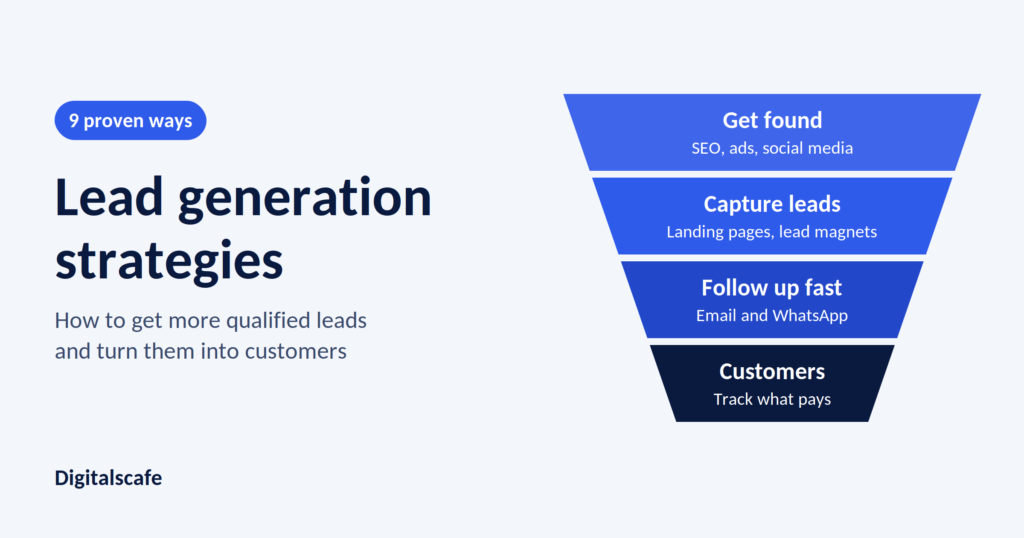
Lead generation strategies are the repeatable actions that attract people who may buy from you and collect their contact details so you can follow up. The nine that work best for most businesses are SEO content, local SEO, landing pages, lead magnets, paid ads, social media, email and WhatsApp follow-up, referrals and personal outreach.
Most businesses do not have a traffic problem. They have a system problem. Visitors arrive, nothing asks them to act, and the few who do inquire wait days for an answer. Strong lead generation strategies fix that.
This guide fixes that. You will learn what each of the nine lead generation strategies does, how to set it up, what mistakes to avoid and how long results take. You will also learn how to make your content rank in Google (SEO), appear in AI-generated answers (GEO) and win direct answers (AEO).
Key facts at a glance
- A lead is a person or company that has shown interest and shared contact details.
- Fast follow-up matters. A well-known Harvard Business Review study of 1.25 million leads found that contacting a lead within an hour made a business nearly seven times more likely to qualify it than waiting just one more hour.
- No single channel works for everyone. The best lead generation strategies combine one fast channel (ads or outreach) with one lasting channel (SEO or referrals).
- Tracking comes first. Without it, you cannot tell which strategy pays.
- Google says no special optimization is required to appear in its AI features. Strong SEO basics still apply.
In this guide
- What lead generation means
- Why most lead generation strategies fail
- Nine lead generation strategies that work
- How to follow up fast and turn leads into customers
- SEO, GEO and AEO: how to get found, cited and quoted
- Metrics that show whether it works
- A 30-day lead generation plan
- Illustrative scenarios
- How we can help
- Frequently asked questions
What Is Lead Generation?
Lead generation is the process of attracting people who are interested in what you sell and getting their contact details. A visitor becomes a lead when they fill out a form, call you, send a message or book a meeting.
There are two main approaches:
- Inbound lead generation: People find you through search, content, social media or referrals, then contact you.
- Outbound lead generation: You reach out first through email, LinkedIn, calls or ads.
The strongest lead generation strategies use both. Inbound builds steady, lower-cost demand over time. Outbound and ads give you speed.
Not every lead is equal. A marketing qualified lead has shown interest, for example by downloading a guide. A sales qualified lead fits your customer profile and is ready for a sales conversation. Knowing the difference stops your team from chasing the wrong people.
Why Most Lead Generation Strategies Fail
Before the strategies, it helps to see why so many fail. Five problems appear again and again.
1. No clear target customer. If you try to speak to everyone, your message reaches no one. Strong lead generation starts with a specific buyer and a specific problem.
2. Traffic without a next step. Pages that never ask visitors to act waste your traffic. Every important page needs one clear action.
3. Weak tracking. Many businesses cannot say which channel brought their last ten customers. That makes every budget decision a guess.
4. Slow or no follow-up. The same Harvard Business Review research found that many companies took days to respond to online inquiries, and some never responded at all. Slow replies quietly kill good leads.
5. Too many channels at once. Spreading effort across ten platforms means none gets enough attention. Start with two or three and do them well.
If you recognize two or more of these, fix them first. Good lead generation strategies start by plugging leaks, which costs less than any new campaign and often raises results the fastest.
9 Lead Generation Strategies That Work
These lead generation strategies suit most service businesses, shops and B2B firms. Pick two or three to start, then add more once they run well.
Strategy 1: SEO and Search-Focused Content
What it is: Creating pages and articles that match what your customers type into Google, so they find you at the moment they need you.
Why it works: People who search are already looking. If your page answers their question well, they are likely to trust you and take the next step.
How to do it:
- List the questions your customers ask before they buy.
- Group them by intent. Some searches are research (“what is a lead magnet”). Others are buying searches (“lead generation agency for small business”).
- Create one page for each important topic. Give a clear answer in the first paragraph.
- Add proof, such as examples, photos, reviews and numbers you can back up.
- Link related pages to each other.
- Add a clear call to action on every page.
Common mistake: Writing for keywords instead of people. Google rewards pages that satisfy the searcher, not pages that repeat a phrase.
Time to results: Often three to six months, sometimes longer in competitive markets.
Strategy 2: Local SEO and Google Business Profile
What it is: Improving how you appear in Google Maps and local search results.
Why it works: Local searches often come from people ready to call or visit.
How to do it:
- Claim and complete your Google Business Profile. Add the right categories, services, hours, photos and a clear description.
- Keep your business name, address and phone number the same everywhere online.
- Ask happy customers for reviews, and reply to every review in a professional way.
- Create a page for each location or service area, with unique content for each.
- Add click-to-call and WhatsApp buttons.
Common mistake: Copying the same page for every city and changing only the city name. Write something genuinely useful for each place.
Time to results: Often four to twelve weeks.
Strategy 3: Landing Pages and Conversion Optimization
What it is: Building focused pages designed to turn a visitor into a lead.
Why it works: More traffic does not help if the page does not convert. Better pages improve results from the visitors you already have.
How to do it:
- Make the offer clear in the first screen: what you do, who it is for and what happens next.
- Use one main call to action, such as “Get a free audit.”
- Keep forms short. Ask only for what you need to follow up.
- Add proof near the button: reviews, client logos and short case studies.
- Make the page fast and easy to use on a phone.
- Test one change at a time, such as the headline or button text.
Common mistake: Sending ad traffic to a homepage with ten different choices. Send each campaign to a page built for it.
Time to results: Often two to eight weeks.
Strategy 4: Lead Magnets
What it is: A useful free item that people exchange their contact details for.
Why it works: It lets you help first and earn trust before you sell.
Good lead magnet ideas:
- A free website or SEO audit
- A calculator, such as a savings, ROI or budget estimate
- A short checklist or template people can use today
- A quiz that diagnoses a problem and suggests next steps
- A mini email course or short video series
- A free consultation or sample
How to make it work: Name it like a product, not a file. “The 15-Minute Website Lead Audit” beats “Marketing PDF.” Deliver it instantly, and make it solve one specific problem.
Common mistake: Offering a generic ebook nobody needs. Specific beats broad.
Strategy 5: Paid Ads
What it is: Paying platforms such as Google, Meta, LinkedIn or YouTube to show your offer to the right people.
Why it works: Ads can bring leads within days and let you test messages quickly.
How to do it:
- Choose one goal, such as booked calls or form leads.
- Set up conversion tracking before spending anything.
- Use search ads for people who are looking now and social ads for people who do not know you yet.
- Add negative keywords and exclude audiences that do not convert.
- Match every ad to a dedicated landing page.
- Review weekly and move money to what works.
Common mistake: Judging ads by clicks. Judge them by qualified leads and cost per customer.
Time to results: Traffic in days, and meaningful tuning over two to four weeks.
Strategy 6: Social Media and Community
What it is: Building visibility and trust where your customers already spend time.
Why it works: People buy from businesses they know and trust. Helpful posts and quick replies build both.
How to do it:
- Pick the platforms your customers actually use. Do not try to be everywhere.
- Mix teaching posts, proof posts and offers.
- Add one clear next step to important posts, such as a link or an invitation to message you.
- Reply fast to comments and messages.
- Join relevant groups and answer questions without pushing a sales pitch.
Common mistake: Posting only promotions. Teach first, sell second.
Time to results: Awareness in weeks, and steady leads usually after two to three months.
Strategy 7: Email and WhatsApp Follow-Up
What it is: Staying in touch with leads using helpful messages until they are ready to buy. It is the most overlooked of all lead generation strategies.
Why it works: Most people do not buy on their first visit. Follow-up keeps you in mind without extra advertising cost.
How to do it:
- Send an instant confirmation when someone fills out a form.
- Follow up with a short sequence: a helpful tip, a case study, an answer to a common worry and an invitation to talk.
- Segment people by interest so messages feel relevant.
- Use WhatsApp for quick conversations where your customers prefer it, and always get permission first.
- Send useful content regularly to people who are not ready yet.
Common mistake: Sending one message and giving up. Many sales happen after several touches.
We cover response speed in detail in the next section.
Strategy 8: Referrals, Reviews and Partnerships
What it is: Getting new customers through people who already trust you.
Why it works: A recommendation carries more weight than an ad.
How to do it:
- Ask happy customers for referrals at the right moment, for example right after a good result.
- Make it easy with a short message they can forward.
- Offer a thank-you reward if it fits your business.
- Partner with complementary businesses that serve the same customers but do not compete with you.
- Collect and display reviews and testimonials on your site and profile.
Common mistake: Waiting for referrals to happen on their own. Ask.
Strategy 9: Personal Outreach Done Right
What it is: Contacting potential customers directly by email, LinkedIn or phone.
Why it works: It gives you control and speed, especially for B2B services with high-value deals.
How to do it:
- Build a small list of people who truly fit your customer profile.
- Research each one for a minute so you can write something specific.
- Lead with their problem, not your product.
- Keep messages short and make one clear, low-pressure ask.
- Follow up a few times, then stop.
- Follow the email and privacy laws that apply where you and your recipients are.
Common mistake: Mass-sending generic messages. They hurt your reputation and your email delivery.
How to Follow Up Fast and Turn Leads Into Customers
Lead generation does not end when someone fills out a form. The first hour matters most.
A Harvard Business Review study by James Oldroyd, Kristina McElheran and David Elkington looked at about 1.25 million leads. Firms that contacted a lead within an hour were nearly seven times more likely to have a meaningful conversation with a decision maker than firms that waited one more hour. They were more than sixty times more likely than firms that waited a day or longer.
The study is from 2011, and channels have changed since. The lesson still holds: speed signals care and catches people while their interest is high. Fast follow-up makes every other lead generation strategy pay more.
Here is a simple follow-up system:
- Send an instant reply. An automatic message by email or WhatsApp confirms you received the request.
- Alert a person. The right team member gets a notification right away.
- Make first contact fast. Call or message within the first hour during business hours.
- Ask two or three good questions. Find out what the person needs, their timeline and their budget range.
- Book the next step. Offer clear meeting times.
- Follow up several times. Use a short, friendly sequence over two weeks.
- Track every lead in one place. A simple CRM or even a shared sheet is enough to start.
If you cannot answer within an hour, set expectations in your auto-reply, such as “We reply within four business hours.” Then keep that promise.
SEO, GEO and AEO: How to Get Found, Cited and Quoted
People now find businesses in three ways: classic search results, AI-generated answers, and direct answer boxes. Each has a name.
| Term | What it means | What you aim for |
| SEO (search engine optimization) | Helping your pages rank in search results | Clicks and visits from Google and Bing |
| GEO (generative engine optimization) | Helping AI systems understand and cite your content | Mentions and links inside AI-written answers |
| AEO (answer engine optimization) | Writing content that gives direct, clear answers to questions | Featured snippets, voice answers and quoted answers |
What Google says about AI search
Google states that its AI features, such as AI Overviews and AI Mode, need no special extra optimization. To appear as a supporting link, a page must be indexed and eligible to show in Google Search with a snippet. Google also says its AI features may use a “query fan-out” method, which means they run several related searches across subtopics to build an answer. You can read the details in Google’s guide, AI features and your website.
This means the best plan is simple: make great pages that cover a topic thoroughly, and keep your technical SEO healthy. No one can guarantee that an AI system will mention you. But clear, trustworthy, well-organized content gives you the best chance.
How to write for SEO
- Put your main keyword (for example, lead generation strategies) in the title, the URL, the first paragraph and at least one subheading. Use it naturally.
- Write a clear meta description that promises a benefit.
- Use one H1 and logical H2 and H3 headings.
- Add internal links to related pages and one or two links to trusted outside sources.
- Add descriptive alt text to images.
- Make the page fast and mobile friendly.
How to write for AEO (direct answers)
- Start each section with a short, direct answer of about 40 to 60 words, then add detail.
- Use questions as headings, written the way people ask them.
- Use lists, steps and tables for processes and comparisons.
- Add a real FAQ section with short, factual answers.
- Define terms in plain words the first time you use them.
How to write for GEO (AI citations)
- Be specific and original. Include real examples, your own data, clear opinions and details that are not available everywhere.
- Show who is behind the content. Add an author name, role and the date you reviewed the page.
- Be consistent. Describe your business the same way on your site, Google Business Profile, LinkedIn and directories.
- Earn mentions. Reviews, interviews, partner pages and respected directories help AI systems and people trust you.
- Use structured data. Schema markup for your organization, articles, FAQs and services helps machines read your pages.
- Check what AI tools say about you. Ask them questions your customers ask. If answers are wrong or missing, update your pages and profiles.
- Allow access. Make sure your robots settings do not block the crawlers you want to reach you.
Readability: write so busy people can scan
Readable content ranks better because people stay and act. Use these rules:
- Keep sentences short. Aim for about 15 to 20 words on average.
- Use short paragraphs of one to three sentences.
- Choose simple words over complex ones.
- Use active voice. Write “we reply within an hour,” not “a reply is provided within an hour.”
- Add transition words such as “first,” “next,” “however” and “because.”
- Break up text with subheadings, lists, tables and images.
- Put the most important point first.
A quick SEO, GEO, AEO and readability checklist
Use this before you publish any lead generation page:
- ☐ Focus keyword is in the title, URL, first paragraph, a subheading and the image alt text
- ☐ Meta description is under 160 characters and includes the keyword
- ☐ The first paragraph answers the main question directly
- ☐ Headings use clear questions and topics
- ☐ There is a table of contents, at least one list and one table
- ☐ Paragraphs are short and sentences are plain
- ☐ There are internal links and at least one trusted external link
- ☐ FAQs are written as short, factual answers
- ☐ Author, date and sources are visible
- ☐ The page loads fast on mobile and is indexable
- ☐ Schema markup is added and tested
- ☐ One clear call to action appears near the top and at the end
Metrics That Show Whether It Works
Track a few numbers each month to judge your lead generation strategies. They tell you where to invest.
| Metric | What it tells you |
| Leads by source | Which channel brings people in |
| Conversion rate (visitor to lead) | How well your pages persuade |
| Cost per lead | How much each lead costs |
| Lead-to-customer rate | How good your leads really are |
| Cost per customer | What winning a customer costs |
| Response time | How fast you follow up |
| Revenue by source | Which channel actually makes money |
Cheap leads are not always good leads. A channel with a higher cost per lead can still be more profitable if its leads become customers more often.
A 30-Day Plan to Launch Your Lead Generation Strategies
| Week | Focus | What you complete |
| Week 1 | Foundation | Define your ideal customer, set up tracking for forms, calls and messages, and audit your website and Google Business Profile |
| Week 2 | Conversion | Build or improve one landing page, create one lead magnet and write your instant reply message |
| Week 3 | Traffic | Publish one strong SEO page, launch one small ad campaign and start a weekly social routine |
| Week 4 | Follow-up | Set up a short email or WhatsApp sequence, ask for five reviews and review your first numbers |
After the first month, double down on what brings leads and drop what does not.
Illustrative Scenarios
These are composite examples to show how the lead generation strategies work in practice. They are not results from specific clients.
Scenario 1: A local clinic with few online bookings
The clinic had good reviews but an unfinished Google Business Profile and a slow booking page. The plan completed the profile, added a short booking form, introduced a review request process and created one page per treatment. The clinic also began replying to every inquiry within an hour.
Why it works: Local searches show strong intent, and quick replies keep the interest alive.
Scenario 2: A B2B service firm with expensive ads
The firm paid for many clicks but got few qualified requests. The plan separated high-intent search campaigns from awareness campaigns, added negative keywords, built a focused landing page with a short qualifying form and tracked leads through to the sales stage.
Why it works: Optimizing for qualified leads, not cheap clicks, reduces waste.
Scenario 3: An online store with traffic but few sales
Visitors browsed but did not buy. The plan added reviews and clearer product pages, set up cart reminder and follow-up messages and created a small calculator that recommended products.
Why it works: It turns existing interest into action and brings back people who already showed intent.
Common Lead Generation Mistakes to Avoid
Even good lead generation strategies fail when these mistakes creep in.
- Starting ads before tracking works
- Choosing too many channels at once
- Using a generic offer instead of a specific one
- Collecting leads but not calling them
- Asking for too much information in the first form
- Ignoring mobile users
- Judging results by traffic or followers instead of customers
- Buying email lists, which damages your reputation and may break privacy laws
- Stopping after one follow-up message
Tools That Help
You do not need expensive software to start running lead generation strategies. Useful categories include:
- A form tool or website forms to collect leads
- A simple CRM to track every lead and next step
- Email and WhatsApp tools for follow-up and automation
- Analytics and Google Search Console to track traffic and search performance
- A call tracking or scheduling tool to measure calls and meetings
Choose tools you will actually use. A simple system that your team follows beats a complex one that nobody opens.
How We Can Help With Lead Generation
At Digitalscafe, we help businesses plan and run lead generation strategies as one system, not as scattered campaigns. [Confirm every service below, and delete any you do not offer.]
- Lead generation audit: We review your website, tracking, traffic sources and follow-up process, then give you a prioritized plan.
- SEO and content: Search-focused pages and articles that bring in people who are ready to buy.
- Local SEO: Google Business Profile, reviews and location pages.
- Landing pages and conversion optimization: Pages built to turn visitors into leads.
- Paid ads management: Google, Meta and LinkedIn campaigns tracked to leads and customers.
- Email and WhatsApp follow-up: Automated sequences and instant replies so leads do not go cold.
- AI search visibility: Structured, clear content so AI tools and search engines can understand and cite your business.
See all our digital marketing services or book a free call.
Offer: Get a free lead generation audit. We will show you where leads are leaking and what to fix first. [Add turnaround time and terms.]
Frequently Asked Questions
What are lead generation strategies?
Lead generation strategies are repeatable actions that attract interested people and collect their contact details so you can follow up. Common examples include SEO content, landing pages, lead magnets, paid ads, email follow-up, referrals and direct outreach. The best mix depends on your customers and budget.
What is the best lead generation strategy for small business?
There is no single best strategy, but the best lead generation strategies for small business combine one fast and one lasting channel. Local businesses often start with Google Business Profile, local SEO and a small ad budget. B2B firms often combine search content with LinkedIn outreach. Start with one fast channel and one lasting channel, and track both.
How do I generate leads online without ads?
Use SEO content, a complete Google Business Profile, reviews, referrals, social media, email and direct outreach. These take more time than ads but build lasting visibility without paying for each click.
What is a lead magnet?
A lead magnet is a free, useful item offered in exchange for contact details. Examples include audits, checklists, calculators, quizzes and short courses. The best ones solve one specific problem and are delivered instantly.
How fast should I follow up with a lead?
As fast as you reasonably can, ideally within an hour during business hours. Research from Harvard Business Review found that firms contacting leads within an hour were far more likely to qualify them than those that waited longer. Use an instant automatic reply as a bridge.
How long do lead generation strategies take to work?
Ads can bring leads within days. Landing page and follow-up improvements often show results in weeks. SEO and content usually need three to six months or longer to build strong momentum.
How much should I spend on lead generation strategies?
It depends on your margins, average sale value and goals. Start by working out what a customer is worth to you, then set a cost-per-customer limit that keeps you profitable. Test with a small budget, then scale what works.
What is the difference between a lead and a prospect?
A lead is someone who has shown interest and shared contact details. A prospect is a lead who fits your target customer profile and is more likely to buy. Many businesses use the terms loosely, so define them clearly for your team.
What is the difference between SEO, GEO and AEO?
SEO helps your pages rank in search results. GEO helps AI systems understand and cite your content. AEO focuses on giving direct, clear answers to questions. All three rely on helpful, well-organized, trustworthy content.
Do I need special optimization to appear in Google AI Overviews?
Google says no additional special optimization is required. A page must be indexed and eligible to appear in Search with a snippet, and normal SEO best practices still apply. No one can guarantee inclusion.
How do I track lead generation results?
Set up conversion tracking for forms, calls and messages. Use Google Analytics and Search Console for traffic, and a CRM or sheet to record each lead’s source and outcome. Review leads by source, cost per lead and lead-to-customer rate every month.
Why am I getting leads but no sales?
Common reasons include slow follow-up, poor lead quality, unclear pricing, weak qualification questions or a mismatch between your ad promise and your offer. Review how fast you reply, which sources bring buyers and what your leads say they want.
Is buying email lists a good way to get leads?
No. Purchased lists often contain unengaged or invalid contacts, can damage your sender reputation and may break privacy and email laws. Build your own list with permission through lead magnets and useful content.
Can AI tools help with lead generation?
Yes, for tasks such as drafting messages, summarizing calls, organizing leads and speeding up replies. Review everything before it goes out. AI cannot replace a clear offer, honest messaging and real follow-up.
Related Searches People Ask
- lead generation for small business
- how to get more leads for my business
- inbound lead generation strategies
- B2B lead generation strategies
- local lead generation ideas
- lead magnet examples
- how to follow up with leads
- lead generation funnel
- lead generation checklist
- how to get cited in AI search
Key Takeaways
- Start with one clear customer, one clear offer and working tracking.
- Combine two or three lead generation strategies: one fast channel (ads or outreach) and one lasting channel (SEO or referrals).
- Build landing pages and lead magnets that solve one specific problem.
- Follow up quickly and several times. Speed and persistence win deals.
- Write clear, original, well-organized content. It supports SEO, GEO and AEO at the same time.
- Measure leads, customers and revenue by source, and invest in what pays.
Ready to Put These Lead Generation Strategies to Work?
Tell us about your business and where leads are slipping away. We will review your website, tracking and follow-up and send you a clear, prioritized plan.
- Visit digitalscafe.com
Results depend on your market, offer, budget and follow-up. Timelines are typical expectations, not guarantees. Scenarios are illustrative composites. The Harvard Business Review study (Oldroyd, McElheran and Elkington, 2011) is cited for its findings on response speed, and Google’s guidance is cited from Google Search Central. Check current rules and platform policies before you apply any tactic.