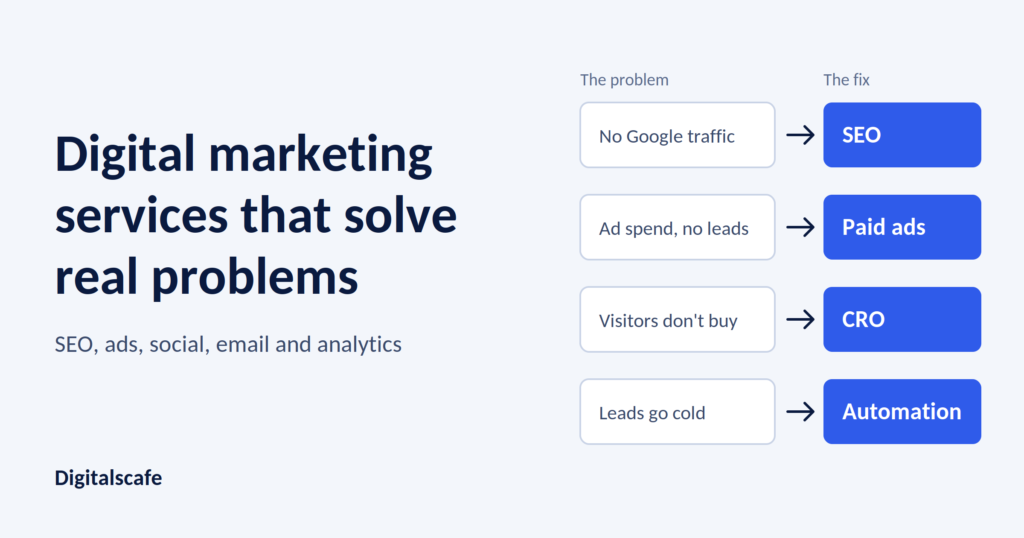
Most businesses do not wake up wanting “digital marketing.” They wake up with a problem.
The website gets almost no visitors. The ads spend money and bring the wrong people. The social media pages are active but nobody inquires. Leads arrive and then go cold. And at the end of the month, nobody can say what actually worked.
That is the difference between buying services and solving problems. This guide walks through the eight most common business problems we see, which digital marketing service fixes each one, what the work actually involves, how long results realistically take, and the offers you can use to get started with low risk.
Quick answer: Digital marketing services are the combined set of online activities (search engine optimization, paid advertising, social media, email and messaging, website conversion optimization, and analytics) that bring the right people to your business and turn them into customers. The right mix depends on your problem, your market and your budget, not on a one-size-fits-all package.
In this guide
- Why most digital marketing disappoints
- Eight real problems and how each one is solved
- Our digital marketing services at a glance
- How a project actually runs
- Illustrative scenarios
- Realistic timelines
- Pricing models and what drives cost
- Packages and offers
- Metrics that matter
- How to choose an agency, and red flags
- Frequently asked questions
Why Most Digital Marketing Disappoints
Before the solutions, it helps to understand why so many businesses feel let down by marketing. In most cases the cause is one of these:
- Activity instead of strategy. Posting daily, running ads and sending emails without a clear target customer, offer or goal.
- Tools instead of outcomes. Reports full of impressions and followers, but nothing about leads, sales or cost per customer.
- One channel carrying everything. A business that depends only on paid ads stops growing the day the budget stops. One that depends only on SEO waits months for anything to happen.
- No tracking. Without proper analytics, every decision is a guess.
- A weak website. The best traffic in the world is wasted on a slow, confusing page with no clear next step.
Good digital marketing fixes the system, not just one piece of it. Here is how.
Problem 1: “Nobody Finds Us on Google”
What it looks like: Your website exists, but searching for what you sell brings up competitors. Traffic is low and most of it comes from people who already know your name.
Why it happens: Search engines rank pages that match what people search for, load quickly, are easy to use and are trusted by other websites. Many sites fail on several of these at once: they target the wrong keywords, have technical errors, thin content or no authority.
The solution: SEO (search engine optimization)
- Technical audit. Fix crawl errors, broken links, slow pages, missing sitemaps, duplicate content and mobile problems that stop Google from properly reading your site.
- Keyword research based on buying intent. Find the searches people make when they are ready to hire or buy, such as “[service] in [your city]” or “[service] cost,” instead of vague high-traffic terms that bring browsers.
- On-page optimization. Rewrite titles, headings, descriptions and page content so each page clearly targets one topic.
- Content that answers real questions. Build service pages, guides and FAQs that match what customers ask before buying.
- Authority building. Earn links and mentions from relevant, trustworthy sites and directories.
What to expect: SEO is a compounding investment. Early technical wins can appear in weeks, but meaningful ranking and traffic growth usually takes three to six months or more, depending on competition.
Problem 2: “We Spend on Ads but Get Few Leads”
What it looks like: The monthly ad bill keeps arriving. Clicks look healthy, but inquiries are few, low quality or too expensive.
Why it happens: Common causes include targeting broad keywords or audiences, sending traffic to the homepage instead of a focused landing page, weak ad messaging, missing negative keywords, poor conversion tracking and no testing.
The solution: Paid ads management (Google Ads, Meta, YouTube and more)
- Account and tracking audit. Check what you are actually paying for, remove wasted spend and make sure form submissions, calls and purchases are tracked correctly.
- Restructure campaigns around intent. Separate high-intent search campaigns from awareness campaigns so you can control budget by purpose.
- Tighten targeting. Add negative keywords, refine audiences and exclude locations or segments that do not convert.
- Match ad to landing page. Each ad group points to a page that continues the same promise and has one clear action.
- Test and improve continuously. Rotate headlines, creatives and offers, and move budget to what produces leads at an acceptable cost.
What to expect: Ads can produce traffic within days, but the first two to four weeks are about learning and tuning. Cost per lead usually improves as data builds.
Problem 3: “We Get Visitors but Nobody Contacts Us”
What it looks like: Analytics show traffic, but contact forms, calls and purchases are rare.
Why it happens: The traffic may be wrong, but often the page itself is the problem: unclear offer, slow loading, buried contact options, no proof, too many form fields or a confusing journey on mobile.
The solution: Conversion rate optimization (CRO) and landing page design
- Review the visitor journey using analytics, heatmaps and session recordings to see where people drop off.
- Clarify the offer in the first screen: what you do, who it is for and what to do next.
- Add proof such as reviews, case studies, client logos, certifications and guarantees.
- Simplify the action. Fewer form fields, a click-to-call button, WhatsApp chat and visible contact details.
- Speed and mobile fixes. A slow or awkward mobile page quietly loses a large share of visitors.
- A/B test headlines, buttons and layouts so changes are proven rather than assumed.
What to expect: CRO often delivers the fastest return of any service, because it improves results from traffic you already pay for.
Problem 4: “We Post on Social Media but Nothing Happens”
What it looks like: Regular posts, a decent follower count, but few comments, messages or sales.
Why it happens: Content is often generic or promotional, posted without a clear audience, with no call to action and no link between social media and the sales process.
The solution: Strategic social media marketing
- Choose the right platforms. A B2B software company may thrive on LinkedIn, while a restaurant or clothing brand may do better on Instagram and TikTok. Do not try to be everywhere.
- Build content pillars: education, proof (results, testimonials, behind the scenes), and offers, in a deliberate mix.
- Use formats that fit each platform: short videos, carousels, stories, live sessions and community posts.
- Add clear next steps: a link, a message prompt, a lead form or a booking button.
- Engage, don’t just broadcast. Reply to comments and messages quickly, and take part in relevant groups and conversations.
- Support the best posts with a small paid budget to reach the right audience.
What to expect: Brand awareness and engagement build over weeks. Lead generation from social usually improves once content and offers are tuned and combined with ads or messaging follow-up.
Problem 5: “Leads Come In and Then Go Cold”
What it looks like: People inquire, but the team replies late, forgets to follow up or loses track. Sales say the leads are poor; marketing says sales did not call.
Why it happens: There is no system. Leads sit in inboxes, spreadsheets and chat apps, with no automatic follow-up, reminders or tracking.
The solution: Email, WhatsApp and CRM automation
- Capture every lead in one place using a CRM.
- Respond instantly with an automatic confirmation by email or message, and notify the right salesperson.
- Run follow-up sequences that provide helpful information, answer common objections and invite a call.
- Nurture people who are not ready yet with useful content, reminders and seasonal offers.
- Track the pipeline so you can see which source brings customers, not just inquiries.
- Win back past customers with reactivation campaigns.
What to expect: Many businesses see improvement within the first weeks simply by responding faster and following up consistently.
Problem 6: “We Can’t Tell What Is Working”
What it looks like: Several channels, a monthly report full of numbers, and still no clear answer to “where should we put the next dollar?”
Why it happens: Tracking is missing or broken, reports focus on vanity metrics, and data lives in separate tools.
The solution: Analytics and reporting setup
- Install and verify tracking: Google Analytics 4, Google Tag Manager, conversion events, call tracking and form tracking.
- Connect Google Search Console and ad accounts so search and paid data sit together.
- Define goals: what counts as a lead, a qualified lead and a sale.
- Build a simple dashboard with cost per lead, conversion rate, lead sources and return on ad spend.
- Review monthly, with clear decisions: what to stop, keep and scale.
What to expect: Good tracking pays off immediately because it stops wasted spend, even before any new campaign launches.
Problem 7: “Customers Don’t Trust Us Online”
What it looks like: People visit but hesitate. Competitors with more reviews win the business, even when your service is better.
Why it happens: Few or no reviews, an incomplete Google Business Profile, an outdated website, inconsistent business details across the web and no visible proof of results.
The solution: Local SEO, reputation and content marketing
- Optimize your Google Business Profile with the right categories, services, photos, posts and accurate hours.
- Collect reviews with a simple, ethical process that asks happy customers at the right moment.
- Respond to every review, good or bad, professionally.
- Keep your name, address and phone details consistent across directories and listings.
- Publish proof: case studies, testimonials, before-and-after examples and expert guides.
- Show the people behind the business with team pages, founder content and real photos.
What to expect: Reviews and profile improvements can influence calls and map visibility within weeks, especially for local service businesses.
Problem 8: “Competitors Keep Outranking and Outspending Us”
What it looks like: The same two or three competitors appear everywhere, in search results and in ads.
Why it happens: They may have more content, stronger links, better pages or a sharper offer, and you may not know where the gaps are.
The solution: Competitor and market analysis
- Identify true competitors from actual search results, not just who you assume you compete with.
- Map their keywords, pages, ads and offers to find gaps and weaknesses.
- Find opportunities they miss: niche services, locations, industries and questions they do not answer well.
- Decide where to compete head-on and where to go around, for example winning specific long-tail searches before taking on the biggest generic terms.
What to expect: This work shapes the whole strategy and often reveals faster, cheaper opportunities than the obvious ones.
A New Problem: “AI Assistants Don’t Mention Us”
More people now ask AI assistants and AI search features for recommendations, so being found no longer means only ranking on Google. Businesses increasingly need to be easy for these systems to understand and cite.
The solution: AI search visibility (GEO)
- Publish clear, factual pages about your services, location, pricing approach and expertise.
- Add structured data (schema) so machines understand who you are and what you offer.
- Build mentions and reviews on trusted third-party websites.
- Answer real customer questions in a direct, well-organized way.
- Check periodically what AI tools say about your business and fix inaccurate or missing information.
No one can guarantee how an AI system will respond, but strong SEO, clear content and a trustworthy online presence help with both traditional search and AI-generated answers.
Our Digital Marketing Services at a Glance
| Service | Solves | Typical deliverables | When results usually show |
| SEO | Low visibility on Google | Technical fixes, keyword strategy, content, link building | 3 to 6+ months |
| Local SEO | Weak local presence and trust | Google Business Profile, reviews, citations, location pages | 4 to 12 weeks |
| Google Ads | Need for leads now | Search, Shopping, Display and YouTube campaigns | First leads in days; tuning over 2 to 4 weeks |
| Meta and social ads | Awareness, lead generation, retargeting | Creative, audiences, lead forms, testing | 2 to 6 weeks |
| Social media management | Inactive or ineffective social presence | Strategy, content calendar, posting, community management | 2 to 3 months |
| Email and WhatsApp marketing | Cold leads and repeat sales | Automation, newsletters, follow-up flows | Often within weeks |
| Conversion rate optimization | Traffic that does not convert | Landing pages, A/B tests, speed and UX fixes | 2 to 8 weeks |
| Content marketing | Low trust and weak authority | Blogs, guides, case studies, video scripts | 3 to 6 months |
| Ecommerce marketing | Low sales and abandoned carts | Product SEO, shopping ads, email flows, merchandising | 4 to 12 weeks |
| Analytics and reporting | No clarity on performance | Tracking setup, dashboards, monthly insights | Immediately |
| Marketing automation and CRM | Lost leads and manual work | Pipelines, workflows, lead scoring | 2 to 6 weeks |
How a Project Actually Runs
Clear process prevents surprises. A typical engagement looks like this:
- Discovery and audit (week 1). We review your business goals, customers, website, ads, analytics and competitors, and find the biggest gaps.
- Strategy and priorities (week 2). You receive a written plan: which channels, which keywords and audiences, what offers, what budget and what success looks like.
- Setup (weeks 2 to 4). Tracking, accounts, landing pages, content and campaigns are built and reviewed.
- Launch and learn (month 1 to 2). Campaigns run, data comes in and we test and refine quickly.
- Optimize and scale (month 3 onward). Budget and effort move toward what works, and new channels are added only when earlier ones are performing.
- Report and decide (monthly). A plain-language report covers leads, cost, what changed and what happens next.
Illustrative Scenarios
The following are composite examples to show how the thinking works, not results from specific clients.
Scenario 1: A local clinic with a good reputation and an empty calendar
Problem: Strong word-of-mouth, but almost no new patients from online search, and an incomplete Google Business Profile.
Plan: Optimize the Google Business Profile, build a review request process, create service and location pages for the treatments patients actually search for, and add a simple booking button and WhatsApp contact. Add a small Google Ads budget for the highest-intent searches.
Why it works: Local, high-intent searches convert well, and trust signals (reviews, photos, clear services) matter a great deal in healthcare.
Scenario 2: A B2B software company spending heavily on ads
Problem: High click costs, many unqualified inquiries and a sales team frustrated with lead quality.
Plan: Audit the account, add negative keywords, separate brand, competitor and solution-intent campaigns, introduce a qualifying form and a demo landing page, and track leads through to the CRM so optimization is based on qualified leads rather than form fills.
Why it works: Optimizing for qualified leads, not cheap leads, reduces wasted spend and aligns marketing with sales.
Scenario 3: An online store with traffic but low sales
Problem: Healthy visits, high cart abandonment, weak product pages and no email program.
Plan: Improve product pages with better photos, clearer descriptions and reviews, add abandoned-cart and post-purchase email flows, run Shopping and retargeting campaigns, and fix slow mobile pages.
Why it works: It increases revenue from existing traffic and brings back visitors who were already interested.
Scenario 4: A service business that depends on referrals
Problem: Work comes only from referrals, so income is unpredictable.
Plan: Build a simple, trustworthy website with clear service pages, start local SEO, publish a few case studies, run a small lead-generation ad campaign and set up automatic follow-up so every inquiry gets a prompt reply.
Why it works: It adds a reliable second source of leads without abandoning the one that already works.
Realistic Timelines
Anyone promising instant first-page rankings or guaranteed sales is overselling. A sensible expectation:
- Week 1 to 2: audits, tracking and quick fixes
- Weeks 2 to 6: ad campaigns launching and tuning, landing pages and automation live
- Months 2 to 3: clearer lead data, improving cost per lead, early SEO movement
- Months 3 to 6: noticeable organic growth, stronger content and authority
- Months 6 to 12: compounding results, lower dependence on paid ads
Results depend on your industry, competition, budget, offer and how quickly your team follows up on leads.
Pricing Models and What Drives Cost
We deliberately avoid quoting a single price here, because the right number depends on the work required. Digital marketing services are usually priced in one of these ways:
- Monthly retainer: best for ongoing work like SEO, content, social and ads management.
- Project-based: best for one-time work such as a website, landing pages, tracking setup or an audit.
- Ad spend plus management fee: you pay the ad platforms directly, plus a management fee (flat or a percentage).
- Hybrid: a set-up fee plus a monthly retainer.
What affects the price:
- Number of channels and services
- Size and competitiveness of your market
- Amount of content and creative required
- Ad budget
- Your website’s current condition
- Reporting depth and meeting frequency
- Number of locations, products or languages
A good agency will explain what you are paying for and why, and will not hide fees inside vague “packages.”
Packages and Offers
Here is how we structure services, along with offers to make starting low-risk.
Starter: for businesses getting their foundations right
Best for small businesses with a new or underperforming website.
- Website and SEO audit
- Google Business Profile optimization
- Analytics and conversion tracking setup
- Basic on-page SEO for key pages
- Monthly report
Price: 100$ per month
Growth: for businesses ready to generate leads consistently
Best for companies that want steady inquiries and sales.
- Everything in Starter
- SEO content and link building
- Google Ads and/or Meta Ads management
- Landing page optimization
- Email or WhatsApp follow-up automation
- Social media management (set number of posts)
- Monthly strategy call
Price: 200$ per month
Pro: for businesses scaling across channels or markets
Best for established companies, ecommerce brands and multi-location businesses.
- Everything in Growth
- Competitor and market tracking
- Advanced CRO and A/B testing
- Marketing automation and CRM integration
- Multi-channel paid campaigns
- AI search visibility optimization
- Dedicated account manager and dashboard
Price: 300$ per month
Current offers
Use the offers you can genuinely deliver, and fill in the details:
- Free website and SEO audit. We review your site, search visibility and competitors, and send you a clear list of priorities.
- Free 30-minute strategy call. Walk through your goals and leave with a practical next-step plan, with no obligation.
- Free ad account review. If you already run Google or Meta ads, we check where money is being wasted.
- New client offer. Get 50% off the one-time setup fee (audit, tracking and campaign build) when you sign a 3-month Growth or Pro agreement. Available to the first 5 new clients, whichever comes first. Cannot be combined with the bundle discount.
- Bundle discount. Combine SEO with Google Ads or Meta Ads management and receive 15% off the monthly management fee on both services. Requires a 3-month minimum agreement. Ad spend is paid separately to the ad platform and is not discounted.
- Referral reward. Refer a business that signs a 3-month agreement and you receive a credit worth 10% of their first three months’ management fees, applied to your next invoices. The business you refer also gets a free website and SEO audit. Credits have no cash value and apply after the referred client’s first payment is received.
Always read the details of any offer, including what is included, how long it lasts and what happens afterward. We list these openly so there are no surprises.
Metrics That Matter
Followers and impressions can look good while the business stays flat. The numbers that actually show progress are:
| Area | Key metrics |
| Search | Organic clicks, rankings for target keywords, impressions, organic leads |
| Paid ads | Cost per lead, cost per sale, conversion rate, return on ad spend |
| Website | Conversion rate, bounce and engagement rate, page speed, form and call completions |
| Social | Engagement rate, messages and leads from social, reach to the right audience |
| Email and automation | Open and click rates, replies, booked calls, revenue per email |
| Business | Qualified leads, close rate, customer acquisition cost, revenue from marketing |
A trustworthy agency reports business metrics first, then explains the marketing metrics behind them.
How to Choose a Digital Marketing Agency (and Red Flags)
Ask these questions before you sign anything:
- How will you measure success? The answer should include leads and revenue, not just traffic.
- Can I see examples and references? Look for clear problems, actions and outcomes, not vague claims.
- Who will actually do the work? Know whether it is your named team or an anonymous outsourced one.
- Will I own my accounts and data? You should always own your ad accounts, analytics, website and content.
- What does the first 90 days look like? You should get a specific plan, not generic statements.
- How often will we communicate, and how do you report?
- What happens if we part ways? Look for fair terms and a clean handover.
Red flags:
- Guaranteed rankings or guaranteed sales
- Refusing to share ad accounts or reports with you
- Long contracts with no clear deliverables
- Vague pricing or constant add-on fees
- Buying links in bulk or using spammy tactics that can get your site penalized
- One generic package offered to every business
- Reports that show only vanity metrics
Frequently Asked Questions
What are digital marketing services?
They are the online activities that help a business get found, attract customers and generate sales, including SEO, paid advertising, social media marketing, email and messaging campaigns, content marketing, conversion optimization and analytics.
Which digital marketing service is best for a small business?
It depends on your problem. Local businesses usually benefit most from Google Business Profile optimization, local SEO and a small Google Ads budget. Online stores often start with product SEO, Shopping ads and email flows. A free audit helps identify the best starting point.
How much do digital marketing services cost?
Costs vary widely with scope, competition and ad budget. Services are commonly priced as monthly retainers, project fees, or a management fee on top of ad spend. Request a scoped proposal rather than relying on a generic price list.
How long does it take to see results?
Paid ads can produce traffic within days, and conversion and automation improvements often show results within weeks. SEO and content typically take three to six months or longer to build strong momentum.
Is SEO or paid advertising better?
They do different jobs. Ads give faster leads but stop when the budget stops. SEO takes longer but builds lasting visibility. Most businesses benefit from combining them, starting with whichever fits their cash flow and timeline.
Do you guarantee first-page rankings or a certain number of leads?
No honest agency can. Search engines and ad platforms are not controlled by agencies. What we can commit to is a clear process, transparent reporting and continuous optimization based on data.
Do I need social media marketing?
If your customers use social platforms to discover, compare or contact businesses like yours, yes. If they do not, your effort may be better spent on search, email or local visibility. We help you choose the right platforms rather than posting everywhere.
Will I own my website, ad accounts and data?
You should. Your accounts, analytics and content belong to you, and we recommend working only with agencies that agree to this in writing.
Can digital marketing work for a business with a small budget?
Yes, if it is focused. A small budget works best on one or two high-intent channels, solid tracking and a strong landing page, not a little spread across everything.
What is the difference between a digital marketing agency and a freelancer?
A freelancer can be excellent for a single skill. An agency typically offers a coordinated team across strategy, content, ads, SEO, design and analytics. Choose based on the breadth of work you need and how much coordination you want to handle yourself.
What information do you need to get started?
Your website address, a short description of your products or services, your target customers and locations, current marketing activity, and your main goal (for example, more inquiries or more online sales). Access to analytics, ad accounts and Search Console speeds up the audit.
Can you help with AI search and ChatGPT visibility?
We can improve the factors that influence it: clear content, structured data, reviews and third-party mentions. Because AI systems change frequently, we monitor and adjust over time, and we never promise a specific placement.
Key Takeaways
- Start with your problem, not with a list of services.
- Fix tracking and your website’s ability to convert before increasing ad spend.
- Combine fast channels (ads, email) with slow, compounding ones (SEO, content, reviews).
- Judge results by leads and revenue, not followers and impressions.
- Choose partners who are transparent about pricing, process and account ownership.
Ready to Find Out What Is Holding Your Marketing Back?
Tell us what you sell, who you want to reach and what has not worked so far. We will review your website, search visibility and campaigns and send you a clear, prioritized plan.
- Get your free website and SEO audit
- Book a free 30-minute strategy call
- Call or WhatsApp: +92-306-4915519
- Email: mubeenanjum155@gmail.com
Timelines and results described in this article are typical expectations, not guarantees. Outcomes depend on industry, competition, budget, offer quality and follow-up. Scenarios are illustrative composites.