Insurance App Marketing: How to Get Policyholders to Download, Use and Stay
Insurance app marketing is how insurers, agencies and insurtechs get the right people to download their app, use it for real tasks like payments, ID cards and claims, and keep coming back at renewal. Because people rarely think about insurance, the best strategies focus on key moments, existing policyholders and features that make the app genuinely useful.
This guide is for marketing, digital and distribution leaders at carriers, MGAs, agencies and insurtech startups. It covers why insurance apps are hard to market, the strategy, getting existing policyholders to adopt the app, acquiring new customers, app store optimization, engagement, AI search, compliance, measurement and the features your app needs so marketing works.
Last updated: November 2026
Key takeaways
- Insurance is a low-frequency product, so plan marketing around moments: buying, paying, renewing, claiming and proving coverage.
- Your biggest audience is usually existing policyholders who haven’t downloaded the app yet.
- Every channel you already own, from billing emails to ID cards and agent calls, can drive app adoption.
- App store pages, deep links and push notifications decide how many downloads turn into active users.
- Insurance advertising is regulated, so compliance review belongs in the marketing process from the start.
- Measure active users, digital payments, digital claims and retention, not downloads alone.
What is insurance app marketing?
Insurance app marketing is the set of activities that drive downloads, sign-ups and ongoing use of an insurance mobile app. It covers acquiring new customers through quote-and-buy apps, moving existing policyholders onto the app for self-service, and using the app to improve renewals, claims experience and cross-selling, all within insurance advertising rules.
It’s different from general app marketing in three ways:
- Low frequency. Most people only interact with their insurer a few times a year.
- High trust. People share personal, financial and sometimes health information.
- Regulation. Ads and claims about coverage, prices and benefits are regulated by state insurance departments.
Why are insurance apps hard to market?
Insurance apps are hard to market because people only need them at a few moments a year, many app features duplicate the website, policyholders don’t know the app exists, and marketing claims must stay within strict advertising rules. Apps that don’t solve a real task at the right moment get deleted after the first use.
Common reasons insurance apps underperform:
- Nobody knows about it. Policyholders aren’t told at the moments they’d use it.
- It doesn’t do enough. Viewing a policy isn’t a reason to download; paying, claiming and showing an ID card are.
- Login is painful. Long registration and forgotten passwords stop people at the first step.
- It’s disconnected from the core. Out-of-date policy or claim information makes people call instead.
- Marketing and product work separately. Campaigns promote features the app doesn’t handle well.
If your app has these problems, fix the product first. Our insurance app development guide covers the features and integrations that make an app worth downloading.
How do you build an insurance app marketing strategy?
Build an insurance app marketing strategy by defining who the app is for, the jobs it does better than the website or a phone call, the moments when people need those jobs, and the channels that reach them at those moments. Then set one main goal, such as active users or digital claims, and measure it from day one.
A one-page strategy answers:
| Question | Example answer |
|---|---|
| Who is the app for? | Existing auto and home policyholders |
| What jobs does it do best? | Pay, show ID card, file and track a claim |
| When do people need it? | Billing date, traffic stop, after an accident, storm season |
| Which channels reach them then? | Billing emails, renewal packs, agent calls, SMS, website |
| What’s the main goal? | Monthly active users and share of digital claims |
| How will you measure it? | App events connected to policy and claims systems |
How do you get existing policyholders to download your insurance app?
Get existing policyholders to download your app by promoting it at the moments they need it: in billing emails and statements, renewal documents, ID cards, claims calls, agent conversations and your website’s login page. Give a clear reason, such as faster claims or instant ID cards, and send them straight to the right store with a deep link.
This is usually the cheapest and fastest growth channel, because you already have the relationship.
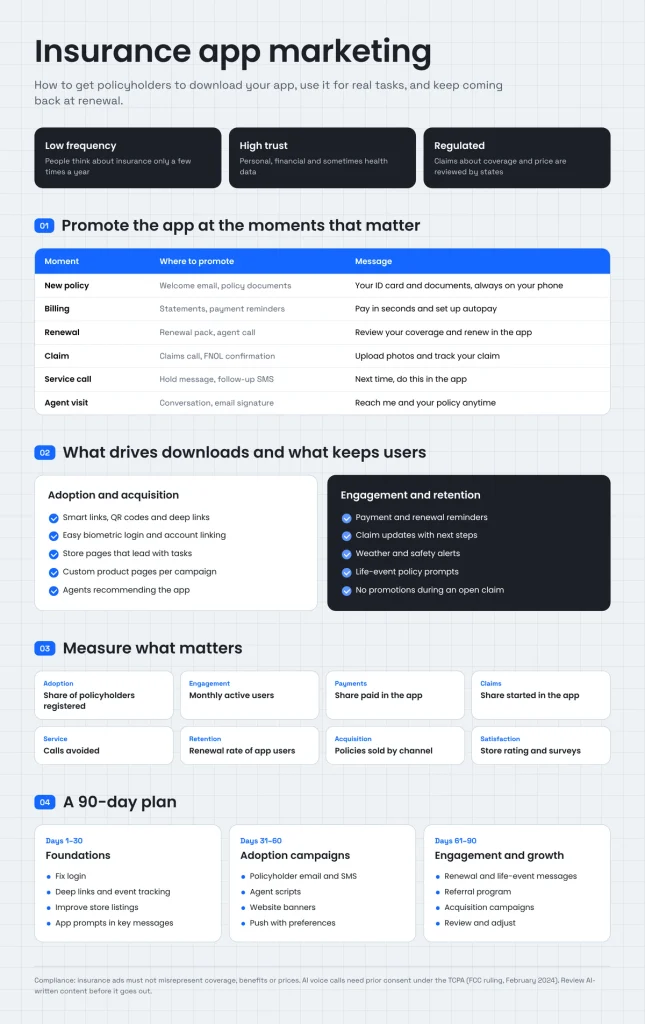
| Moment | Where to promote | Message |
|---|---|---|
| New policy | Welcome email, policy documents | “Your ID card and documents, always on your phone” |
| Billing | Statements, payment reminders | “Pay in seconds and set up autopay” |
| Renewal | Renewal pack, agent call | “Review your coverage and renew in the app” |
| Claim | Claims call, FNOL confirmation | “Upload photos and track your claim” |
| Service call | Hold message, call follow-up SMS | “Next time, do this in the app” |
| Website login | Account page banner | “Get the app for faster access” |
| Agent visit | Agent conversation, email signature | “Here’s how to reach me and your policy anytime” |
Practical tips:
- Use smart links and QR codes that detect the device and open the right store.
- Use deep links so a link in a claims email opens the claims screen, not the home screen.
- Make login easy, with biometric sign-in and account linking using a policy number.
- Track the source of every download with campaign links. The free UTM Builder creates tagged links for emails and SMS.
How do you acquire new customers with an insurance app?
Acquire new customers through an insurance app by making quoting fast and simple, ranking for searches about your products, running targeted ads that lead to the right store page or a web quote, using comparison and educational content, and partnering with businesses that serve your customers. Most new customers start on the web, so connect web and app journeys.
Acquisition channels that work for insurance:
- Search (SEO and paid): people search for quotes, coverage explanations and comparisons.
- Comparison content: honest guides that explain coverage options.
- Paid social and app install ads: for quote-and-buy apps, with careful compliance review.
- Partnerships and embedded insurance: offering coverage at the point of sale, such as car dealers or property managers.
- Referrals: satisfied policyholders inviting friends, with tracked invite links.
- Agents and brokers: many buyers still prefer to talk to a person before buying.
For agencies, speed matters as much as reach. New quote requests should get a reply within minutes. Zonified Connect, our AI voice CRM, contacts each new lead by text and, with consent, by phone, then books a call with a producer.
What is app store optimization for insurance apps?
App store optimization (ASO) for insurance apps means improving your App Store and Google Play listings so they rank for searches like your brand name, “car insurance app” or “pay insurance bill”, and convince visitors to install. It covers the app name, subtitle, keywords, screenshots, preview video, ratings and reviews.
What works:
- Lead with tasks in screenshots. Show paying, the ID card and claim filing in the first two screenshots, with short captions.
- Use your brand plus the task in the name and subtitle, within each store’s character limits.
- Ask for ratings after successes, such as a completed payment or a claim update, using the stores’ official in-app review prompts.
- Reply to reviews, especially complaints about login or claims.
- Use custom product pages. Apple allows up to 70 custom product pages per app, so a claims campaign can link to a page that shows claims first.
- Keep listings accurate. Coverage and pricing claims in store listings are advertising too.
How do you keep policyholders engaged between renewals?
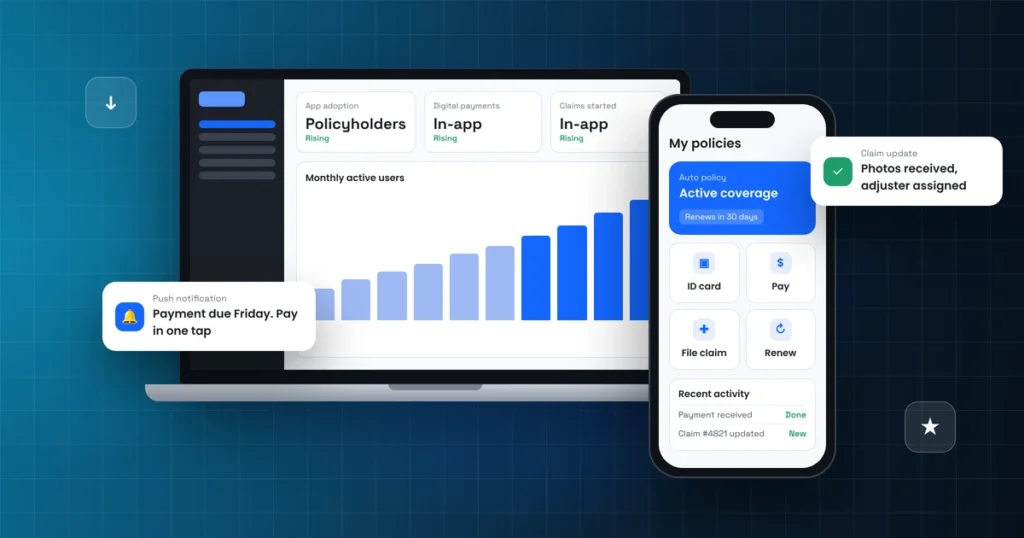
Keep policyholders engaged by giving them useful reasons to open the app between renewals: payment reminders, ID cards, claim updates, timely safety alerts, policy reviews when life changes, and helpful tools for their home, car or health. Every message should be relevant and easy to act on, or it becomes a reason to switch notifications off.
| Trigger | In-app or push message |
|---|---|
| Payment due | Reminder with one-tap payment |
| Severe weather forecast | Preparation tips and how to file a claim if needed |
| Claim status change | Update with next steps |
| Life event (new car, move, new driver) | Prompt to update the policy |
| Renewal approaching | Coverage review and renewal option |
| Policy anniversary | Summary of coverage and savings options |
Rules for messages:
- Ask for notification permission at the right moment, after explaining the value, not on first launch.
- Let people choose topics and frequency.
- Never send promotions during an open claim. It’s the fastest way to lose trust.
- Personalize by policy type and stage, using data from your policy and claims systems.
How can AI help insurance app marketing?
AI helps insurance app marketing by personalizing messages based on policy and behavior, predicting which customers may not renew, answering questions in the app from policy documents, responding to new leads instantly, and drafting campaign content for review. Marketing and compliance teams should review AI-written content before it goes out.
Useful AI applications:
- Renewal risk scoring so retention outreach starts before renewal, not after a cancellation.
- Personalized offers based on coverage gaps and life events, within your rules.
- In-app assistants that answer coverage questions from the customer’s policy wording, with the source shown. Our Insurance Claims RAG Assistant uses this approach for claims professionals.
- Lead follow-up by text and voice for quote requests, using AI voice agents where calls are involved.
- Content drafting for emails, push messages and social posts, reviewed before sending.
How do insurance brands show up in AI search?
Insurance brands show up in AI search, such as Google’s AI Overviews, ChatGPT, Gemini and Perplexity, by publishing clear, specific answers to coverage and process questions, keeping company and product information consistent, earning reviews and mentions on trusted sites, using structured data, and letting the right AI crawlers access the site.
The three practices behind this:
- AEO (answer engine optimization): direct answers to questions like “how do I file a claim?” under question headings.
- AIO (AI Overviews optimization): content Google’s AI Overviews can quote and cite.
- GEO (generative engine optimization): making your brand easy for AI assistants to understand and recommend.
Practical steps:
- Write FAQ answers in 40–60 words and keep them current. The free FAQ Generator gives you a starting draft to edit.
- Add structured data for your organization, FAQs and app. The Schema Markup Generator creates valid JSON-LD.
- Check whether AI crawlers can access your site with the free AI Visibility Checker.
- Write search titles and descriptions that promise a clear benefit. Draft them with the SEO Title Generator and Meta Description Generator, then preview them in the Google SERP Preview Tool.
What rules apply to insurance app marketing?
Insurance app marketing must follow state insurance advertising rules, which prohibit misleading statements about coverage, benefits and prices; consent rules for calls and texts; privacy and data security laws; and app store and ad platform policies for financial services. AI-written content is covered by the same rules as anything a person writes.
Key areas:
- State insurance advertising rules. State insurance departments regulate insurance advertising, and most base their rules on NAIC model laws on unfair trade practices. Ads must not misrepresent coverage, benefits, exclusions or premiums.
- Licensing. Content that solicits a sale may need to come from a licensed producer, depending on the state and the activity.
- Calls and texts. Under a February 2024 FCC ruling, AI-generated voices count as artificial voices under the TCPA, so AI calls need prior express consent. Marketing texts and calls need proper consent and opt-outs.
- Privacy and data security. State insurance data security laws, federal privacy rules and HIPAA for health plans govern how app data is used for marketing.
- App tracking. On iPhone, tracking users across other companies’ apps requires permission through Apple’s App Tracking Transparency.
- Ad platform policies. Check each platform’s rules for financial services and insurance ads before launching campaigns.
Build a simple review step: marketing drafts, compliance reviews, then the campaign goes live. Keep records of approved versions.
Which features does your app need so marketing works?
For marketing to work, an insurance app needs fast and secure login, deep links into key screens, event tracking for important actions, an attribution setup, push notifications with well-timed permission requests, in-app messaging, referral links, review prompts and real-time connections to policy, billing and claims systems.
A build checklist to share with your development team:
- Biometric login and simple account linking with a policy number.
- Deep links to payments, ID cards, claims and renewals.
- Event tracking for sign-up, payment, ID card view, claim started and claim completed.
- Attribution connecting installs and actions to campaigns.
- Push notifications with topic preferences and a pre-permission explanation screen.
- In-app messages for tips and announcements.
- Referral links with tracking.
- In-app review prompts after successful tasks.
- Real-time core connections so policy, billing and claims information is current.
- Remote configuration to change messages and offers without a new release.
If your app is missing these, our insurance software development services team can add them, whether you’re extending an existing app or building a new one. For deeper changes behind the app, see our guide to custom insurance software.
How do you measure insurance app marketing?
Measure insurance app marketing by tracking adoption (downloads and registrations among policyholders), engagement (monthly active users and key tasks completed), operational impact (digital payments, digital claims and fewer service calls) and business results (retention, renewals and new policies). Downloads alone don’t show whether the app is working.
| Category | Metric |
|---|---|
| Adoption | Share of policyholders registered in the app |
| Engagement | Monthly active users, tasks completed per user |
| Payments | Share of payments made in the app, autopay sign-ups |
| Claims | Share of claims started in the app, time to first update |
| Service | Calls avoided for tasks the app handles |
| Retention | Renewal rate for app users vs non-users |
| Acquisition | Quotes, policies sold and cost per policy by channel |
| Satisfaction | App store rating, survey scores |
Compare app users with non-users carefully. App users may already be more engaged customers, so look at changes over time, not just the gap between groups.
A 90-day insurance app marketing plan
A 90-day plan fixes adoption basics in the first month, launches moment-based campaigns in the second, and adds personalization, acquisition and optimization in the third.
| Period | Focus | Actions |
|---|---|---|
| Days 1–30 | Foundations | Fix login, add deep links and event tracking, improve store listings, add app prompts to billing, renewal and claims communications |
| Days 31–60 | Adoption campaigns | Policyholder email and SMS campaigns, agent scripts, website banners, push notification setup with preferences |
| Days 61–90 | Engagement and growth | Personalized renewal and life-event messages, referral program, acquisition campaigns, review and adjust based on data |
Common insurance app marketing mistakes
- Promoting the app before it handles key tasks well.
- Asking for notification permission on first launch.
- Sending promotions during an open claim.
- Measuring downloads instead of active users and completed tasks.
- Ignoring agents, who are often the most trusted channel.
- Skipping compliance review for ads, store listings and AI-written messages.
- Generic messages that don’t reflect the customer’s policy or stage.
Frequently asked questions
What is insurance app marketing?
Insurance app marketing is the work of driving downloads, sign-ups and ongoing use of an insurance mobile app. It includes moving existing policyholders onto the app, acquiring new customers, store optimization, engagement messages and measurement, all within insurance advertising rules.
How do I increase downloads of my insurance app?
Promote the app at the moments policyholders need it: billing, renewal, claims, ID cards and service calls. Use deep links and smart links, improve your store listing, make login easy, and ask agents to recommend it. Existing policyholders are usually the fastest source of downloads.
How do insurance apps keep users engaged?
Insurance apps keep users engaged with useful, timely features and messages: payment reminders, ID cards, claim updates, weather alerts, life-event prompts and renewal reviews. Messages should be relevant to each customer’s policy and stage, with clear preferences and no promotions during claims.
What features help market an insurance app?
Fast biometric login, deep links into key screens, event tracking, attribution, push notifications with good permission timing, in-app messages, referral links, review prompts and real-time connections to policy, billing and claims systems all help marketing work and be measured.
Is insurance advertising regulated?
Yes. In the US, state insurance departments regulate insurance advertising, generally based on NAIC model laws on unfair trade practices. Ads, app store listings and messages must not misrepresent coverage, benefits or prices. Calls and texts also need proper consent.
How can AI help market an insurance app?
AI can predict renewal risk, personalize messages, answer coverage questions in the app from policy documents, respond to new leads quickly and draft campaign content. Marketing and compliance teams should review AI-written content before it’s sent.
How do I measure the success of an insurance app?
Track the share of policyholders using the app, monthly active users, digital payments and claims, calls avoided, renewal rates and new policies by channel. Downloads alone don’t show whether the app is delivering value.
Should agencies have their own insurance app?
It depends on size and service model. Larger agencies and brokerages benefit from a branded app or client portal for policies, certificates and service requests. Smaller agencies often get more from fast lead follow-up and a strong website first.
Make your app worth opening
The best insurance app marketing starts with an app that solves real problems at the right moments. Get those moments right, connect the app to your core systems, and every billing email, renewal and claim becomes a reason to use it.
Digitals Cafe builds insurance apps, portals, AI assistants and the integrations behind them. See our insurance software development services or contact us to plan your next release.