
Digital Marketing vs SEO in 2027: Which One Is Best for Your Business?
SEO is not an alternative to digital marketing. It is one channel inside it. In 2027, SEO is the best single foundation for most businesses, because search engines and AI answer tools read your website. But digital marketing as a whole, including social media, email and paid ads, is the system that turns that foundation into customers. The right choice depends on your goal, budget and how fast you need results.
This guide explains the difference between digital marketing vs SEO, how search engine algorithms and social media algorithms actually decide what people see, and how to choose your mix for 2027. It is written for US business owners and marketers, with notes for readers who also sell in other countries.
Key takeaways
- The digital marketing vs SEO debate is the wrong fight. SEO is a part of digital marketing, so the real question is how much of each to use.
- Search algorithms reward helpful, original pages and match them to what people type or ask. Results can last for months or years.
- Social algorithms reward content people watch, share and save. Results often fade in days unless you keep posting.
- Google says its AI search features use the same SEO fundamentals as regular search. There is no separate trick.
- For most US businesses in 2027, start with SEO and local search, add one or two social platforms, and use paid ads to speed up what already works.
What is the difference between digital marketing vs SEO?
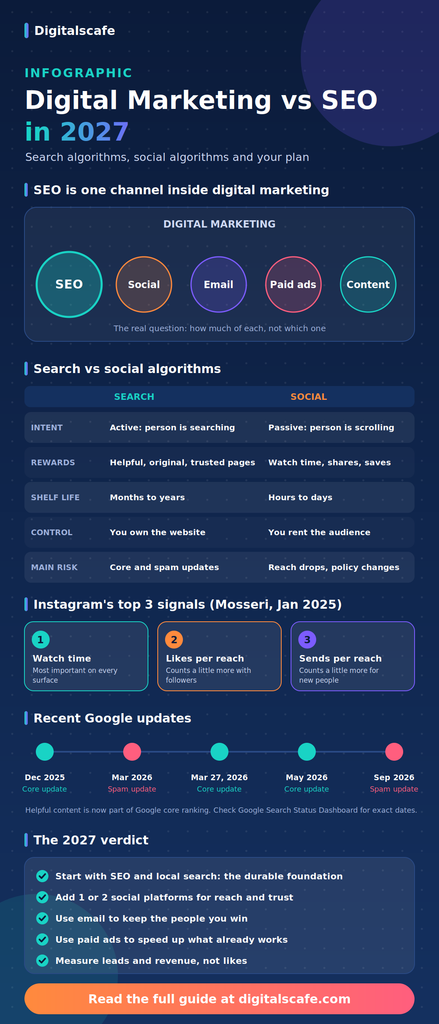
Digital marketing is every way a business promotes itself online: search, social media, email, paid ads, content, video and more. SEO, or search engine optimization, is the part that earns free visibility in search results and AI answers. SEO is one tool. Digital marketing is the whole toolbox.
People often compare them as if they were rivals. A better picture is a toolbox and one of its tools. Here is how the main channels differ.
| Channel | What it does | How you pay | Speed of results |
| SEO | Earns visibility in search results, maps and AI answers | Time, content and expertise | Slower, but compounds |
| Paid search (PPC) | Buys ads in search results | Per click or per lead | Fast, stops when budget stops |
| Social media (organic) | Builds audience and trust through posts and video | Time and creative work | Fast bursts, short shelf life |
| Paid social | Buys reach and leads on social platforms | Per impression, click or lead | Fast, stops when budget stops |
| Email marketing | Nurtures people who already know you | Tool costs and content | Medium, depends on your list |
| Content marketing | Feeds SEO, social and email with useful material | Time and expertise | Slow to medium |
SEO works well beside every other channel. A strong page ranks in search, gets shared on social media, supports paid ads with a good landing page, and feeds your email list. That is why the best answer is almost never “only one.”
Digital marketing vs SEO in 2027: which is best?
For most businesses, SEO is the best foundation in 2027, and a wider digital marketing mix is the best strategy. SEO gives durable visibility in Google and AI answers. Social, email and paid media add speed, reach and repeat contact. Your goal, budget and timeline decide the split.
Here is a quick decision guide.
| If your main goal is… | Start with | Add next |
| Steady leads over the long term | SEO and local SEO | Email and content |
| Leads this month | Paid search | SEO to lower costs over time |
| Brand awareness and community | Organic social and video | SEO for brand searches |
| Local customers (clinics, trades, restaurants) | Google Business Profile, reviews, local SEO | Paid search and short video |
| Online sales (ecommerce) | SEO plus paid shopping and social ads | Email and retention |
| B2B sales with long cycles | SEO, LinkedIn, email | Webinars and targeted ads |
If you can only do one thing with a small budget, we usually recommend search. Customers there already want what you sell. Social media can find people who were not looking yet, but it needs constant fresh content to keep working.
Our guide to SEO for small business in 90 days shows how to start.
How do search engine algorithms work in 2027?
Search engine algorithms crawl pages, store them in an index, and rank them by relevance and quality for each search. Google combines many systems, including core ranking and spam detection. In 2027, these systems favor original, helpful pages from trustworthy sources and increasingly feed AI-generated answers.
Search works in three steps. First, crawlers find your pages. Second, the engine stores and understands them in its index. Third, when someone searches, ranking systems pick the best matches. Many signals feed that final step, including how well a page matches the query, its quality, links and mentions from other sites, page experience and, for local searches, location.
What are Google core updates and spam updates?
A core update is a broad change to Google’s main ranking systems, made to show more helpful, reliable results. A spam update improves detection of spam tactics. Both roll out over days or weeks and can shift rankings. Google usually releases several core updates each year.
Recent examples show the pattern. Google ran a core update in December 2025, a spam update in March 2026, a core update that began on March 27, 2026, another core update in May 2026 and a spam update in September 2026. The helpful content system is now part of Google’s core ranking, so there is no separate “helpful content update” to wait for.
The advice from Google and from most SEO analysts is consistent: create content for people first, show real experience, keep pages accurate and avoid spam tactics such as mass-produced pages or keyword stuffing. Rankings can move after an update even if you did nothing wrong, and recovery, when needed, usually takes months of real improvement rather than quick fixes.
How have search algorithms changed over the last few years?
Search algorithms have moved from rewarding keywords and links toward rewarding helpfulness, originality and trust. Google introduced a sitewide helpful content signal in August 2022, then folded it into its core ranking systems in 2024. Spam policies also grew tougher, especially on mass-produced and auto-generated pages.
This matters for the digital marketing vs SEO decision. Older SEO often meant publishing many pages around many keywords. That approach is now risky. Google’s published guidance says to create people-first content and to show who wrote it and why they are qualified to write it. This is often summarized as E-E-A-T: experience, expertise, authoritativeness and trust. It is not a score you can see, but it is a useful test for any page: does it show real, first-hand knowledge, and could a reader trust it?
For businesses, the takeaway is practical. Fewer, better pages beat many thin ones. Real photos, real examples, named authors and accurate details separate your pages from generic content that any tool could produce.
How do Google AI Overviews and AI Mode change SEO?
Google AI Overviews and AI Mode show generated answers above or instead of the usual list of links. Google says they rely on the same fundamentals as regular search, and that no special markup is required. Pages that are crawlable, accurate and original are the ones worth citing.
In May 2026, Google published guidance on succeeding in its generative AI search features. It stresses technical accessibility, genuinely useful content and accurate business details, such as a complete Google Business Profile for local businesses. You can read it on Google’s page about AI features and your website.
Two practical effects follow. Some simple searches end without a click, so you should measure leads and brand searches, not only visits. And other AI tools, such as ChatGPT and Perplexity, may use different signals, so it is wise to check how you appear in each. For more, see our lead generation strategies for 2027.
How does local search ranking work?
Google ranks local results mainly on relevance, distance and prominence. Relevance is how well your profile matches the search. Distance is how close you are. Prominence is how well known you are, including reviews and links. You control relevance and prominence, but not the searcher’s location.
To improve, complete your Business Profile, choose the right categories, collect reviews and keep your name, address and phone number consistent online. Our local SEO guide covers this in detail.
How do social media algorithms work in 2027?
Social media algorithms collect eligible posts, score them using signals such as watch time, shares, saves and relevance to each person, predict how much that person will value them, then rank them. Most major platforms now recommend content by interest, so people who do not follow you can see your posts.
Published guides describe the same four steps across platforms: gather candidate content, evaluate signals, predict engagement value and rank the results. Platforms do not publish exact weights, and they change them often, so treat any “secret formula” with caution. What stays consistent is the direction: reward content people actually watch, share and save, and demote content that feels spammy or recycled.
How does the Instagram algorithm work?
Instagram uses separate ranking systems for Feed, Stories, Reels and Explore. Its head, Adam Mosseri, said in January 2025 that the three most important signals are watch time, likes per reach and sends per reach. Likes count slightly more with followers, and sends count slightly more for reaching new people.
Mosseri also pointed creators to three numbers in Insights: average watch time, likes per reach and sends per reach. In practice, this means hooks that keep people watching, and posts people want to send to a friend, such as practical tips, relatable moments or useful checklists.
How do the TikTok, YouTube, LinkedIn and Facebook algorithms work?
TikTok and YouTube lean heavily on watch time and viewer satisfaction. LinkedIn and Facebook favor meaningful conversation and relevance. All four now push content by interest, not only by who you follow. Exact weights are not public, so test and watch your own analytics.
- TikTok: builds an interest profile for each viewer. Guides point to watch time, completion, shares and saves as strong signals.
- YouTube: uses many signals. Published guides highlight click-through rate, view duration, session time and viewer satisfaction.
- LinkedIn: reportedly replaced several separate ranking systems with one model built on a large language model in March 2026. It rewards relevance and conversation over simple popularity.
- Facebook: favors meaningful interactions, video and Reels, and content from groups and close connections.
How can you work with social algorithms instead of against them?
Work with social algorithms by making content people finish, send and save. Open with a strong first few seconds, deliver one clear idea, add captions, use original footage and ask a simple question. Avoid reposted, watermarked or recycled content, which platforms tend to demote.
- Hook early. Watch time is a core signal on most platforms, so the first seconds decide whether people stay.
- Make it send-worthy. Useful tips, checklists and relatable moments get shared in private messages, which is a strong signal for reaching new people on Instagram.
- Add search-friendly words. Use clear captions, on-screen text and descriptions with the words your customers use.
- Use original material. Instagram’s leadership has said it wants to reward original content over repurposed or purely AI-generated posts.
- Post consistently, but not blindly. A steady rhythm helps, but one strong video a week beats seven weak ones.
- Study your own analytics. Check average watch time, shares, saves and follower growth to see what your audience actually values.
- Link back to your site. Send interested people to a page or sign-up form you own.
Social platforms are also becoming search engines. Many people now search TikTok, Instagram, YouTube and LinkedIn directly, so clear captions, titles and descriptions matter. Treat each platform like a small search engine, not only a feed.
How do search algorithms and social algorithms compare?
Search algorithms match content to what people actively ask for, and rankings can last months. Social algorithms match content to what people might enjoy while scrolling, and reach often fades in days. Search rewards depth and trust. Social rewards attention and shareability.
| Factor | Search engine algorithms | Social media algorithms |
| User intent | Active: the person is searching | Passive: the person is browsing |
| What they reward | Helpful, original, trustworthy pages | Watch time, shares, saves, relevance |
| Shelf life | Months to years | Hours to days (some content lasts longer) |
| Main risk | Core and spam updates, AI answers reducing clicks | Reach drops, policy changes, account issues |
| Control | Moderate: you own the website | Low: you rent the audience |
| Best for | Capturing ready-to-buy demand | Building awareness, trust and community |
| Typical lead quality | Often high intent | Often early stage, needs nurturing |
The practical lesson: own what you can. Your website, email list and Google Business Profile are assets you control. Social accounts and ad accounts can change or be suspended.
What are the pros and cons of SEO and other digital marketing channels?
SEO is durable and high intent, but slow and exposed to algorithm updates. Paid ads are fast and controllable, but stop when you stop paying. Organic social builds awareness, but reach is short-lived. Email gives you an owned audience, but needs a list. Each channel covers another’s weakness.
| Channel | Main strengths | Main weaknesses |
| SEO | Compounds over time; reaches people who are searching; builds trust | Slow start; affected by core and spam updates; AI answers can reduce clicks |
| Paid search and paid social | Fast; precise targeting; easy to test offers | Costs rise with competition; results stop when spend stops; account suspensions are possible |
| Organic social | Builds community and brand; good for video and storytelling | Short shelf life; depends on platform algorithms; needs constant content |
| Owned audience; strong for repeat sales; easy to measure | Needs a list and good deliverability; weak for cold discovery | |
| Content marketing | Feeds every other channel; shows expertise | Needs real knowledge and time; generic content gets ignored |
Is digital marketing or SEO more cost-effective?
SEO is often more cost-effective over a long period because pages keep earning visits without paying per click. Paid ads can be more cost-effective in the short term when you need leads quickly. The best answer usually blends both, with SEO lowering your paid costs over time.
We do not quote average prices here, because costs vary widely by industry, location and competition. What matters is how costs behave. Paid ads charge for each click or lead, so costs grow as you scale. SEO has up-front effort, then each ranking page can keep working, although you must maintain it. Social media looks free, but good video and consistent posting take real time or budget.
A simple way to compare channels is cost per qualified lead and cost per customer, tracked over at least three months. Do not judge SEO by the first month, and do not judge paid ads only by clicks.
How does the digital marketing vs SEO choice look for different businesses?
Local service businesses should lean on SEO and reviews, ecommerce stores on SEO plus paid and email, and B2B firms on SEO plus LinkedIn and email. Creative or consumer brands often need more video and social. The balance changes with how customers discover and decide. These examples are illustrative.
- A dental clinic in Phoenix: most new patients search for “dentist near me,” so local SEO, reviews and a strong Business Profile come first. Short videos introducing the team build trust. Paid search covers urgent searches.
- A B2B software company: buyers research solutions on search and in AI tools, so comparison pages, case studies and expert guides matter. LinkedIn shares those pieces with decision-makers, and email nurtures longer sales cycles.
- An online clothing store: product pages and category pages need SEO. Short-form video on Instagram and TikTok drives discovery. Email brings buyers back, and paid shopping ads scale the best sellers.
Why should businesses not depend on one platform or algorithm?
Because every platform can change its algorithm, rules or access without warning. A core update can move rankings, a social algorithm shift can cut reach, and an ad account can be suspended. A mix of channels spreads that risk and keeps leads flowing when one channel dips.
We have seen this in our own client work. 3 Global Tours faced a suspended Google Ads account at the same time as a weak SEO baseline: our audit scored the site 28 out of 100, with critical title tag and metadata problems. Rebuilding the ads account while rewriting site content and building SEO assets reduced the dependence on a single channel. For EasyHadya, a platform for sending food gifts to pilgrims in Makkah and Madinah, we combined an SEO audit and full content rewrite with Meta, Google Performance Max and YouTube Performance Max campaigns, targeted by city and neighborhood across priority markets.
Public examples tell a similar story. Weka USA, as reported by Demand Gen Report, moved from more than 50 trade shows a year toward content and SEO, and from 2018 to 2023 reported blog page views up 148%, featured snippet rankings up 366% and website leads up 180%. These are self-reported results and will differ for each business.
How should you build a digital marketing plan around algorithms?
Build around people’s needs, not around algorithm tricks. Put your website and local profile first, publish content that answers real questions, repurpose it for one or two social platforms, use email to keep contact, and use paid ads to test and scale what works. Measure leads and revenue, not only likes.
Use this simple flywheel:
- Research. Find the questions customers ask in search, on social platforms and in your sales calls.
- Create one strong asset. A guide, tool, video or case study that answers a question better than what exists.
- Publish it on your website with clear structure, a short answer at the top and a call to action.
- Repurpose it for social. Cut a video, a carousel or a short post that points back to the page.
- Capture contacts. Offer a checklist, tool or newsletter so interested people can hear from you again.
- Add paid media. Promote the pieces that already perform.
- Review monthly. Keep what brings leads; improve or drop the rest.
What should you do when an algorithm update hits?
Stay calm, check the facts, and avoid sudden changes. Confirm the timing of the update, compare affected pages in Search Console or your social analytics, and look for real quality or relevance gaps. Improve those pages for users. Wait until the rollout finishes before judging results.
- Check the date. Compare your traffic drop with the update’s rollout window.
- Segment the loss. See which pages, queries or countries lost visibility.
- Audit those pages. Are they thin, outdated, generic or unclear about who wrote them?
- Improve for people. Add original experience, current facts, clearer answers and better structure.
- Do not panic-delete or mass-rewrite. Targeted improvements beat sweeping changes.
- Watch your other channels. If one dips, shift effort temporarily to email, referrals or paid.
Does international SEO matter for digital marketing in 2027?
It matters only if you sell outside your home market. A US-only English site does not need hreflang. If you serve other countries or languages with separate pages, use hreflang so Google shows the right version, and adapt social content to each market’s language and platform habits.
- US only: write in US English, show dollar prices and keep local details consistent.
- Canada, UK or other English markets: create separate pages when prices, laws or wording differ, and link versions with hreflang (for example en-US, en-CA, en-GB). Each version should list itself and the others.
- Spanish-speaking US customers: publish fully translated pages, reviewed by a person.
- Social media: platform popularity and posting habits differ by country, so check where your audience actually spends time.
What does a 90-day plan for 2027 look like?
A 90-day plan sets up tracking and your site in month one, publishes helpful content and starts one social channel in month two, and adds email and paid tests in month three. Review leads, cost and revenue by channel each month. This plan is illustrative, so adjust it to your resources.
| Month | Focus | Actions |
| 1 | Foundation | Set up Search Console, analytics and a CRM; complete Business Profile; fix technical and metadata issues; choose one or two social platforms |
| 2 | Create and publish | Publish service pages and two guides; repurpose into short posts or videos; start collecting reviews and email sign-ups |
| 3 | Test and scale | Run one small paid test; send a first email series; review channel results; double down on what produces leads |
What mistakes should you avoid in digital marketing and SEO?
The most common mistakes are treating SEO and digital marketing as rivals, chasing every algorithm rumor, relying on one platform, publishing generic AI-written content, ignoring tracking and judging results by likes instead of leads. Each one wastes budget and weakens your results.
- Chasing algorithm rumors. Focus on durable principles: helpful content, good experience, real engagement.
- Posting without a goal. Every post and page needs a next step.
- Generic AI content. If it could be about any business, it will not stand out.
- No tracking. Without data, you cannot tell which channel works.
- Ignoring local search. A missing or weak Business Profile loses easy leads.
- Stopping too early. SEO and trust-building take months.
Digital marketing vs SEO checklist for 2027
- Goal, budget and timeline written down
- Google Search Console, analytics and call tracking set up
- Google Business Profile complete and reviews flowing
- Service pages with a short answer at the top and a clear call to action
- Titles and metadata unique on every page
- One or two social platforms chosen, with a realistic posting rhythm
- Video and posts built for watch time, shares and saves
- Email sign-up offer on key pages
- Monthly review of leads, cost and revenue by channel
- Monthly check of how you appear in Google, AI Mode, ChatGPT and Perplexity
- A plan for algorithm updates: check dates, segment losses, improve for users
Frequently asked questions
Is SEO part of digital marketing, or is it digital marketing vs SEO?
Yes. SEO is one channel within digital marketing, alongside paid ads, social media, email and content. Digital marketing is the broader strategy for promoting a business online. SEO focuses on earning free visibility in search results, maps and AI answers. Most successful plans combine several channels.
Is SEO still worth it in 2027?
Yes. Google says its AI search features rely on the same SEO fundamentals as regular search. Searchers still look for services and compare options. Results take time and some clicks are lost to AI answers, so measure leads and brand searches, not only traffic.
Which is better for a small business, SEO or social media?
For most small businesses, SEO and local search come first, because customers are actively searching. Social media then builds awareness and trust. If you sell a visual or impulse product, or serve a community, social may deserve more weight. Test and track both.
How do social media algorithms decide what to show?
They gather eligible posts, score them using signals such as watch time, shares, saves and relevance to each person, predict value for that person and rank the results. Platforms differ and change often, so focus on content people genuinely watch, share and save.
How often does Google update its algorithm?
Google makes small changes constantly and usually announces several core updates and some spam updates each year. Rollouts can take days or weeks. In 2026 there were core updates in March and May and spam updates in March and September. Check Google’s Search Status Dashboard for confirmed dates.
How long does SEO take compared with paid ads?
Paid ads can bring traffic within days but stop when the budget stops. SEO usually takes several months to build momentum, then keeps working. As a rough guide, many businesses see early movement in three to six months. This is an estimate, not a guarantee.
Should I focus on AI search or traditional SEO?
Focus on strong traditional SEO first. Google says AI features use the same fundamentals, and you do not need special markup. Then check how you appear in AI tools and adjust. Clear answers, accurate facts and original experience help in both.
Do I need hreflang or international SEO?
Only if you publish separate pages for different countries or languages. A US-only English site does not need hreflang. If you add versions for Canada, the UK or Spanish speakers, give each its own URL and link all versions together, including itself.
Ready to build the right mix for 2027?
If you want help settling the digital marketing vs SEO question for your business or running the channels, Digitalscafe offers SEO, content, social media and paid advertising support. Explore our digital marketing services, or contact us for a plain-spoken review of where your visitors and leads come from today and what to fix first.