
Real Estate Digital Marketing in 2027: SEO vs Social Media vs Ads for Lead Generation
Real estate digital marketing is how agents, brokerages and developers attract buyers, sellers and renters online through SEO, social media, paid ads, email and AI. No single channel is best for lead generation. SEO captures people already searching, social media builds the trust that wins referrals, ads buy speed, and fast AI follow-up turns leads into clients.
This guide explains the difference between digital marketing, SEO and social media marketing, which works best for which goal, how AI changes each one, how to show up in AI search (AIO, AEO and GEO), how to reach international buyers, and a 90-day plan to compete in 2027.
Last updated: November 2026
Key takeaways
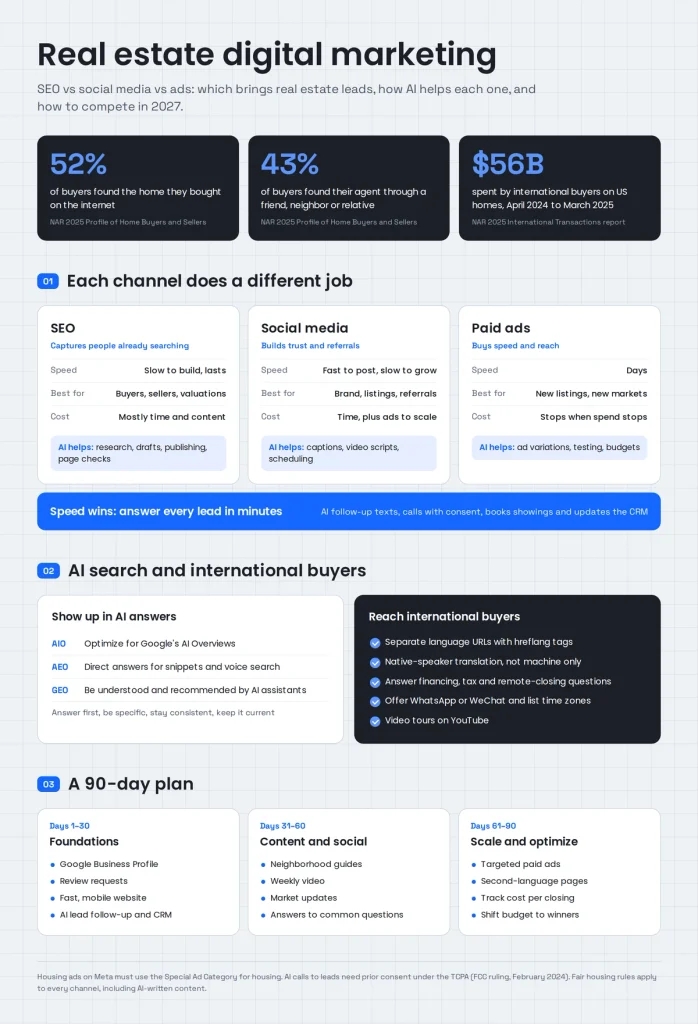
- Search finds the home, but trust often chooses the agent: 52% of buyers found their home online, while 43% found their agent through a friend, neighbor or relative (NAR 2025).
- SEO brings people who are actively searching; social media builds the reputation behind referrals.
- Paid ads are fastest but stop working the day you stop paying.
- AI search tools now answer property and neighborhood questions directly, so clear, specific content matters more.
- International buyers spent $56 billion on US homes in a year; multilingual content can reach them.
- Most lost deals come from slow follow-up, not weak marketing. AI follow-up fixes that.
What is real estate digital marketing?
Real estate digital marketing is the use of online channels such as websites, search engines, social media, paid ads, email and AI tools to attract and convert property buyers, sellers, renters and investors. It covers both getting found and following up quickly, so leads become appointments and closings.
The reason it matters: according to the National Association of Realtors’ 2025 Profile of Home Buyers and Sellers, 52% of buyers found the home they purchased on the internet, and half of repeat buyers started their search by looking at properties online. Yet 88% still bought through an agent, so the goal of digital marketing is to make sure buyers find and choose you.
What’s the difference between digital marketing, SEO and social media marketing?
Digital marketing is the umbrella for all online marketing. SEO is one part of it: improving your website and listings so they appear in search engines and AI answers without paying per click. Social media marketing is another part: building an audience and trust on platforms like Facebook, Instagram, TikTok, YouTube and LinkedIn.
| Digital marketing | SEO | Social media marketing | |
| What it is | All online marketing combined | Ranking in search and AI answers | Content and ads on social platforms |
| Includes | SEO, social, ads, email, website, AI | Website, Google Business Profile, content, links | Posts, video, community, social ads |
| Who it reaches | Everyone you target | People actively searching | People scrolling, often not yet searching |
| Speed | Varies by channel | Slow to build, long-lasting | Fast to post, slow to build an audience |
| Cost model | Mix of time and spend | Mostly time and content | Time, plus ad spend to scale |
| Best at | Coordinating everything | Capturing high-intent buyers and sellers | Building trust, referrals and brand |
Think of it this way: SEO is how people find you when they’re ready, social media is how they remember you before they’re ready, and digital marketing is the plan that connects both.
Which is best for real estate lead generation?
For real estate lead generation, SEO and local search usually produce the highest-intent leads over time, social media builds the trust and referrals that most agents depend on, and paid ads deliver leads fastest. The best results come from combining them, with instant follow-up so no lead is wasted.
NAR’s data shows why a mix wins. Buyers find homes online, but 43% of buyers found their agent through a friend, neighbor or relative. Search brings the person looking at a listing; social media and reputation make sure your name is the one their friends recommend.
Best channel by goal
| Your goal | Best channel | Why |
| Buyers searching specific neighborhoods | SEO and local search | They’re actively looking and ready to talk |
| Seller leads (home valuations) | SEO plus paid search | Sellers search “what’s my home worth” |
| Brand and referrals | Social media | Keeps you top of mind with your network |
| Fast leads for a new listing | Paid social and paid search | Immediate reach |
| Luxury and investor clients | LinkedIn, YouTube, SEO | Longer research and higher trust needs |
| International buyers | Multilingual SEO and YouTube | They research from abroad, often for months |
| Renters | Listing portals, paid search, social | High volume, short decision cycles |
How does SEO work for real estate?
Real estate SEO is the work of making your website, listings and Google Business Profile appear when people search for homes, neighborhoods, agents or valuations in your area. It focuses on local search, neighborhood pages, helpful guides, fast listing pages and reviews, so you attract buyers and sellers who are already looking.
Local SEO and Google Business Profile
Your Google Business Profile decides how you appear in Google Maps and local results.
- Choose “Real estate agency” or “Real estate agent” as the primary category.
- List the areas you serve, your hours, services and a booking link.
- Post new listings, sold homes and market updates weekly.
- Ask every client for a review after closing, and reply to all of them.
- Keep your name, address and phone number identical everywhere online.
Neighborhood and listing pages
Portals like Zillow and Realtor.com dominate searches for individual listings, so your best opportunity is neighborhood and local-expert content they can’t match:
- Neighborhood guides with schools, commute times, price trends, amenities and your own photos.
- Market updates for each area you serve, refreshed monthly.
- Buyer and seller guides for your city, such as closing costs or the selling process.
- Answers to real questions from your clients, like “Is it a good time to sell in Round Rock?”
Technical SEO for listing sites
Listing sites have many pages that change often, which creates technical problems:
- Make listing pages fast on phones, with compressed photos.
- Use clean, descriptive URLs and avoid thousands of near-duplicate filter pages.
- Handle sold and expired listings properly instead of leaving broken pages.
- Add structured data, such as RealEstateAgent and LocalBusiness schema.
- Submit an up-to-date sitemap in Google Search Console.
If you’d rather not write and publish neighborhood content by hand, our SEO tool, Zonified Rank, plans, drafts, publishes and tracks content, with an optional approval step before anything goes live.
How do AI Overviews and AI assistants change real estate SEO?
AI Overviews in Google and assistants like ChatGPT, Gemini and Perplexity now answer many real estate questions directly, such as neighborhood comparisons or buying steps. To appear in those answers, publish clear, specific, up-to-date content, keep your business details consistent, earn reviews and local mentions, and use structured data.
Three related terms describe this work:
- AIO (AI Overviews optimization): shaping content so Google’s AI Overviews can pull and cite it.
- AEO (answer engine optimization): writing direct answers to questions for featured snippets, voice search and AI answers.
- GEO (generative engine optimization): making your brand and content easy for AI assistants to understand, trust and recommend.
What works in practice:
- Answer questions in the first two sentences under each heading, then add detail.
- Be specific: name neighborhoods, price ranges, school districts and timelines.
- Show real experience: your own photos, sold examples and local observations.
- Stay consistent across your website, Google Business Profile, Zillow profile and social accounts.
- Earn mentions from local news, chambers of commerce and community sites.
- Keep it current. Out-of-date market data gets ignored.
How does international SEO help reach foreign buyers?
International SEO helps agents reach buyers in other countries by publishing content in their language, using hreflang tags so search engines show the right version, and answering questions foreign buyers have about financing, taxes and remote buying. It matters most in markets popular with international buyers.
The opportunity is real. According to NAR’s 2025 International Transactions report, international buyers purchased $56 billion of existing US homes (78,100 properties) between April 2024 and March 2025, up 33.2%. The top countries of origin were China, Canada, Mexico, India and the United Kingdom, and the top destinations were Florida, California, Texas, New York and Arizona.
How to set up international SEO
- Pick languages by your market. Spanish and Mandarin for many US markets; Hindi, Portuguese or others where your buyers come from.
- Use separate URLs per language, such as /es/ and /zh/, with hreflang tags linking the versions.
- Translate with a native speaker, not machine translation alone, and adapt the content, not just the words.
- Answer foreign buyers’ questions: financing as a non-resident, closing remotely, taxes and property management.
- Show prices and sizes clearly: US dollars with context, and square feet with square meters where useful.
- Offer the contact channels they use, such as WhatsApp or WeChat, and say which time zones you cover.
- Use YouTube. Video tours and neighborhood walk-throughs help buyers who can’t visit.
Our mobile app development team can build multilingual property apps and portals for brokerages and developers selling to buyers abroad.
How does social media marketing generate real estate leads?
Social media marketing generates real estate leads by keeping you visible and trusted with your network, showing your local expertise through video and stories, and turning followers into referrals and direct inquiries. It works best for brand, referrals and listings, while paid social adds reach when you need it fast.
Which platform does what:
| Platform | Best for | Content that works |
| Local community, referrals, paid lead ads | Listings, sold stories, local events, groups | |
| Brand, listings, lifestyle | Reels of homes and neighborhoods, behind-the-scenes | |
| TikTok | Reaching younger buyers | Short tours, market explainers, first-time buyer tips |
| YouTube | Search on video, international buyers | Full tours, neighborhood guides, market updates |
| Luxury, commercial, investors, relocation | Market insight, investment analysis, relocation guides |
Practical rules: post consistently, show your face and real homes, answer comments and messages quickly, and always give viewers a next step, such as a link to a neighborhood guide or a showing request.
Where do paid ads fit?
Paid ads fit when you need leads quickly, such as for a new listing, a slow season or a new market. Google Ads reach people actively searching, while social ads reach people who aren’t searching yet. Ads deliver results within days, but leads stop when spending stops, so pair them with SEO and strong follow-up.
- Google Search ads: high-intent searches like “homes for sale in [area]” or “sell my house fast”.
- Local Services Ads: appear at the top of Google with a “Google Screened” badge where available.
- Meta (Facebook and Instagram) ads: listing promotion, home valuation offers and retargeting.
- YouTube ads: video tours for luxury and international audiences.
Housing ads have special rules. On Meta, real estate ads must run under the Special Ad Category for housing, which limits targeting by age, gender and ZIP code. Google’s personalized advertising policy restricts similar targeting for housing ads in the US and Canada. Plan audiences around interests, location radius and your own website visitors instead.
How do you use AI across real estate marketing?
AI helps real estate marketing by drafting listing descriptions and posts, planning and writing SEO content, creating video scripts, translating content for international buyers, analyzing which channels bring clients, and, most importantly, responding to every lead within minutes. A person should still review content and handle advice and negotiation.
| Channel | How AI helps | What stays human |
| SEO | Keyword and question research, content drafts, publishing, page checks | Local insight, accuracy, final approval |
| AI search (AIO and GEO) | Structuring answers, checking consistency across profiles | Real experience and opinions |
| Social media | Captions, video scripts, scheduling, reply suggestions | Your face, voice and stories |
| Paid ads | Ad variations, budget suggestions, audience testing | Strategy and compliance review |
| International | Draft translations and localized FAQs | Native-speaker review |
| Lead follow-up | Instant texts and calls, qualification, booking, CRM logging | Advice, pricing and negotiation |
| Reporting | Summaries of sources, costs and results | Budget decisions |
The biggest AI win isn’t content. It’s speed. You can create great marketing and still lose the lead if nobody replies for hours.
Why do real estate leads go to waste, and how does AI fix it?
Real estate leads go to waste when nobody replies quickly, calls go unanswered after hours, follow-up stops too early and details never reach the CRM. AI fixes this by responding within minutes by text or phone, qualifying the lead, booking a showing on the agent’s calendar and logging everything automatically.
This is what our own product, Zonified Connect, does. Voice and SMS agents connect to HubSpot, Google and Outlook calendars, Vapi and Twilio, contact each new lead on the business’s own sequence, log every conversation and book an appointment only after the lead confirms a time. The moment a person takes over, the automation steps back.
For calls, AI voice agents can answer when your team is in showings or off for the night, then pass a summary to the right agent.
What rules apply to real estate marketing?
Real estate marketing must follow fair housing law, platform rules for housing ads, consent rules for calls and texts, and honest advertising standards. AI-written ads and chatbots are covered by the same rules as anything a person writes.
- Fair housing. Don’t target, describe or steer by protected characteristics. Review AI-written copy for language that implies a preferred buyer.
- Housing ad categories. Use Meta’s Special Ad Category and follow Google’s housing ad policies.
- Calls and texts. In February 2024, the FCC ruled that AI-generated voices count as artificial voices under the TCPA, so AI calls need prior consent.
- Email. Follow CAN-SPAM: identify yourself, include your address and offer an unsubscribe link.
- Accuracy. Listing details, prices and claims must be correct and current.
Have your broker or legal counsel review your setup before launching AI calls or new ad campaigns.
How do you outcompete other agents in 2027?
To outcompete other agents in 2027, own your local area with genuinely useful neighborhood content, show up in AI answers as well as Google, build trust on social media, answer every lead within minutes, and measure which channels produce closings. Most competitors still do one or two of these well, so doing all five is a real advantage.
- Be the local expert online. Neighborhood guides and market updates for every area you serve.
- Be findable in AI answers. Clear answers, consistent details and fresh information.
- Be visible on social. Regular video showing real homes and real expertise.
- Be first to respond. AI follow-up within minutes, day and night.
- Be multilingual where it matters, especially in markets popular with international buyers.
- Know your numbers. Track cost per closing, not just cost per lead.
A 90-day real estate marketing plan
A 90-day real estate marketing plan sets up the foundations in month one, builds content and social presence in month two, and adds paid ads, international content and optimization in month three, with AI follow-up running from day one so every lead is answered.
| Period | Focus | Key actions |
| Days 1–30 | Foundations | Complete Google Business Profile, set up review requests, fix website speed, launch AI lead follow-up, connect CRM |
| Days 31–60 | Content and social | Publish neighborhood guides, start weekly video, post market updates, answer common questions |
| Days 61–90 | Scale and optimize | Add targeted paid ads, publish key pages in a second language if relevant, review which channels produce appointments |
How do you measure what’s working?
Measure real estate marketing by tracking leads, response time, appointments, signed clients and closings by channel, then cost per closing. Website traffic and followers are early signals, but the channel that produces closings at the lowest cost deserves more budget.
- Speed to lead: how fast every new lead gets a reply.
- Lead-to-appointment rate by channel.
- Appointments to signed clients.
- Closings and commission by channel.
- Cost per closing for paid channels.
- Search visibility: rankings, Google Business Profile views and mentions in AI answers.
Our data and analytics team builds dashboards that combine CRM, ads and website data so you can see this in one place.
Frequently asked questions
Which is best for real estate lead generation: SEO, social media or ads?
None is best on its own. SEO produces high-intent leads over time, social media builds trust and referrals, and paid ads deliver leads quickly. Most successful agents combine all three and use fast follow-up so every lead is answered within minutes.
What is the difference between SEO and social media marketing for real estate?
SEO helps you appear when people search for homes, neighborhoods or agents on Google and AI tools. Social media marketing builds an audience and trust on platforms like Facebook, Instagram and YouTube. SEO captures active searchers; social media reaches people before they start searching.
How is AI used in real estate marketing?
AI drafts listing descriptions, posts and SEO content, translates content for international buyers, suggests ad variations, analyzes results and responds to new leads within minutes by text or phone. People should still review content and handle advice, pricing and negotiation.
What is GEO in real estate marketing?
GEO, or generative engine optimization, is the work of making your brand and content easy for AI assistants like ChatGPT, Gemini and Perplexity to understand and recommend. It relies on clear answers, specific local detail, consistent business information, reviews and mentions on trusted sites.
How long does real estate SEO take to work?
Google Business Profile improvements and reviews can help within weeks. Ranking neighborhood and guide pages usually takes several months, and longer in competitive cities. Keep paid ads or social media running for leads while SEO builds.
Do real estate agents need international SEO?
Agents in markets popular with foreign buyers can benefit. International buyers purchased $56 billion of US homes in a year, mostly in Florida, California, Texas, New York and Arizona. Multilingual pages with hreflang tags and answers to foreign buyers’ questions help reach them.
Can AI respond to real estate leads automatically?
Yes. AI can text and, with consent, call new leads within minutes, ask qualifying questions, book showings on an agent’s calendar and log everything in the CRM. Agents then take over for advice and negotiation.
Is social media worth it for real estate agents?
Yes, mainly for trust and referrals. Many buyers find their agent through people they know (43% in NAR’s 2025 survey), and social media keeps you visible to your network between transactions. It works best with regular video, real homes and quick replies to messages.
Get found, then answer first
The agents who win in 2027 won’t just market more. They’ll be found in search and AI answers, trusted on social media, and the first to respond when a lead comes in.
Digitals cafe builds the tools behind that: Zonified Rank for SEO content, Zonified Connect for instant AI follow-up, voice agents, multilingual websites and apps, and reporting dashboards. Contact us to plan yours.