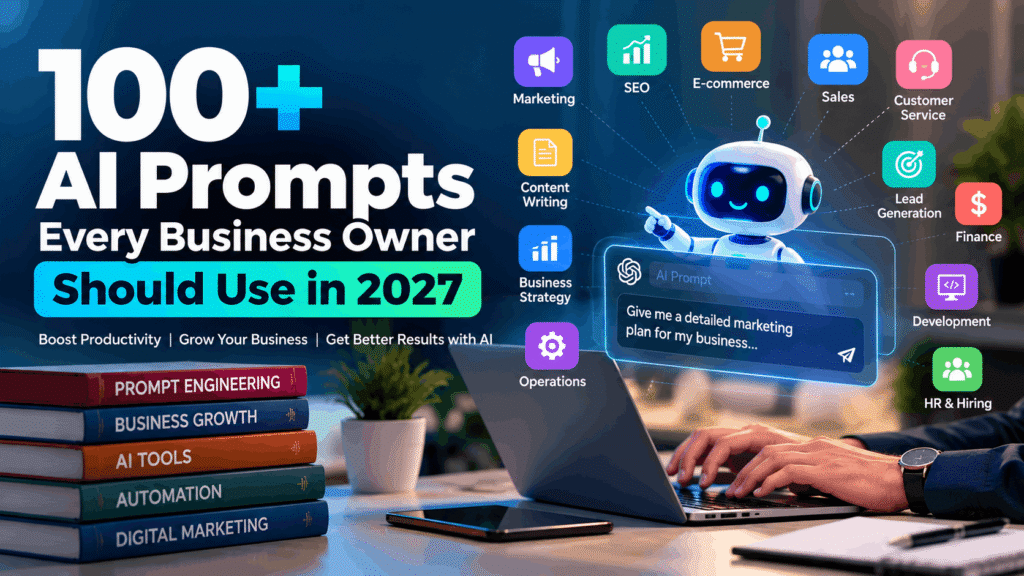
Learn how to communicate with AI more effectively, create better prompts, improve research, generate stronger content, automate business tasks and get more useful results from ChatGPT and other AI tools.
AI has changed how people search, write, research, analyse data and solve business problems. But there is an important difference between using AI and using AI effectively.
You can ask an AI tool:
“Give me a marketing strategy.”
You will probably receive an answer.
But if you provide your business model, target audience, location, competitors, budget, objective, limitations and expected output, you are much more likely to receive something that is actually useful.
That is the foundation of prompt engineering.
Prompt engineering is the process of designing and refining instructions so an AI model can better understand your objective and produce an output that meets your requirements. OpenAI describes prompting as providing input to a model and recommends clear instructions, relevant context and iterative refinement; Google Cloud similarly describes prompt engineering as designing prompts with context, instructions and examples to guide desired outputs.
For businesses, this matters because AI is increasingly being used for customer service, marketing, sales, research, operations, software development and decision support.
This guide explains what prompt engineering is, how it works, different prompting techniques, how to write better prompts, common mistakes, practical business examples and how to build reusable AI workflows.
What Is Prompt Engineering?
A prompt is the instruction, question, information or other input you provide to an AI system.
For example:
“Write a Facebook post about SEO.”
That is a prompt.
Prompt engineering goes one step further.
You deliberately structure the request to give the AI enough information to understand:
- What you want
- Why you want it
- Who it is for
- What information it should use
- What it should avoid
- What the final result should look like
For example:
“Act as a senior digital marketing strategist. I run a local dental clinic in Lahore targeting adults aged 25–55. Create 10 Facebook post ideas designed to generate appointment enquiries. Focus on common dental problems, trust and education. Keep each hook under 12 words and provide a short CTA for each post.”
The second prompt contains considerably more useful context.
That is prompt engineering in practice.
Why Does Prompt Engineering Matter?
A common misconception is that AI automatically understands exactly what you want.
It doesn’t.
AI can generate impressive responses, but the quality and usefulness of those responses depend partly on the instructions and context you provide.
OpenAI recommends making prompts clear and specific, providing necessary context, specifying the desired tone and refining the prompt based on the result.
Think about asking a human employee to complete a task.
If you say:
“Research our competitors.”
They may ask:
- Which competitors?
- Which market?
- What should I analyse?
- What period?
- What should the report contain?
AI has the same fundamental problem.
A vague request creates room for interpretation.
A well-designed prompt reduces unnecessary guessing.
Prompt Engineering Is Not Just About Writing Long Prompts
This is important.
Longer does not automatically mean better.
A 2,000-word prompt filled with unnecessary instructions can be worse than a short, precise prompt.
The goal is useful context, not maximum text.
A good prompt should provide the information the model actually needs.
For example:
Weak
Write an SEO strategy.
Better
Create an SEO strategy for a UK-based plumbing company targeting homeowners in London.
Stronger
Act as a senior local SEO strategist. Create a 90-day SEO strategy for a London-based plumbing company targeting homeowners searching for emergency plumbing, boiler repair and bathroom plumbing services. Prioritize commercial-intent keywords and local search visibility. Include technical SEO, service pages, Google Business Profile, reviews, local content, link building and measurement. Present the plan in a weekly action table.
The final version is not necessarily better because it is longer.
It is better because the requirements are clearer.
The Six Core Elements of a Good Prompt
A useful business prompt can usually be built around six elements.
1. Role
Tell the AI what perspective or expertise you want.
Examples:
Act as a senior SEO strategist.
Act as a B2B sales consultant.
Act as a UX researcher.
Act as a financial analyst.
The role gives the model a useful frame for the task.
2. Context
Tell AI what it needs to know about the situation.
For example:
I run a Shopify clothing store targeting women aged 25–40 in the UK.
Context can include:
- Industry
- Location
- Target audience
- Product
- Price
- Business size
- Existing performance
- Competitors
- Available resources
Without context, AI has to make assumptions.
3. Task
Clearly explain what you want done.
Instead of:
Help my business.
Say:
Identify five customer acquisition problems and provide a practical solution for each.
The task should be specific enough to produce an actionable output.
4. Constraints
Tell AI what it should or should not do.
Examples:
Keep the answer under 1,000 words.
Do not invent statistics.
Use simple English.
Don’t recommend tactics that violate Google’s guidelines.
Separate assumptions from verified information.
Boundaries are particularly useful for business work where accuracy matters. OpenAI’s small-business guidance recommends including boundaries such as flagging missing information or keeping content as a draft until reviewed.
5. Examples
Examples can teach AI what you mean.
This is known as few-shot prompting when you provide examples for the model to follow.
For example:
Here are two examples of our preferred social media captions:
Example 1:
Example 2:
Now create five new captions following the same structure without copying the wording.
Few-shot prompting can be particularly useful when the desired style or classification criteria are specific. IBM notes that a small set of examples can make outputs more consistent for specialized tasks.
6. Output Format
Tell AI what you want the result to look like.
For example:
Present the results in a table with these columns:
Keyword | Search Intent | Difficulty | Content Type | Priority
Or:
Give me:
- Hook
- Caption
- CTA
- Hashtags
This makes the output easier to use.
The Basic Prompt Formula
A simple reusable formula is:
Role + Context + Task + Requirements + Output
For example:
Role: Act as a senior digital marketing strategist.
Context: I own a local restaurant in Lahore targeting families aged 25–50.
Task: Create a 30-day customer acquisition strategy.
Requirements: Focus on Google, Instagram and Facebook. Monthly marketing budget is PKR 100,000.
Output: Present the strategy in a weekly table with activities, objectives, KPIs and estimated budget.
This structure can be adapted to almost any business task.
Zero-Shot Prompting
Zero-shot prompting means asking the model to perform a task without giving examples.
Example:
Create five customer personas for a premium skincare business.
This works well for familiar, relatively straightforward tasks.
Few-Shot Prompting
Few-shot prompting provides examples.
Example:
Here are three examples of our previous product descriptions:
[Example 1]
[Example 2]
[Example 3]
Create five new product descriptions following the same tone, structure and level of detail.
This can help when your brand has a specific style.
IBM identifies zero-shot and few-shot prompting as practical techniques for different types of tasks, with few-shot particularly useful when the model needs to follow specific examples or criteria.
Iterative Prompting
One of the most useful techniques is simply not accepting the first answer as final.
Instead:
Prompt 1
Create a marketing strategy.
Follow-up
Identify the weakest parts of this strategy.
Follow-up
Rewrite the strategy based on those weaknesses.
Follow-up
Now make the plan realistic for a small business with a PKR 100,000 monthly budget.
This creates a feedback loop.
OpenAI recommends iterative refinement: review the response, then adjust wording, context or requirements to improve the result.
Ask AI to Identify Missing Information
One of the most useful prompt improvements is asking AI what information it needs before completing a complex task.
Use:
“Before creating the strategy, identify up to five pieces of information that would materially improve your answer. Ask me only the most important questions.”
This prevents the model from filling important gaps with assumptions.
OpenAI’s small-business prompting guidance recommends asking for missing information when it would materially improve the result.
Use AI as a Research Assistant
Prompt engineering becomes especially useful for research.
Instead of:
Research my competitors.
Try:
Act as a market research analyst. I operate a digital marketing agency targeting small and medium-sized businesses. Analyze the following competitors: [list]. Compare their services, positioning, target audience, content strategy, SEO visibility, advertising approach, pricing signals and customer reviews. Separate observable facts from assumptions. Identify five market gaps that I should investigate further. Do not invent information that cannot be verified.
This is much more useful because the task has:
- A role
- Context
- Competitors
- Research criteria
- Output requirements
- Accuracy boundaries
Prompt Engineering for SEO
AI can support many SEO workflows.
Keyword Research Prompt
Act as an experienced SEO strategist. My business is [business]. My target market is [location]. Generate a keyword research framework covering informational, commercial, transactional and local search intent. Group related keywords into topical clusters and identify which topics should have service pages, supporting blogs and FAQs.
Search Intent Prompt
Analyze the search intent behind the keyword “[keyword]”. Classify it as informational, navigational, commercial investigation or transactional. Explain what the searcher is likely trying to accomplish and recommend the most appropriate content type.
Content Gap Prompt
Compare the following competitor topics with my existing content. Identify important topics, questions and subtopics that appear to be missing. Prioritize gaps based on commercial relevance and usefulness to the target audience.
Prompt Engineering for Social Media
Social media teams can use prompts for research, planning and content development.
Content Calendar Prompt
Act as a social media strategist. Create a 30-day content calendar for [business]. Target audience: [audience]. Platforms: Instagram, Facebook and LinkedIn. Include content format, hook, topic, key message, CTA and objective. Maintain a professional brand voice and avoid generic motivational content.
Reel Research Prompt
Identify 20 short-form video concepts for [business]. Focus on customer problems, frequently asked questions, myths, mistakes, comparisons and practical advice. For each concept provide a three-second hook, video structure and CTA.
Prompt Engineering for Digital Advertising
AI can help marketers analyse campaign data and generate hypotheses.
For example:
Act as a paid advertising strategist. Here is my campaign data: [data]. Analyze CTR, CPC, CPM, conversion rate and cost per lead. Identify possible performance problems and give me five tests to run next. Do not claim that a change will definitely improve performance; explain the hypothesis behind each test.
That final instruction matters.
AI should help generate hypotheses—not pretend to know the outcome before testing.
Prompt Engineering for Lead Generation
A lead-generation prompt could be:
Act as a B2B lead-generation strategist. My company provides [service] to [target customer]. Identify the five strongest customer pain points, buying triggers, common objections and reasons prospects delay purchasing. Then create a lead-generation funnel from awareness to consultation. Include content, advertising and follow-up activities.
Prompt Engineering for Sales
AI can also help sales teams prepare for conversations.
Act as a B2B sales coach. I am selling [service] to [customer type]. Create a discovery-call framework containing questions about current problems, existing solutions, budget, urgency, decision-makers and desired outcomes. Include possible objections and professional responses.
The salesperson should still use judgment rather than mechanically reading the script.
Prompt Engineering for Customer Service
Example:
Act as a customer support specialist. Rewrite the following response so it is professional, empathetic and solution-focused. Do not admit liability unless the facts provided establish it. Do not promise refunds, timelines or policies that are not included in the information.
Then provide the customer message.
This creates a useful boundary.
Prompt Engineering for E-Commerce
Product Description
Act as an e-commerce copywriter. Write a product description for [product]. Target customer: [audience]. Include the main benefits, features, use cases, common objections and CTA. Do not make claims that are not supported by the product information provided.
Prompt Engineering for Local Businesses
For a local business:
Act as a local SEO consultant. I operate a [business] in [city]. Identify the main local customer intents related to my services. Suggest service-page topics, local FAQ topics, Google Business Profile content ideas and conversion opportunities. Prioritize genuine relevance rather than keyword repetition.
Prompt Engineering for Business Strategy
A business owner can ask:
Act as a business strategy consultant. My company sells [product/service] to [audience] in [market]. Current monthly revenue is [amount], average order value is [amount], and our main acquisition channels are [channels]. Identify potential growth constraints and create three strategic scenarios: conservative, moderate and aggressive. Clearly state assumptions and identify information that needs validation.
This is far more useful than:
“How can I grow my business?”
Prompt Engineering for Competitor Research
Competitor research is another common AI use case.
A practical prompt:
Act as a competitive intelligence analyst. Analyze these competitors: [names/URLs/data]. Compare their positioning, products, services, pricing signals, customer complaints, content themes, social activity and differentiators. Separate direct observations from interpretation. Do not invent missing data. Finish with opportunities I should investigate rather than assuming they are guaranteed opportunities.
This distinction between evidence and interpretation is important.
Prompt Engineering for Customer Research
Use:
Analyze the following customer reviews: [reviews]. Identify recurring complaints, desired outcomes, buying objections, positive experiences, product gaps and language customers use to describe their problems. Group similar themes and provide examples from the supplied data.
This is particularly useful because customers often describe problems differently from how businesses describe them.
Prompt Engineering for Content Writing
Instead of:
Write a blog about SEO.
Use:
Act as an experienced SEO content strategist. Write a comprehensive guide about Local SEO for small businesses. Target business owners with limited SEO knowledge. Cover Google Business Profile, local keywords, reviews, citations, local landing pages, local content, links, measurement and common mistakes. Use simple English, practical examples and clear headings. Avoid unsupported ranking guarantees. End with FAQs and a relevant CTA.
Prompt Engineering for AI Research
If you’re researching a topic, tell AI how to handle evidence.
For example:
Research [topic] using current, reputable sources. Prioritize primary sources, official documentation, academic research and authoritative industry publications. Separate verified facts, expert opinions and assumptions. Include publication dates where relevant. If evidence is insufficient, say so rather than filling the gap.
This is particularly important when researching:
- Market trends
- Statistics
- Regulations
- Prices
- Technology
- Competitors
- Current events
AI-generated research should be checked before publication or important decisions.
Prompt Engineering for Data Analysis
You can give AI a dataset and ask it to identify patterns.
Example:
Analyze this sales dataset. Identify the strongest products, weakest products, month-over-month trends, unusual changes and potential relationships between product category and revenue. Explain your findings in plain English. Do not assume causation from correlation. List the calculations or additional data needed to validate important conclusions.
This helps prevent overconfident interpretation.
Prompt Engineering for Meetings
Before a meeting:
I have a meeting with [client/company] about [topic]. Based on the information below, prepare a meeting brief containing objectives, key questions, risks, likely objections, information we need and recommended next steps. Separate known facts from assumptions.
After a meeting:
Convert these meeting notes into decisions, action items, owners, deadlines, unresolved questions and follow-up points. Do not invent information.
Prompt Engineering for Daily Productivity
AI can become a daily work assistant.
Morning Planning
Here are today’s tasks: [tasks]. Help me prioritize them based on business impact, urgency and dependencies. Identify what can be delegated, automated or postponed.
End-of-Day Review
Review the following completed and unfinished tasks. Summarize progress, identify blockers and create tomorrow’s priority list.
Prompt Engineering for Business Automation
This is where prompting starts moving beyond content generation.
For example:
Analyze this customer support workflow. Identify repetitive steps, decision points, information that must be collected, tasks suitable for automation and tasks that should remain human-controlled. Then propose an AI-assisted workflow.
This can become the starting point for an automation project.
IBM’s current business-AI research notes that AI applications increasingly extend beyond routine automation into productivity, customer experience, operations and decision support.
Prompt Engineering for Software Development
Developers can use AI for:
- Code generation
- Debugging
- Documentation
- Test cases
- Refactoring
- API integration
- Architecture discussions
Example:
Act as a senior backend developer. Review the following API implementation. Identify security risks, performance issues, error-handling gaps and maintainability problems. Explain each issue and propose a corrected implementation. Do not change the API contract unless you explicitly identify why it is necessary.
Good prompts help developers communicate requirements and constraints more precisely.
But generated code should still be reviewed, tested and secured by qualified developers.
Prompt Engineering for UX/UI
Design teams can ask:
Act as a senior UX researcher. Analyze this checkout flow. Identify possible friction points, unclear interactions, accessibility concerns and opportunities to reduce abandonment. Prioritize findings by user impact and implementation effort.
You can then provide screenshots, user feedback or analytics.
This is particularly useful when combining AI with human design expertise.
Prompt Engineering for HR
Example:
Create a structured interview framework for a [job title]. Focus on skills, experience, problem-solving and role-specific scenarios. Include scoring criteria for each competency. Avoid questions that could introduce unnecessary bias or request protected personal information.
AI can assist with structure, but recruitment decisions should remain subject to appropriate human review.
Prompt Engineering for Finance
Example:
Act as a financial analysis assistant. Review the following revenue and expense data. Identify trends, unusual movements and areas that require investigation. Show calculations clearly. Do not provide regulated financial advice or make investment recommendations. Flag any missing data that could materially change the analysis.
Prompt Engineering for Restaurants
A restaurant owner could use:
Act as a restaurant growth consultant. My restaurant serves [cuisine] in [location]. Analyze our target customer groups, menu positioning, peak periods and marketing channels. Suggest a 90-day plan covering customer acquisition, repeat visits, social media, Google Business Profile and promotions. Prioritize measurable actions.
Prompt Engineering for Real Estate
Act as a real estate marketing strategist. I sell [property type] in [location]. Identify buyer personas, likely objections, search intent, content topics and lead-generation channels. Create a 30-day marketing plan focused on qualified enquiries rather than general reach.
Prompt Engineering for Healthcare
Healthcare requires additional caution.
A suitable prompt might be:
Summarize the following non-sensitive administrative information into a clear workflow for appointment management. Do not provide medical diagnosis or treatment recommendations. Identify any information that requires review by a qualified professional.
Sensitive patient information should not be entered into an AI system unless the organization’s approved system, privacy controls and applicable requirements permit it.
OpenAI’s small-business guidance specifically advises users to provide only the information required and keep passwords, payment details, confidential records and other secrets out of prompts.
Prompt Engineering for Education
Teachers and education businesses can use:
Create a lesson plan for [subject] and [age/level]. Include learning objectives, explanation, activity, practice exercise and assessment. Adapt the material for students with different levels of prior knowledge.
AI can assist educators, but teachers should review educational accuracy and suitability.
Prompt Engineering for Content Repurposing
One piece of content can become multiple assets.
Prompt:
Convert the following 1,500-word article into:
- 5 LinkedIn posts
- 5 Instagram carousel concepts
- 3 short video scripts
- 10 social media hooks
- 5 FAQ questions
- 1 email newsletter
Preserve the original factual claims and do not introduce new statistics.
This can dramatically reduce repetitive content-production work.
Prompt Engineering for Brand Voice
If your company has a specific tone, give AI examples.
Our brand voice is professional, direct, knowledgeable and approachable. Avoid exaggerated claims, excessive emojis and generic motivational language.
Then provide examples.
Ask:
Analyze these examples and identify the recurring characteristics of our brand voice. Create a five-point style guide that future content should follow.
Now your prompt becomes reusable.
A Powerful Meta-Prompt
A meta-prompt asks AI to help improve the prompt itself.
For example:
Act as a prompt engineering specialist. I will give you a rough task. First identify missing context, ambiguity and unnecessary requirements. Then rewrite my request into a clear production-ready prompt containing the objective, context, constraints and output format. If critical information is missing, ask me up to three questions before rewriting it.
This is useful when you know what you want but don’t know how to structure the request.
The Difference Between a Prompt and a Workflow
This distinction becomes important as businesses become more advanced.
Prompt
One instruction produces one result.
Workflow
Multiple AI steps work together.
For example:
Market Research
↓
Competitor Analysis
↓
Customer Pain Points
↓
Content Strategy
↓
Content Creation
↓
Review
↓
Publishing
A business can turn repeated prompts into a documented workflow.
That is much more valuable than maintaining a folder full of random prompts.
Prompt Libraries: Build Your Own
Instead of searching Google every time you need a prompt, create your own internal library.
Organize prompts by:
- Marketing
- SEO
- Sales
- Customer service
- HR
- Finance
- Operations
- Research
- Content
- Product
- Development
For every reusable prompt, save:
Prompt name
Purpose
Required inputs
Prompt
Expected output
Version
Last tested
Known limitations
For production AI systems, OpenAI recommends managing prompts in code, using typed inputs, tests and evaluation checks as prompts evolve.
How to Test Whether a Prompt Is Good
Don’t judge a prompt only because the output “looks good.”
Define success criteria.
For example:
Content prompt
Success means:
- Correct facts
- Correct tone
- Required keywords included
- Correct length
- Clear CTA
Research prompt
Success means:
- Relevant sources
- Evidence separated from assumptions
- No fabricated statistics
- Clear conclusions
Customer support prompt
Success means:
- Correct policy
- Professional tone
- No unsupported promises
- Appropriate escalation
This makes prompt engineering measurable.
Why AI Sometimes Gives Bad Answers
Even an excellent prompt cannot guarantee a correct answer.
Problems can come from:
- Missing information
- Ambiguous instructions
- Incorrect source material
- Model limitations
- Outdated information
- Conflicting requirements
- Poor examples
- Hallucinated information
IBM’s production prompt work highlights an important lesson: useful AI systems need explicit constraints, domain-specific context, structured outputs and mechanisms for handling uncertainty rather than simply trying to make the model sound helpful.
Don’t Tell AI to “Never Make Mistakes”
Instead of:
Never give me incorrect information.
Use:
If the information provided is insufficient to answer confidently, say what is missing. Do not invent facts. Separate verified information from assumptions.
That is a much more practical instruction.
Add a Human Review Step
For important business decisions, AI output should be treated as input to a decision, not automatically as the decision itself.
Before publishing or acting on important AI-generated material:
- Check important claims
- Verify numbers
- Review names and dates
- Check legal or policy statements
- Validate recommendations
- Confirm customer-facing information
OpenAI’s business guidance specifically recommends tracing important claims to sources, recalculating important numbers and keeping a person responsible for final decisions.
Common Prompt Engineering Mistakes
Mistake 1: Being Too Vague
❌ “Create a business plan.”
Better:
“Create a 12-month business plan for a Lahore-based B2B software company targeting SMEs.”
Mistake 2: No Context
AI doesn’t know your business unless you explain it.
Mistake 3: Too Many Objectives
Don’t ask AI to simultaneously:
- Research competitors
- Write a blog
- Create ads
- Analyse finances
- Build a strategy
Break complex work into logical stages when necessary.
Mistake 4: No Output Format
If you need a table, say so.
Mistake 5: No Constraints
Tell AI what to avoid.
Mistake 6: Trusting the First Answer
Review and refine.
Mistake 7: Asking for Fake Data
Never ask AI to invent reviews, statistics, customer experiences or research findings.
Is Prompt Engineering Still Important in 2027?
This is a question increasingly discussed in AI communities.
Some users report that newer models can understand relatively simple prompts better than earlier systems, leading to debate over whether elaborate prompt frameworks are always necessary.
That doesn’t mean prompt engineering has disappeared.
It means the skill is changing.
For simple tasks:
“Summarize this article in five bullet points.”
may be enough.
For complex business work:
“Analyze our customer data, identify churn patterns, compare three strategic options, state assumptions, calculate the relevant metrics and produce an executive summary.”
still benefits from careful instruction and structured inputs.
The future is therefore less about memorizing complicated prompt formulas and more about clear communication, context design, evaluation and workflow design.
IBM’s current guide similarly points toward broader context engineering, structured inputs and retrieval-based approaches as prompting becomes part of larger AI systems.
Prompt Engineering vs Context Engineering
Prompt engineering focuses primarily on the instructions you give the model.
Context engineering goes broader.
It asks:
What information should the AI have available when it performs the task?
For example, a customer-support AI may need:
- Product documentation
- Pricing
- Refund policy
- Customer history
- Current order information
The prompt alone isn’t enough.
The system needs the right context.
This distinction becomes increasingly important when businesses build AI assistants, chatbots and automated workflows.
Prompt Engineering and AI Agents
AI systems are also moving toward more agentic workflows.
Instead of:
Question → Answer
you may have:
Goal → Research → Analysis → Tool use → Decision → Action → Verification
For example:
A sales AI agent might:
- Receive a lead.
- Analyze the lead.
- Check CRM information.
- Identify the customer’s industry.
- Prepare a personalized message.
- Request human approval.
- Record the activity.
The prompt becomes only one component of the larger system.
IBM’s current AI guidance notes the growing use of agentic AI for accomplishing goals and handling more complex business tasks with limited supervision.
The Future of Prompt Engineering
Prompt engineering is likely to become less about writing “magic prompts” and more about:
- Clear instructions
- Structured context
- Reusable templates
- Examples
- Evaluation
- Guardrails
- Workflow design
- Human oversight
- AI agents
- Business process integration
In other words:
Good prompting is becoming good AI system design.
Frequently Asked Questions About Prompt Engineering
What is prompt engineering?
Prompt engineering is the process of designing and refining instructions for AI models to produce more relevant, useful and reliable outputs.
Is prompt engineering difficult?
The fundamentals are relatively accessible. The difficulty increases when prompts are used for complex business workflows, applications or production AI systems.
What makes a good AI prompt?
A good prompt clearly communicates the objective, provides relevant context, defines requirements and specifies the desired output.
Should prompts always be long?
No. A prompt should be as detailed as necessary, not as long as possible.
What is few-shot prompting?
Few-shot prompting gives an AI model a small number of examples so it can better understand the desired pattern or criteria.
What is zero-shot prompting?
Zero-shot prompting asks an AI model to perform a task without providing examples.
Can prompt engineering improve ChatGPT results?
Clear instructions and relevant context can make AI outputs more aligned with your requirements. OpenAI recommends clear, specific prompts and iterative refinement.
Can prompt engineering be used for SEO?
Yes. It can assist with keyword research, search-intent analysis, content planning, content briefs, competitor research and internal-linking strategy.
Can businesses use prompt engineering?
Yes. Businesses can use structured prompts for marketing, sales, research, customer service, operations, content, data analysis and other workflows.
Can prompt engineering replace employees?
Prompt engineering is a method for interacting with AI. It does not automatically replace human roles. Businesses still need people to provide expertise, review outputs and make decisions.
Can AI prompts contain confidential business information?
Businesses should follow their organization’s privacy and security requirements and use only approved AI systems for sensitive information. Avoid putting passwords, payment information, confidential records or unnecessary personal information into prompts.
What is a meta-prompt?
A meta-prompt is an instruction that asks AI to create, analyze or improve another prompt.
What is prompt optimization?
Prompt optimization involves testing and refining prompts to improve output quality, consistency or efficiency.
Is prompt engineering still relevant?
Yes, particularly for complex tasks and AI systems. However, modern AI models can often handle simpler instructions without elaborate prompt structures. The important skill is knowing how much context and structure a task actually requires.
What is context engineering?
Context engineering focuses on designing the information and context available to an AI model so it can perform a task effectively. It extends beyond the wording of a single prompt.
How Digital’s Cafe Can Help Businesses With AI
Prompt engineering is only the starting point.
The real opportunity comes when businesses connect AI with their existing workflows.
Digital’s Cafe provides AI & Automation solutions including AI chatbots, automation systems and data tools designed to streamline business operations. (Digitals Cafe)
The practical process can be:
Identify the business problem
↓
Find repetitive or inefficient processes
↓
Determine where AI can help
↓
Design prompts and workflows
↓
Integrate appropriate AI tools
↓
Test the system
↓
Measure the result
↓
Improve the workflow
This approach is more valuable than simply giving employees a list of 100 generic ChatGPT prompts.
Final Thoughts
Prompt engineering is not about discovering a secret phrase that makes AI perfect.
It is about communicating clearly with an AI system.
The strongest prompts usually answer a few basic questions:
What do I want?
Why do I want it?
What does AI need to know?
What should it avoid?
What should the final result look like?
Once you understand those principles, you can apply them to almost any business function.
You can use AI to research competitors, analyze customer feedback, develop marketing campaigns, plan SEO content, prepare sales scripts, improve customer service, analyse data and identify automation opportunities.
But the biggest opportunity isn’t simply generating more AI content.
It is building repeatable AI-assisted business processes.
A good prompt produces a useful answer.
A good workflow turns that answer into business value.
And a well-designed AI system can turn that workflow into a repeatable capability.
That is where prompt engineering becomes more than a productivity trick—it becomes part of modern digital business strategy.
- AI for Business → your existing AI business-growth article AI and Business: Complete Guide
- AI & Automation Services → your AI/automation service page Digital’s Cafe Services