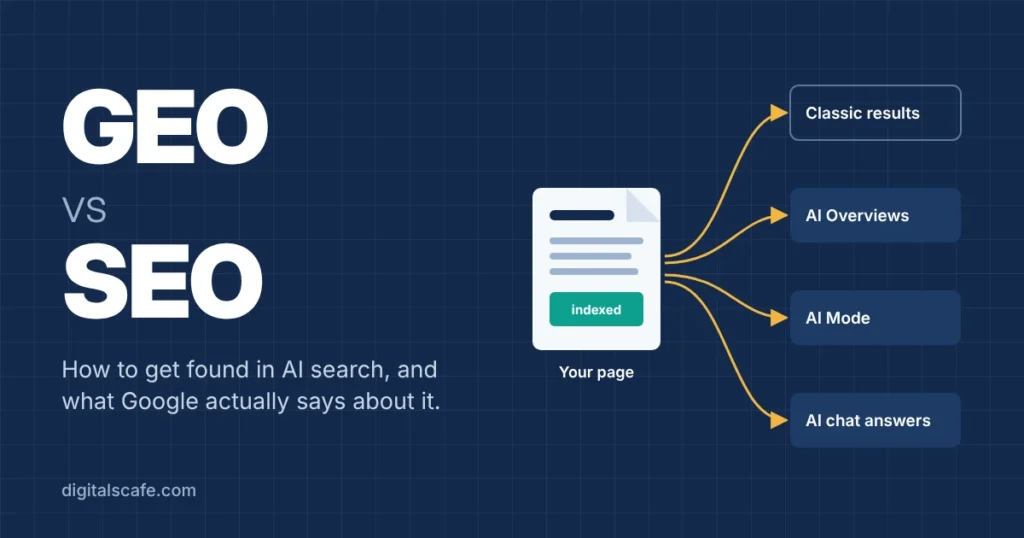
GEO vs SEO: How to Get Found in AI Search (and What Google Actually Says)
Quick answer: For Google, GEO is not a separate discipline. Google’s own guidance says optimizing for AI Overviews and AI Mode is still SEO, because those features pull their sources from the same search index and ranking systems. What gets you cited is what has always worked: crawlable pages, a clear structure, and content with a genuine point of view that nobody else has published. Other AI tools add one extra job: making sure their crawlers can reach your site.
If you’ve been told you need a brand-new “GEO strategy” on top of your SEO, read this first. The truth is simpler, and it saves you from paying twice for the same work.
What changed: Google’s official word on GEO vs SEO
For two years, marketers have argued about whether AI search needs its own playbook. New acronyms appeared every few months, each with a new service package attached.
Then Google settled it, at least for its own search engine. In its official guide to optimizing for generative AI search, last updated in July 2026, Google addresses “AEO” and “GEO” directly. From Google Search’s perspective, optimizing for generative AI search is optimizing for search, so it is still SEO.
The same guide lists popular AI-search tactics that Google Search ignores, and recommends checking any third-party “AEO” or “GEO” advice against Google’s own guidance on evaluating SEO advice.
That doesn’t mean nothing has changed. How people search has changed a lot. They ask longer questions, follow up, and often get a summarized answer before they ever see a link. Which pages get cited inside those answers matters more than ever. But the route to being cited runs through the same foundations as classic SEO.
How AI search actually picks its sources
Once you understand the mechanics, most of the GEO mystery goes away. Google describes two techniques behind AI Overviews and AI Mode.
Retrieval-augmented generation (also called grounding). The AI doesn’t answer from memory alone. It retrieves relevant, current pages from Google’s search index using the same core ranking systems, reads the specific information on them, writes a response, and shows links to the pages that support it. If your page isn’t indexed and ranking for the topic, it isn’t in the pool the AI picks from.
Query fan-out. For one question, the AI runs several related searches in parallel. Ask “how do I get more leads from my website?” and it might also search for landing page conversion tips, lead magnet ideas and contact form best practices, then build one answer from the best pages across all of them.
Two practical consequences follow:
- You can be cited for questions you never targeted. A strong page on contact form design can appear inside an answer about lead generation, because fan-out found it.
- Depth across a topic beats one page per keyword. A site that covers a subject thoroughly gets more chances to be picked across the fan-out searches than a site with one thin page.
There are also two hard requirements. A page must be indexed and eligible to show in Google Search with a snippet. Google’s guide also says a site must be included in Search’s generative AI features in Search Console to be eligible, so check that setting once.
AIO, AEO, GEO and SEO: what each term means
The acronyms overlap, which is half the confusion. Here’s how they’re generally used:
| Term | Stands for | What people usually mean |
| SEO | Search engine optimization | Earning visibility in search results, now including AI features |
| AIO | AI Overviews optimization (sometimes “AI optimization”) | Getting your pages cited in Google’s AI Overviews |
| AEO | Answer engine optimization | Structuring content so it directly answers questions in any answer-style result |
| GEO | Generative engine optimization | Getting your brand cited or recommended in AI-generated answers across tools |
In practice they describe one goal, being the source an AI trusts enough to cite, seen from slightly different angles. For Google, all four come down to SEO done properly. For tools like ChatGPT and Perplexity, a few extra steps apply, and they’re covered below.
What actually gets you into AI answers
Strip away the acronyms and five things decide whether AI search cites you.
1. Write what nobody else can write
This is the big one. Google’s guide says content that is unique, useful and compelling will likely shape your presence in AI search more than any other factor.
Google separates commodity content from non-commodity content. Commodity content is common knowledge anyone could write, the kind of generic tips list that already exists a thousand times. Non-commodity content comes from experience: what you tried, what happened, what you’d do differently.
In marketing terms, “10 ways to improve your SEO” is commodity. “What happened to our leads when we cut a client’s blog from 120 posts to 40” is not. An AI that has already read a hundred tips lists has no reason to cite the hundred-and-first. It does have a reason to cite the one page that shows real results.
Before you publish, ask: what does this page say that an AI couldn’t produce from what’s already online? If the honest answer is “nothing,” add your own data, a client story, a screenshot or a clear opinion.
2. Make sure your pages can be found at all
AI features draw from the search index, so technical basics are the entry ticket:
- Allow crawling. Check that robots.txt, your firewall and your CDN aren’t blocking search crawlers. This is the most common silent failure.
- Get indexed. Use Search Console’s URL Inspection tool on key pages.
- Link pages together. Internal links help crawlers find content and show how topics connect, which matters for fan-out searches.
- Keep key content in text. Answers trapped inside images, PDFs or tabs that load on click are harder to use.
- Give visitors a good experience. Fast, mobile-friendly pages where the main content is easy to spot.
- Reduce duplicates. Near-identical pages waste crawling and split your signals.
3. Organize for people, which also helps machines
Use clear headings, short paragraphs and direct answers near the top of each section. Not because AI needs content cut into tiny pieces (Google says it doesn’t), but because people skim, and a page people can follow is a page AI can follow too.
4. Add images and video that earn their place
AI results can show images and video alongside text, which gives you more ways in. Original visuals work best: annotated screenshots, charts from your own data, short explainer videos. Stock photos add nothing.
5. Keep your business information current
When someone asks an AI about a business, it often draws on official listings. Keep your Google Business Profile complete and accurate, make your name, contact details and services consistent everywhere, and earn genuine reviews and mentions. Google is clear that manufactured mentions don’t help.
GEO tactics you can safely ignore
A lot of GEO advice is noise, at least for Google. According to Google’s guide, these don’t help your Google visibility:
| Tactic | What Google says |
| Creating an llms.txt file | Google Search doesn’t use it. It won’t hurt, and other tools may read it, but it does nothing for Google rankings or AI Overviews. |
| “Chunking” content into tiny sections | Not required. Google’s systems can understand multiple topics on one page. There’s no ideal page length. |
| Rewriting pages “for AI” | Not needed. AI understands synonyms and meaning, so you don’t need every keyword variation. |
| Seeking inauthentic mentions | Unhelpful. Ranking systems reward quality, and spam systems filter manipulation. |
| Special schema for AI | There isn’t any. Structured data is still useful for rich results, but no markup unlocks AI features. |
| One page per fan-out query | Risky. Mass-producing pages for every query variation can break Google’s scaled content abuse policy. |
If someone sells you a GEO package built on these tactics, you’re paying for work Google says it ignores.
Beyond Google: ChatGPT, Perplexity and other AI tools
Google’s guidance covers Google only. Other AI assistants run their own crawlers and their own ways of choosing sources, so there’s a little extra work:
- Check which AI crawlers you allow. Most AI companies publish separate crawlers for model training and for live search answers. Blocking the search ones means those tools can’t read your pages when a user asks about your topic. Review your robots.txt line by line against each provider’s published crawler list, and decide deliberately.
- Don’t forget Bing. Microsoft’s Copilot draws on Bing’s search index, so verify your site in Bing Webmaster Tools and submit your sitemap there too.
- Keep llms.txt if you want it. Some AI tools may read it. Just don’t expect it to move Google.
- Be the brand people talk about. AI assistants often reflect what’s said about a business across reviews, forums, videos and industry articles. Real customer reviews and genuine coverage carry over to these tools in a way no markup can.
The good news: every step that helps Google, such as strong content, clean technical setup and accurate business information, helps these tools too.
How to measure your AI search visibility
You can’t improve what you can’t see. Here’s what to track:
- Search Console’s Generative AI performance report. Google now reports how your content performs in its generative AI features. Start here.
- Overall search traffic. Clicks from AI Overviews and AI Mode are included in Search Console’s standard Performance report under the “Web” search type.
- Conversions, not just clicks. Google says clicks from pages with AI Overviews tend to be higher quality, with visitors staying longer. Track leads and sales in your analytics so you see the value, not just the volume.
- Manual spot checks. Each month, ask ChatGPT, Perplexity and Google’s AI Mode the questions your buyers ask. Note whether you’re cited, who is cited instead, and what those pages do better.
Be wary of any tool that claims to see “inside” Google’s AI rankings. Google says no third-party tool has access to its internal ranking or AI systems.
International SEO in the age of AI search
AI search makes international SEO more important, not less. When someone asks a question in Spanish, German or Arabic, the AI looks for sources that answer in that language and fit that market. A strong English page may not be enough to be cited there.
Give each language its own URL
Search engines need a separate, crawlable URL for each language or regional version. Avoid switching content on one URL based on the visitor’s location. Pick one structure and stay consistent:
| Structure | Example | Good for | Trade-off |
| Subfolders | example.com/es/ | Most businesses; builds on one domain’s authority | Weaker local signal than a country domain |
| Country domains | example.es | Strong local signal for a single country | Each domain builds authority separately |
| Subdomains | es.example.com | Teams that need separate hosting | Often treated more like a separate site |
Connect versions with hreflang
Use hreflang tags to tell search engines which page serves which language or region. Each version should list every other version and itself, and an x-default should point to your fallback page. Rank Math and most multilingual plugins can generate these, but check them, because one missing return link breaks the pair.
Don’t redirect visitors by location
Forcing visitors to a version based on their IP address frustrates travelers and can hide pages from crawlers, which often crawl from a single country. Show a banner suggesting the local version instead, and let people choose.
Localize, don’t just translate
Machine-translated pages are the definition of commodity content. Localize what matters to buyers in each market: currencies, prices, local examples, regulations, case studies and contact options. A page that clearly understands its market is far more likely to be cited by an AI answering a local question.
Build local trust signals in every market
Where you have a real presence, keep a business listing for that location, collect reviews from local customers, and earn mentions in local publications. AI answers about “the best agency in [city]” lean heavily on these signals.
Common mistakes that keep businesses out of AI answers
Most sites that never appear in AI answers aren’t being punished. They’re tripping over avoidable problems, and the same ones come up again and again:
- Blocking crawlers by accident. A security plugin, a CDN setting or an old robots.txt rule quietly shuts out search or AI crawlers. Everything else in this guide depends on fixing this first.
- Publishing the post everyone else published. A “top 10 tips” article written from other top-10 articles gives an AI nothing new to cite.
- Hiding your expertise. Posts with no named author, no experience and no examples look interchangeable. Put a real person’s name on your content and show what they’ve actually done.
- Service pages with no substance. A page that only says “we offer SEO services” can’t answer anyone’s question. Explain how you work, what’s included and who it suits.
- Inconsistent business details. Different names, phone numbers or addresses across the web make it harder for search engines to connect mentions back to you.
- Chasing every new acronym. Rebuilding your site for each new trend burns time that would be better spent improving your best pages.
Fix these before anything else. They cost little, and they remove the most common reasons a good business stays invisible.
A 30-day plan to improve your AI visibility
You don’t need a new strategy. You need the existing one done well, in the right order.
| Week | Focus | Actions |
| 1 | Access | Check robots.txt and firewall rules for search and AI crawlers; confirm key pages are indexed; check the generative AI setting in Search Console; verify the site in Bing Webmaster Tools |
| 2 | Content | Pick your three most important service or guide pages. Add first-hand detail to each: real numbers, a client story, a screenshot, a clear opinion |
| 3 | Trust | Update your Google Business Profile, make business details consistent everywhere, and ask recent happy clients for reviews |
| 4 | Measure and expand | Open the Generative AI performance report, run your manual AI checks, and plan your next language version if you serve other markets |
Then repeat the content step every month. AI visibility builds on a library of genuinely useful pages, not on one clever trick.
Frequently asked questions
Is GEO different from SEO?
For Google, no. Google’s official guidance says optimizing for its generative AI features is still SEO, because those features draw on its core search index and ranking systems. For other AI tools, a few extra steps apply, mainly allowing their crawlers and building genuine brand mentions.
Do I need an llms.txt file to appear in AI search?
Not for Google. Google Search doesn’t use llms.txt, and having one neither helps nor hurts there. Some other AI tools may read it, so it’s optional.
How do I get my website into Google AI Overviews?
Make sure the page is indexed and eligible to show with a snippet, check the generative AI setting in Search Console, and publish content with original insight that answers the question well. There is no special markup or file required.
How do I get cited by ChatGPT or Perplexity?
Allow their search crawlers in robots.txt, keep your content crawlable in plain text, and build genuine mentions through reviews, coverage and community discussion. Strong pages that rank well in search tend to get picked up across AI tools.
Does schema markup help with AI search?
Not directly. Google says no special structured data is needed for its AI features. Schema is still worth using because it helps with rich results, and it must always match what’s visible on the page.
Will AI search reduce my website traffic?
It changes the mix. Some simple questions get answered without a click, but Google reports that clicks from results with AI Overviews tend to be higher quality. Track leads and conversions, not only sessions.
How long does it take to show up in AI answers?
As long as it takes to be indexed and trusted for the topic. Technical fixes can help within weeks once pages are recrawled. Building the depth of content and reputation that earns regular citations takes months.
Does international SEO matter for AI search?
Yes. AI tools answer in the user’s language and favor sources that fit their market. Separate URLs per language, correct hreflang and properly localized content give you a chance to be cited outside your home market.
Should I hire a GEO agency?
Hire for good SEO that covers AI search, not for a separate GEO package. Be cautious of anyone promising guaranteed AI citations or claiming access to Google’s internal AI systems. Google says no third-party tool has that access.
Get found where your buyers now search
AI search hasn’t replaced SEO. It has raised the bar for it. The businesses being cited are the ones with crawlable sites, genuinely useful pages and a reputation people actually talk about.
If you’d like a clear view of where your site stands in classic and AI search, Digitals Cafe can audit it and show you what to fix first.
Explore our SEO services · Get in touch
Related reading: Local SEO guide · Digital marketing services · AI automation services