Digital Marketing vs Social Media Marketing vs SEO
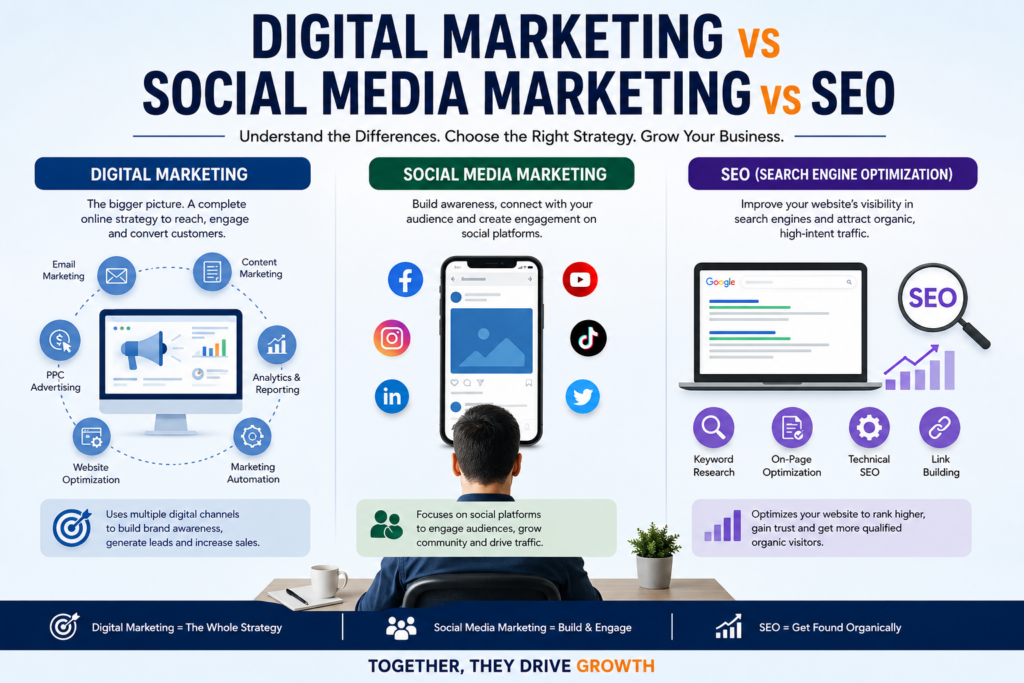
Digital marketing, social media marketing and SEO are often discussed as though they are the same service. They are closely connected, but each plays a different role in helping a business attract customers, build trust and generate revenue.
This distinction matters when you are hiring a digital marketing agency, planning your company’s marketing budget or preparing for a digital marketing interview. A business may need greater visibility on Google, stronger engagement on social media or a complete strategy combining multiple digital channels. Selecting the wrong service can lead to increased activity without a meaningful improvement in qualified leads.
This guide explains the differences between digital marketing, social media marketing and SEO in a practical question-and-answer format. It also covers digital marketing services, agency selection, local search, AI digital marketing and common interview questions.
Google recommends creating helpful, reliable and people-first content that answers the needs of the audience. It also advises website owners to use the language people use when searching, particularly in titles, headings and other prominent areas of a page.
What Is Digital Marketing?
Digital marketing is the use of online channels to promote a business, communicate with potential customers and generate measurable commercial results.
It is an umbrella term covering several specialist areas, including:
- Search engine optimisation
- Social media marketing
- Content marketing
- Email marketing
- Pay-per-click advertising
- Website design and optimisation
- Online reputation management
- Influencer marketing
- Video marketing
- Conversion rate optimisation
- Marketing automation
- Digital analytics and reporting
A digital marketing company may provide all these services or specialise in selected areas. The right combination depends on the business model, target audience, available budget and customer buying journey.
For example, a local plumbing company may benefit from local SEO and Google Ads because customers actively search for urgent services. A fashion brand may rely more heavily on Instagram, TikTok, influencer partnerships and email marketing. A business-to-business software company may use SEO, LinkedIn, educational content and email nurturing to generate qualified sales opportunities.
Digital marketing is therefore not one campaign or platform. It is a coordinated system designed to move potential customers from awareness to consideration and, eventually, conversion.
What Is Social Media Marketing?
Social media marketing is the process of using social platforms to promote a brand, communicate with customers and build an engaged audience.
Common platforms include:
- TikTok
- YouTube
- X
- Snapchat
Social media and marketing work together by helping businesses reach audiences in the online spaces where they already spend time. A company can publish educational content, demonstrate products, answer customer questions, share testimonials and run targeted advertising campaigns.
Social media marketing is particularly effective for increasing brand awareness, creating demand and developing trust. It allows businesses to communicate more personally than they might through a standard website or advertisement.
However, social media activity should not be measured through followers and likes alone. A business should also monitor website visits, enquiries, purchases, booked appointments, cost per lead and customer acquisition cost.
Instagram business accounts, for example, provide access to insights, contact information and advertising tools that help businesses understand performance and reach potential customers.
What Does a Social Media Manager Do?
A social media manager is responsible for planning, publishing, managing and evaluating a brand’s social media activity.
Typical responsibilities include:
- Creating a social media strategy
- Researching the target audience
- Planning monthly content calendars
- Writing captions and campaign copy
- Coordinating graphic design and video production
- Scheduling and publishing content
- Responding to comments and messages
- Monitoring brand mentions
- Managing paid social campaigns
- Analysing performance
- Reporting results to clients or management
- Reviewing competitors and market trends
A professional social media manager does more than publish attractive posts. They connect content to a commercial objective.
For example, if a company wants more consultation bookings, the manager should develop content that explains customer problems, demonstrates expertise, answers objections and directs suitable prospects towards an enquiry page.
This is why the growing demand for social media managers is not simply about posting frequently. Businesses need professionals who can combine creativity, audience understanding, data analysis and lead-generation strategy.
What Is Social Media Marketing Compared With Digital Marketing?
The simplest explanation is that social media marketing is one part of digital marketing.
Digital marketing includes all online marketing channels, while social media marketing focuses specifically on social networks.
A company running Facebook and Instagram content is conducting social media marketing. If that same company also uses SEO, Google Ads, email campaigns and landing pages, it is implementing a broader digital marketing strategy.
Social media marketing usually helps a business create interest and maintain customer relationships. SEO and search advertising are often stronger at capturing existing demand because the user is already searching for a solution.
Both approaches can support each other. A potential customer may discover a company through an Instagram video, search for the business on Google, read a case study and then submit an enquiry. The final conversion may appear to come from Google, but social media contributed to the decision.
What Is SEO Marketing?
SEO stands for search engine optimisation. SEO marketing is the process of improving a website so that it can be discovered more easily through unpaid search engine results.
The purpose of SEO is not merely to increase website traffic. It should attract relevant users who are likely to become customers, applicants, subscribers or business partners.
SEO normally includes four main areas.
1. Keyword Research
Keyword research identifies the words and questions potential customers use when searching.
Examples include:
- Digital marketing agency
- Digital marketing services
- Social media marketing company
- Social media marketing services
- SEO company
- Digital marketing near me
- What is digital marketing?
- What is social media marketing?
These keywords represent different types of search intent. Someone searching “what is digital marketing?” is probably looking for information. Someone searching “digital marketing agency near me” may be ready to contact a service provider.
A strong SEO strategy creates content for both audiences and guides informational visitors towards the appropriate commercial service.
2. On-Page SEO
On-page SEO improves the content and structure of individual website pages.
It includes:
- Page titles
- Meta descriptions
- Headings
- Internal links
- Image descriptions
- Keyword placement
- Content quality
- Page structure
- Calls to action
Keywords should be included naturally. Repeating “digital marketing agency” in every paragraph will not make a weak page useful. The content must answer the searcher’s question, demonstrate relevant expertise and offer a logical next step.
3. Technical SEO
Technical SEO helps search engines access, understand and index a website.
It may include:
- Website speed
- Mobile usability
- Secure HTTPS connections
- Crawlability
- Indexing controls
- XML sitemaps
- Canonical tags
- Redirect management
- Structured data
- Core website architecture
Google advises website owners to maintain websites that are secure, accessible, mobile-friendly and technically understandable to search engines.
4. Off-Page SEO
Off-page SEO concerns the reputation and authority of a website beyond its own pages.
This may involve:
- Relevant backlinks
- Digital public relations
- Business citations
- Media coverage
- Industry partnerships
- Customer reviews
- Brand mentions
A trustworthy SEO company should focus on relevant and credible authority-building activity rather than purchasing large quantities of low-quality links.
What Is the Difference Between SEO and Social Media Marketing?
SEO focuses primarily on search visibility. Social media marketing focuses on discovery, engagement and audience relationships.
| Area | SEO | Social Media Marketing |
|---|---|---|
| Primary channel | Search engines | Social platforms |
| User behaviour | Actively searching | Browsing or discovering |
| Main objective | Organic visibility and demand capture | Awareness, engagement and demand creation |
| Content lifespan | Often long-term | Usually shorter and more immediate |
| Typical content | Service pages, blogs and guides | Posts, videos, Stories and campaigns |
| Key metrics | Rankings, organic traffic and conversions | Reach, engagement, clicks and conversions |
| Timeframe | Generally gradual | Can generate immediate visibility |
| Best use | Capturing existing demand | Building interest and relationships |
Neither option is automatically better.
SEO may be more valuable for a solicitor, accountant or home services company because customers search directly for those services. Social media may be more influential for restaurants, beauty brands, fashion retailers, personal trainers and entertainment businesses.
Many companies need both. SEO helps users find the business when they have a defined need, while social media keeps the brand visible before that need becomes urgent.
What Services Does a Digital Marketing Agency Provide?
A full-service digital marketing agency usually provides a combination of strategy, creative production, campaign management and performance analysis.
Common digital marketing services include:
Digital Strategy
The agency reviews the business, audience, competitors and objectives before recommending appropriate channels.
SEO Services
This can include keyword research, technical audits, content planning, local SEO, link acquisition and performance reporting.
Social Media Marketing Services
These services may include account management, content calendars, creative production, community management and paid social advertising.
Paid Search Advertising
The agency manages advertisements shown to people searching on Google or other search engines.
Content Marketing
Content marketing includes blogs, landing pages, guides, case studies, videos and downloadable resources.
Email Marketing
Email campaigns support lead nurturing, customer retention, offers, product updates and abandoned customer journeys.
Website and Landing Page Optimisation
The agency may improve website messaging, page design, forms, calls to action and conversion paths.
Analytics and Reporting
Performance should be reviewed through meaningful metrics such as qualified enquiries, conversion rate, cost per lead, sales and return on marketing investment.
A digital agency marketing strategy should not consist of disconnected services. SEO, social media, paid advertising and website optimisation should support the same commercial objectives.
Should I Hire an SEO Company or a Digital Marketing Agency?
Hire an SEO company when your main problem is limited organic search visibility.
An SEO specialist may be suitable when:
- Your website does not rank for important services
- Competitors consistently appear above you
- Organic traffic is declining
- Your website has technical SEO problems
- You need local search visibility
- You want a long-term source of relevant traffic
A full digital marketing agency may be better when:
- You need support across several channels
- Your branding and messaging are inconsistent
- You need both immediate and long-term lead generation
- Your website receives traffic but does not convert
- You need content, advertising, SEO and social media managed together
- You do not have an internal marketing team
The decision should be based on the business problem, not the number of services included in a proposal.
How Does Digital Marketing Generate Qualified Leads?
Qualified lead generation begins with relevance.
A qualified lead is not simply someone who fills out a form. It is someone whose requirements, location, budget or authority make them a reasonable potential customer.
Digital marketing can generate qualified leads through the following process:
- Identify the ideal customer.
- Understand their problems and search behaviour.
- Select the channels they use.
- Create content that answers their questions.
- Present evidence of experience and credibility.
- Offer a clear service proposition.
- Direct them to an appropriate landing page.
- Use a form or booking process to collect relevant information.
- Measure lead quality, not only lead quantity.
- Improve campaigns based on sales feedback.
For example, a page targeting “social media marketing services” should not simply define social media. It should explain deliverables, target customers, expected outcomes, the working process and how to request a proposal.
Commercial pages should include trust signals such as case studies, testimonials, team experience, transparent processes and frequently asked questions.
How Can a Business Rank for “Digital Marketing Near Me”?
The phrase “digital marketing near me” represents local commercial intent. The searcher is probably looking for an agency that understands their location or can provide accessible support.
Businesses targeting local searches should:
- Maintain an accurate Google Business Profile
- Use consistent business details
- Create a clear location or service-area page
- Publish genuine local case studies
- Collect authentic customer reviews
- Add location information naturally
- Earn links and mentions from relevant local sources
- Provide clear contact details
- Ensure the website works effectively on mobile devices
Google explains that local results are mainly determined by relevance, distance and prominence. A business cannot simply pay Google to receive a better organic local position.
Avoid creating dozens of almost identical city pages with only the location name changed. Each local page should provide useful information about the services, customers, market and experience in that area.
How Should I Choose a Digital Marketing Company?
Choosing a digital marketing company should involve more than comparing monthly prices.
Ask the following questions before appointing an agency:
Does the Agency Understand Our Commercial Goal?
The agency should ask about revenue, customers, margins, sales processes and market position—not only followers and website traffic.
Can It Demonstrate Relevant Experience?
Look for case studies that explain the challenge, strategy, implementation and result. A screenshot of increased traffic without information about leads or sales provides limited evidence.
How Will Performance Be Measured?
Reporting should connect marketing activity to business outcomes. Useful metrics can include qualified leads, conversion rate, cost per acquisition and revenue.
What Work Will Be Completed Each Month?
The proposal should clearly identify deliverables, responsibilities, timescales and approval requirements.
Who Will Manage the Account?
Understand who will develop the strategy, produce the work and communicate with your team.
Does the Agency Make Realistic Promises?
Be cautious of guaranteed first-place rankings or immediate organic results. Google itself recommends understanding basic SEO practices before hiring a professional so businesses can recognise techniques that may be inappropriate or discouraged.
How Is AI Used in Digital Marketing?
AI digital marketing refers to the use of artificial intelligence to support marketing research, production, personalisation and optimisation.
AI can assist with:
- Market and competitor research
- Keyword clustering
- Content planning
- Customer segmentation
- Advertising optimisation
- Email personalisation
- Data analysis
- Reporting
- Chatbots
- Creative variations
- Predictive modelling
AI can improve efficiency, but it should not replace strategic judgement or subject-matter expertise.
Publishing large volumes of generic AI-generated content is unlikely to build meaningful trust. Content should be reviewed for accuracy, originality, brand consistency and usefulness.
Google’s guidance does not prohibit AI-assisted content simply because AI was used. Its emphasis remains on whether the final content is helpful, reliable and created to benefit people rather than manipulate search rankings.
Common Digital Marketing Interview Questions and Answers
Q1: What Is Digital Marketing?
Suggested answer:
Digital marketing is the promotion of a business through online channels such as search engines, social media, email, websites and paid advertising. Its purpose is to attract a relevant audience, build interest and generate measurable actions such as enquiries or sales.
Q2: What Is the Difference Between Digital Marketing and Social Media Marketing?
Suggested answer:
Digital marketing is the broader discipline. Social media marketing is one component of digital marketing that focuses on platforms such as Instagram, Facebook, LinkedIn and TikTok.
Q3: What Is the Difference Between SEO and PPC?
Suggested answer:
SEO aims to earn unpaid visibility in search results, while PPC involves paying for advertisements and clicks. PPC can generate immediate traffic, whereas SEO normally develops gradually and may provide longer-term value.
Q4: What Is Search Intent?
Suggested answer:
Search intent is the reason behind a user’s query. It may be informational, navigational, commercial or transactional. Understanding intent helps marketers create the correct page and call to action.
Q5: Which Digital Marketing Metrics Are Most Important?
Suggested answer:
The most important metrics depend on the objective. For lead generation, I would prioritise qualified leads, conversion rate, cost per lead, customer acquisition cost and revenue rather than focusing only on impressions or clicks.
Q6: How Would You Improve a Website Receiving Traffic but No Leads?
Suggested answer:
I would review traffic relevance, keyword intent, landing-page messaging, mobile usability, page speed, trust signals, calls to action and form completion. I would also compare lead quality by traffic source before increasing the campaign budget.
Q7: What Is a Marketing Funnel?
Suggested answer:
A marketing funnel represents the customer journey from initial awareness to consideration, conversion and retention. Different content and channels are used at each stage.
Q8: How Would You Develop a Social Media Strategy?
Suggested answer:
I would define the business objective, identify the target audience, select the relevant platforms, establish content themes, create a publishing schedule and agree on performance indicators. I would then review results regularly and optimise the strategy.
Q9: How Do You Use AI in Digital Marketing?
Suggested answer:
I use AI to support research, analysis, ideation and repetitive tasks. I still apply human review to verify accuracy, maintain brand tone and ensure the final work provides original value.
Q10: How Would You Prepare a 90-Day Digital Marketing Plan?
Suggested answer:
During the first 30 days, I would complete research and audits. During the next 30 days, I would implement priority improvements and launch campaigns. During the final 30 days, I would evaluate performance, test improvements and prepare the next growth plan.
The strongest interview answers include a real example. Use the structure: situation, objective, action, result and learning.
Final Thoughts
Digital marketing, social media marketing and SEO should not be treated as competing activities. They are different parts of a complete customer acquisition strategy.
SEO helps a business become visible when people search. Social media helps the business build awareness, credibility and relationships. Digital marketing connects these channels with content, advertising, email, website optimisation and performance measurement.
The right service depends on where your customers are, what they need and how they make purchasing decisions.
If your business needs more than impressions, likes or unqualified website traffic, speak to our digital marketing team. We can review your current SEO, social media and lead-generation activity and recommend a practical strategy focused on measurable business growth.
Request a digital marketing consultation today and discover which channels can generate the strongest opportunities for your business.