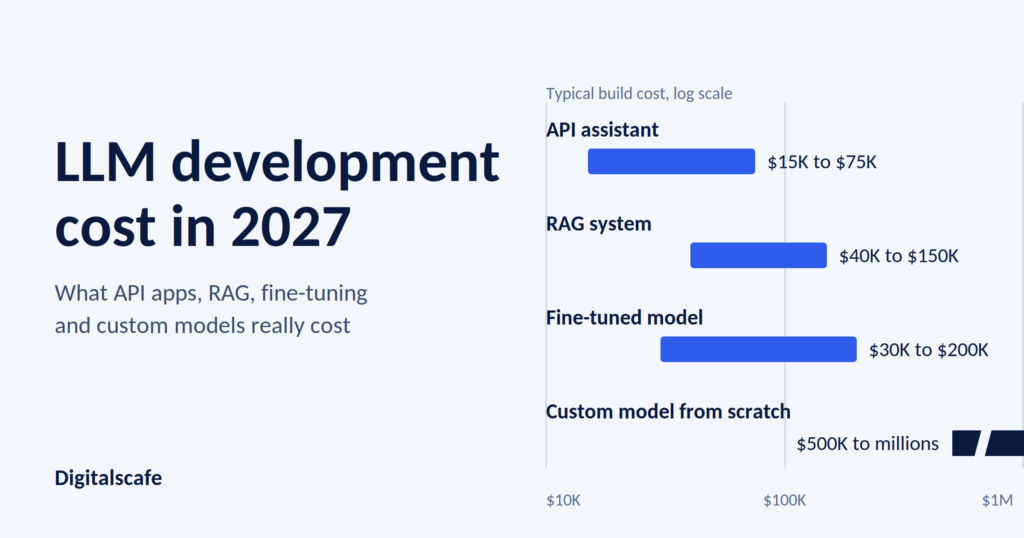
Quick answer: LLM development cost ranges from roughly $15,000 for a simple API-based assistant to $500,000 or more for a custom, regulated enterprise platform, and into the millions for training a model from scratch. Most businesses land between $40,000 and $250,000 for a production-ready system built on an existing model with retrieval (RAG), integrations and proper evaluation. The biggest cost drivers are not the model itself: they are data preparation, integration work, security and compliance, evaluation, and ongoing operations.
If you have searched for “how much does it cost to build a custom LLM,” you have probably noticed that every article gives a different answer. One guide says $25,000, another says $750,000, a third says millions. They are not all wrong. They are answering different questions, because “building an LLM” can mean three very different projects.
This guide explains those three routes, breaks down every cost component, shows real-world examples from companies like Klarna and Bloomberg, walks through illustrative budgets for different business types, and gives you a checklist for keeping the number under control. By the end, you should be able to estimate your own budget within a sensible range and know the right questions to ask any LLM development company.
In this guide:
- What “LLM development” actually means
- LLM development cost at a glance
- Route 1: API-based LLM applications
- Route 2: RAG (retrieval-augmented generation)
- Route 3: Fine-tuning an existing model
- Route 4: Training a custom model from scratch
- The full cost breakdown, line by line
- Ongoing costs most budgets forget
- Real-life examples
- Illustrative budgets for three business types
- How to estimate your own LLM budget
- 12 ways to reduce LLM development cost
- Build in-house vs hire an LLM development partner
- How to choose an LLM development company (and red flags)
- LLM development in Austin and Texas
- Frequently asked questions
- Related searches people ask
What Does “LLM Development” Actually Mean?
A large language model (LLM) is an AI model trained on vast amounts of text so it can understand and generate language. GPT, Claude, Gemini, Llama and Mistral are all LLMs. When a business says it wants “an LLM,” it almost never means it wants to train a new GPT from zero. In practice, it wants one of four things:
- An application that uses an existing LLM through an API, such as a support assistant, a document summarizer or an internal writing tool.
- A system that connects an LLM to the company’s own knowledge, usually through retrieval-augmented generation (RAG), so answers are grounded in the company’s documents instead of the model’s general memory.
- A fine-tuned model that has been further trained on company data so it follows a specific style, format or domain vocabulary.
- A fully custom model trained from scratch, which is rare and only justified in special cases.
These four routes differ in cost by a factor of ten to a hundred. That is why choosing the route comes before estimating the budget. According to published agency cost guides in 2027, the choice of approach alone can change roughly 80% of the cost structure before a single engineer is hired.
LLM Development Cost at a Glance (2027)
The table below shows typical market ranges for production-grade projects. These are illustrative planning ranges, not quotes. Your real figure depends on scope, data quality, integrations and compliance requirements.
| Project type | Typical build cost | Typical timeline | Main cost driver |
| API-based assistant or chatbot (single use case) | $15,000 to $75,000 | 4 to 10 weeks | Integrations, UX, guardrails |
| RAG system over company documents | $40,000 to $150,000 | 8 to 16 weeks | Data pipelines, retrieval quality, evaluation |
| AI agent with tools and multi-step workflows | $60,000 to $250,000 | 10 to 20 weeks | Orchestration, tool integration, safety |
| Fine-tuned model on proprietary data | $30,000 to $200,000 | 8 to 24 weeks | Training data, compute, evaluation cycles |
| Enterprise LLM platform (multi-team, regulated) | $150,000 to $500,000+ | 4 to 8 months | Security, compliance, integration depth |
| Custom model trained from scratch | $500,000 to several million | 6 to 18+ months | GPU compute, data, specialist research talent |
Published estimates from different agencies vary widely. Some put basic LLM apps at around $25,000 and enterprise custom builds at $300,000 or more. Others quote $75,000 to $750,000 for custom LLM applications, and some enterprise-focused guides go up to $800,000. Compliance requirements such as HIPAA or SOC 2 are frequently reported as adding six figures to the baseline in regulated industries. Treat any single number you read, including the ones here, as a starting point for a scoping conversation rather than a promise.
Route 1: API-Based LLM Applications
Cost range: $15,000 to $75,000. Timeline: 4 to 10 weeks.
This is the most common starting point. You use a hosted model such as GPT, Claude or Gemini through an API and build an application around it. The model itself is rented, not built, so most of the cost is ordinary software engineering:
- Designing the user experience and conversation flows
- Writing and testing prompts
- Integrating with your CRM, helpdesk, database or internal tools
- Adding authentication, logging and rate limiting
- Building guardrails so the model stays on topic and refuses unsafe requests
- Setting up basic monitoring
When it fits: your use case relies on general knowledge, your data is not highly sensitive, and speed to market matters. Examples include marketing copy assistants, meeting summarizers, simple customer FAQ bots and internal drafting tools.
Watch out for: costs that scale with usage. Because you pay per token, a pilot with 20 users can look cheap and a launch with 20,000 users can look very different. We cover that formula in the ongoing-costs section.
Route 2: RAG (Retrieval-Augmented Generation)
Cost range: $40,000 to $150,000. Timeline: 8 to 16 weeks.
RAG is the workhorse of enterprise LLM development. Instead of retraining a model on your data, you store your documents in a searchable index (usually a vector database), retrieve the most relevant passages when a user asks a question, and give them to the LLM as context. The answer is grounded in your content, and you can show the source passage next to the answer.
RAG costs more than a plain API integration because the hard part is not the model. It is the data:
- Ingestion pipelines that pull documents from SharePoint, Google Drive, databases, PDFs and email
- Cleaning and chunking, because messy or duplicated documents produce messy answers
- Embedding and indexing, including re-indexing when documents change
- Retrieval tuning, such as hybrid search, re-ranking and metadata filters
- Access control, so users only see answers drawn from documents they are allowed to read
- Citation and source display, so users can verify answers
- Evaluation, to measure whether the right passages are retrieved and the answers are accurate
When it fits: you have a large body of documents, policies, manuals or records that people constantly search through, and accuracy and traceability matter more than creativity. Insurance claims handling, legal research, internal knowledge bases, technical support and compliance are classic examples. If you want to explore this route, see our RAG development services.
Route 3: Fine-Tuning an Existing Model
Cost range: $30,000 to $200,000. Timeline: 8 to 24 weeks.
Fine-tuning takes an existing model and continues its training on your own examples. It is excellent for teaching a model a consistent tone, a strict output format, a specialized vocabulary or a narrow classification task. It is not the best way to teach a model new facts, because facts change and fine-tuned knowledge goes stale. That is what RAG is for.
Fine-tuning costs come from:
- Training data preparation: collecting, cleaning, labeling and reviewing hundreds to many thousands of high-quality examples. This is usually the largest and most underestimated line item.
- Compute: GPU time for training runs, often several runs while you tune settings.
- Evaluation: building test sets so you can prove the tuned model is actually better than the base model with a good prompt.
- Deployment: hosting the tuned model, which can be more expensive than calling a hosted API.
- Retraining: every time the base model changes or your requirements shift.
A common and costly mistake is jumping to fine-tuning when better prompting plus RAG would have solved the problem. A responsible LLM development partner will test the cheaper options first and fine-tune only when the evaluation shows a real gap.
Route 4: Training a Custom Model From Scratch
Cost range: $500,000 to several million dollars. Timeline: 6 to 18+ months.
Training a foundation model from nothing requires enormous datasets, large GPU clusters and specialist research engineers. For almost every business, this is the wrong choice. It makes sense only when you have a huge proprietary dataset that no existing model has seen, hard requirements that existing models cannot meet, or your model is the product itself.
To make this concrete, consider BloombergGPT. Bloomberg built a 50-billion-parameter model for finance, trained on roughly 363 billion tokens of its own financial data plus about 345 billion tokens of general text. The training budget was around 1.3 million GPU hours on NVIDIA A100 GPUs, using 512 GPUs for roughly 53 days. If you price those GPU hours at typical cloud rates of a few dollars per hour (an illustrative assumption, not a figure Bloomberg published), the compute alone lands in the millions of dollars, before counting data engineering, research salaries, evaluation and infrastructure.
Bloomberg is a company whose core business is financial data, and it had a unique dataset built over decades. Almost no other organization is in that position. For everyone else, RAG on top of a strong existing model is faster, cheaper and easier to keep current.
The Full LLM Development Cost Breakdown
Whatever route you choose, the budget is made of the same building blocks. Here is where the money actually goes in a typical production project.
1. Discovery and strategy (5 to 10% of budget)
Defining the use case, success metrics, data sources, risks and architecture. Skipping this is the most expensive shortcut in AI projects, because it is where you discover that the data does not exist, the use case is unclear or the compliance team will block deployment.
2. Data preparation (15 to 35%)
Collecting, cleaning, deduplicating, structuring and securing the data the system will use. Many teams underestimate this by a factor of two or three. If your documents are scattered across five systems in six formats, much of the early budget will go into just making them usable.
3. Model selection and architecture (5 to 10%)
Choosing between hosted and self-hosted models, comparing providers, designing the retrieval and orchestration architecture, and planning for fallbacks if a provider has an outage or changes pricing. A vendor-neutral partner matters here, because the right model is the one that fits your accuracy, latency, privacy and cost needs, not the one your vendor resells.
4. Core engineering (25 to 40%)
The actual application: backend services, prompt and retrieval pipelines, agent logic, APIs, user interface, authentication and role-based access.
Connecting the LLM system to your CRM, ERP, ticketing, document stores, identity provider and analytics. Integration is where timelines slip, because every legacy system has quirks.
6. Evaluation and testing (10 to 15%)
Building test datasets, scoring answers for accuracy and faithfulness, red-teaming for harmful or off-topic outputs, load testing and regression testing. LLM outputs are probabilistic, so you cannot test them like normal software. Teams that skip evaluation ship systems they cannot trust and cannot improve.
7. Security, privacy and compliance (5 to 20%)
Encryption, access controls, audit logs, data residency, PII redaction and vendor risk review. In regulated sectors such as healthcare, insurance and finance, this share rises sharply. Requirements like HIPAA, SOC 2, ISO 42001 and state privacy laws can add significant cost.
8. Deployment and infrastructure (5 to 10%)
Cloud setup, CI/CD, monitoring dashboards, scaling and cost controls.
9. Training and change management (3 to 8%)
Documentation, user training and rollout support. An LLM tool nobody uses has an ROI of zero, however good the model is.
Ongoing Costs Most Budgets Forget
The build cost is only the first invoice. A realistic LLM budget includes running costs that continue every month.
Token and API usage
If you use a hosted model, you pay per token (a token is roughly three-quarters of a word). The formula is:
Monthly model cost = (conversations x input tokens x input price) + (conversations x output tokens x output price)
Here is a worked example with deliberately hypothetical prices. Suppose a support assistant handles 50,000 conversations a month. Each conversation sends about 2,000 input tokens (the question plus retrieved context) and receives about 500 output tokens. Assume a price of $3 per million input tokens and $15 per million output tokens:
- Input: 50,000 x 2,000 = 100 million tokens, which costs $300
- Output: 50,000 x 500 = 25 million tokens, which costs $375
- Total: about $675 per month
That is cheap. But change the assumptions to 2 million conversations, longer context windows and a premium model, and the same system can cost tens of thousands of dollars a month. Always check each provider’s current pricing page, because prices change often and differ widely between models. Routing simple questions to a smaller, cheaper model and reserving the premium model for hard ones is one of the biggest savings available.
Infrastructure
Vector database hosting, application servers, storage, logging and monitoring. For moderate workloads this is often a few hundred to a few thousand dollars per month. Self-hosting an open model on your own GPUs shifts the cost from per-token fees to fixed infrastructure, which pays off only at sufficient volume or when data cannot leave your environment.
Monitoring and maintenance
Models, libraries and APIs change constantly. Prompts that worked last quarter may behave differently after a model update. One published industry estimate puts annual maintenance at around 15 to 25% of the original build cost, which is a useful rule of thumb for planning.
Knowledge base upkeep
Your documents change. Policies get updated, products launch, regulations shift. Someone needs to keep the index current and review the questions the system fails to answer.
Retraining and improvement
Fine-tuned models need periodic retraining. Even RAG systems need ongoing retrieval tuning as usage reveals gaps. Budget for continuous improvement, not a one-time launch.
Real-Life Examples of LLM Projects and What They Teach
Example 1: Klarna, the API-based assistant at massive scale
In early 2024, the fintech company Klarna announced an AI assistant built with OpenAI technology. Within its first month, the company reported that the assistant had handled 2.3 million conversations, about two-thirds of its customer service chats, equivalent to the work of roughly 700 full-time agents. Klarna also reported customer satisfaction on par with human agents and estimated a $40 million profit improvement for 2024.
The cost lesson: Klarna did not train its own model. It built on an existing LLM and invested in integration, guardrails, multilingual support and the ability for customers to reach human agents when they preferred. The value came from applying an existing model to a high-volume, well-defined problem, not from building a model.
Example 2: BloombergGPT, the from-scratch model
As described above, Bloomberg trained a 50-billion-parameter finance model using about 1.3 million GPU hours. It was a deliberate research and product investment by a company with decades of proprietary financial text.
The cost lesson: Training from scratch is feasible for organizations with unique data at enormous scale and a strategic reason to own the model. For a typical mid-sized company, the same money would fund many RAG and agent projects.
Example 3: Air Canada, the cost of weak guardrails
In 2024, a Canadian tribunal ruled against Air Canada after its website chatbot gave a customer incorrect information about bereavement fares. The airline was held responsible for what its chatbot said.
The cost lesson: Cutting evaluation and guardrail budgets is a false economy. A single wrong answer can cost more than the testing would have, plus the reputational damage. Grounded retrieval, source citations and human escalation paths are not optional extras in customer-facing systems.
Example 4: Samsung, the data governance lesson
In 2023, Samsung restricted employee use of public generative AI tools after staff reportedly pasted sensitive internal code into them.
The cost lesson: Privacy and governance costs are part of LLM development. Many companies end up building private deployments or enterprise-controlled integrations precisely because the alternative risks leaking confidential data.
Example 5: An insurance claims RAG assistant
At AllZone, we built a retrieval assistant over policy and claims documentation for an insurance use case. Instead of asking a model to answer from memory, the system retrieves the relevant policy wording, claims handbook sections and endorsements, then answers in plain language with the source passage attached. A claims professional can check each statement against the clause it came from rather than trusting a summary blindly.
The cost lesson: In regulated industries, the expensive parts are rarely the model call. They are document ingestion, retrieval accuracy, citation display, access control and evaluation against real claim scenarios. That is exactly where a well-scoped RAG project spends its budget, and it is why RAG projects often cost more than a plain chatbot but deliver far more trustworthy results.
Illustrative Budgets for Three Business Types
The following scenarios are composites meant to show how budgets behave, not accounts of specific clients.
Scenario A: A 40-person insurance agency wants a policy Q&A assistant
- Goal: Let agents ask questions about policy terms and get cited answers.
- Route: RAG on a hosted model.
- Scope: 3,000 policy documents, two source systems, role-based access, citation display, evaluation set of 200 real questions.
- Typical build: $60,000 to $110,000 over 10 to 14 weeks.
- Typical monthly run cost: $1,000 to $4,000 for hosting, tokens and monitoring.
- Where the money goes: Data ingestion and cleaning (about 30%), retrieval tuning and evaluation (about 25%), integration and access control (about 20%).
Scenario B: A multi-clinic healthcare group wants clinical documentation support
- Goal: Draft visit summaries and surface relevant history from patient records.
- Route: RAG plus workflow integration, with strict privacy controls.
- Scope: EHR integration, PHI redaction, audit logging, HIPAA-aligned architecture, clinician review step.
- Typical build: $150,000 to $350,000 over 5 to 8 months.
- Typical monthly run cost: $5,000 to $20,000, depending on volume and hosting model.
- Where the money goes: Compliance and security (about 25%), integration with clinical systems (about 25%), evaluation with clinician input (about 15%).
Scenario C: A SaaS startup wants an in-product AI copilot
- Goal: Add a context-aware assistant that helps users operate the product.
- Route: API-based agent with tool calling and a lightweight RAG layer over the help center.
- Scope: Tool integrations with the product API, guardrails, usage analytics, A/B testing.
- Typical build: $50,000 to $140,000 over 8 to 12 weeks.
- Typical monthly run cost: Scales with users; commonly $2,000 to $15,000 as adoption grows.
- Where the money goes: Agent design and tool integration (about 35%), evaluation (about 15%), UX (about 15%).
If you are unsure which scenario resembles your project, a short scoping workshop can turn a vague idea into a priced plan.
How to Estimate Your Own LLM Budget
Use this five-step approach before talking to any vendor.
- Define one narrow use case. “AI for customer service” is too vague. “Answer order-status and returns questions for our top 20 intents” is a scope you can price.
- List your data sources. How many systems, how many documents, what formats, who owns them, and how sensitive are they?
- Choose the simplest route that could work. Start with API plus RAG. Move to fine-tuning only if testing shows a real gap.
- Estimate usage. How many users or conversations per month, and how long are typical interactions? This drives token cost.
- Add compliance and operations. Include security review, monitoring and 15 to 25% of the build cost per year for maintenance.
Then multiply your result by a realistic contingency of 15 to 25% for the unknowns that every AI project contains.
A simple ROI check
Compare the total first-year cost (build plus run cost) with the annual value. For a support assistant, value might be: tickets deflected per month x cost per ticket x 12. If an assistant deflects 3,000 tickets a month and each human-handled ticket costs $6, that is $216,000 a year in avoided cost, so a $100,000 project pays back in under a year. Replace these numbers with your own, and be conservative about deflection rates.
12 Ways to Reduce LLM Development Cost
- Start with a pilot. Launch one use case, prove value, then expand. A minimum viable LLM product is the cheapest way to validate an idea.
- Use RAG before fine-tuning. It is cheaper, easier to update and more transparent.
- Pick the right-sized model. Smaller models handle many tasks well at a fraction of the price.
- Route by difficulty. Send easy queries to a cheap model and hard ones to a premium model.
- Cache repeated answers. Many questions repeat. Caching cuts token spend sharply.
- Trim your context. Sending 20 retrieved passages when 4 would do multiplies cost without improving answers.
- Invest early in data quality. Clean data reduces rework, which is the biggest hidden budget killer.
- Build evaluation sets from day one. You cannot optimize what you cannot measure.
- Avoid vendor lock-in. Abstract the model layer so you can switch providers when prices or quality change.
- Reuse existing infrastructure. Use your current cloud, identity and logging stack where possible.
- Phase the integrations. Launch with the two most valuable systems, then add the rest.
- Set usage limits and alerts. Budget guardrails prevent surprise bills.
Build In-House vs Hire an LLM Development Partner
In-house gives you maximum control and long-term knowledge, but you must recruit scarce talent (LLM engineers, data engineers, ML platform and security specialists), and ramp-up takes months. It makes sense when AI is core to your product and you plan to maintain a standing team.
A development partner gives you an experienced team immediately, along with proven architectures and lessons from previous projects. It makes sense when you want to reach production quickly, need specialized skills for a bounded project or want to avoid hiring ahead of proven value.
A hybrid approach is increasingly common: a partner designs and builds the first version while your internal team shadows the work and takes over operations. Allzone supports both project engagements and dedicated teams that join your process and repositories.
How to Choose an LLM Development Company (and Red Flags)
Ask these questions before signing:
- Can you show production LLM work? Look for named case studies with outcomes, not demos.
- Which models and frameworks do you work with, and why? A good partner explains trade-offs between providers and is not tied to one vendor.
- How do you evaluate accuracy? Ask to see their evaluation approach, test sets and how they handle hallucinations.
- How do you handle security and data privacy? Look for clear answers on data residency, encryption, access control and whether your data is used for training.
- What happens after launch? Monitoring, retraining and support should be part of the plan.
- How is pricing structured? Fixed price, time and materials and dedicated team models each suit different situations.
Red flags:
- Promising a fixed price before understanding your data or use case
- Recommending a custom model or fine-tuning without testing simpler approaches first
- No evaluation methodology or no plan for handling wrong answers
- Vague claims with no named clients, metrics or technical depth
- No discussion of ongoing costs
- Unwillingness to explain which parts of the system they build themselves
LLM Development in Austin and Texas
Austin has one of the fastest-growing AI and software ecosystems in the country, with active developer communities and a mix of startups, enterprises, healthcare organizations and insurance and financial firms. For Austin-area businesses, working with a nearby partner can make workshops, security reviews and stakeholder alignment easier. Allzone’s US headquarters is in Cedar Park, Texas, in the Greater Austin area, so on-site discovery sessions and in-person reviews are straightforward for teams in Austin, Round Rock, Georgetown and Leander.
Texas-based businesses should also account for state privacy requirements, such as the Texas Data Privacy and Security Act, in addition to sector rules like HIPAA for healthcare and GLBA for financial services. Confirm the current requirements with your legal counsel before deploying any system that handles personal data. A good LLM partner designs for these requirements from the start instead of retrofitting them.
Frequently Asked Questions About LLM Development Cost
How much does it cost to build a custom LLM?
It depends on what “custom” means. A custom application on top of an existing model typically costs $15,000 to $250,000. A fine-tuned model usually costs $30,000 to $200,000. Training a new foundation model from scratch starts around $500,000 and can reach millions, mostly because of GPU compute, data and specialist talent.
How much does LLM development cost for a small business?
Small businesses usually start with an API-based assistant or a small RAG system, which typically costs $15,000 to $60,000 to build, plus modest monthly running costs. Starting with one narrow use case keeps the budget manageable.
Is it cheaper to fine-tune an LLM or use RAG?
RAG is usually cheaper to build and much easier to keep up to date, because you update documents instead of retraining a model. Fine-tuning is better for teaching style, format or specialized behavior. Many production systems use both.
How long does LLM development take?
A focused API-based assistant can reach production in 4 to 10 weeks. RAG systems often take 8 to 16 weeks. Enterprise platforms with compliance requirements and many integrations commonly take 4 to 8 months.
What are the hidden costs of LLM development?
The most common hidden costs are data preparation, integration with legacy systems, evaluation and testing, compliance work, ongoing token and infrastructure fees, and maintenance after launch. Data cleanup alone can consume a quarter or more of the project budget.
How much does it cost to run an LLM per month?
For a hosted model, running costs depend on token volume and model choice. A moderate workload can cost a few hundred dollars a month, while high-volume systems can cost tens of thousands. Add infrastructure, monitoring and maintenance on top.
Do I need my own data to build an LLM application?
Not always. A general assistant can work without proprietary data. But most business value comes from connecting the model to your own documents and systems, which is why data quality matters so much.
Should I use OpenAI, Anthropic, Google or an open-source model?
Choose based on your accuracy needs, latency, privacy requirements, cost and compliance constraints. Hosted frontier models usually give the best quality quickly. Open models give more control and can run in your own environment. A vendor-neutral partner can test several against your actual tasks.
Can an LLM be hosted privately for sensitive data?
Yes. Options include private cloud deployments, virtual private networking to hosted providers with strict data terms, and self-hosted open models in your own infrastructure. Private options generally cost more to build and operate but can be necessary for regulated data.
How do I make sure an LLM does not give wrong answers?
You cannot eliminate errors entirely, but you can reduce them significantly with retrieval grounding, source citations, evaluation test sets, guardrails, confidence thresholds and human review for high-stakes outputs. Budget for evaluation from the start.
Is LLM development worth the investment?
It is when the use case is specific, the volume is high enough and success is measurable. Klarna’s reported results show what is possible at scale, but many projects fail when scope is vague or data is poor. A pilot with clear metrics is the safest way to find out.
What is the cheapest way to start with LLM development?
Pick one high-volume, low-risk task, build a small API-based or RAG prototype, measure results with real users and expand only if the numbers justify it.
Related Searches People Ask
People researching this topic also commonly search for:
- how much does it cost to build an AI chatbot
- RAG development cost
- LLM fine-tuning cost
- cost of training a large language model
- enterprise LLM development cost
- custom GPT development cost
- AI agent development cost
- LLM vs RAG cost comparison
- open source LLM vs OpenAI cost
- private LLM deployment cost
- AI development company pricing models
- LLM development company in Austin, Texas
Key Takeaways
- LLM development cost depends first on the route: API integration, RAG, fine-tuning or training from scratch.
- Most businesses get the best value from API plus RAG, typically in the $40,000 to $250,000 range for production systems.
- Data preparation, integration, evaluation and compliance usually cost more than the model itself.
- Running costs are real: plan for token usage, infrastructure and roughly 15 to 25% yearly maintenance.
- Real-world cases show the pattern: Klarna created value by applying an existing model to a high-volume problem, Bloomberg trained from scratch because it had unique data at scale, and Air Canada showed the price of weak guardrails.
- Start with one narrow use case, prove value, then expand.
Ready to Scope Your LLM Project?
Every LLM project is different, and the fastest way to replace a rough range with a real number is a short scoping conversation. At Allzone Technologies, we design and build production LLM systems, from RAG assistants and AI agents to fine-tuned models and enterprise AI platforms, working through a clear process of discovery, architecture, build, validation, deployment and continuous improvement.
Cost figures in this article are illustrative planning ranges based on published 2027 industry estimates and project experience. Actual costs vary with scope, data, integrations and compliance needs. Model pricing changes frequently, so confirm current rates with each provider.